
Zu Der Lehre Von Den 9 Ursachen Im Yogabhasya
Added to library: September 2, 2025
Summary
Here's a comprehensive summary of the provided Jain text, "Zu Der Lehre Von Den 9 Ursachen Im Yogabhasya" by A. Wezler, focusing on its content and arguments:
Overall Purpose:
The article by A. Wezler examines the "Doctrine of the 9 Causes" as presented in the Yogabhāṣya (YBh) commentary on Patañjali's Yoga Sūtras (YS). The core of the study is to analyze this doctrine within the YBh, compare it to similar lists found in Buddhist texts, and investigate the historical relationship between them. Wezler argues that the "Doctrine of the 9 Causes" in the YBh is likely an adaptation of a Buddhist concept, rather than an original Indian yoga teaching.
Key Sections and Arguments:
1. Introduction (Section 1):
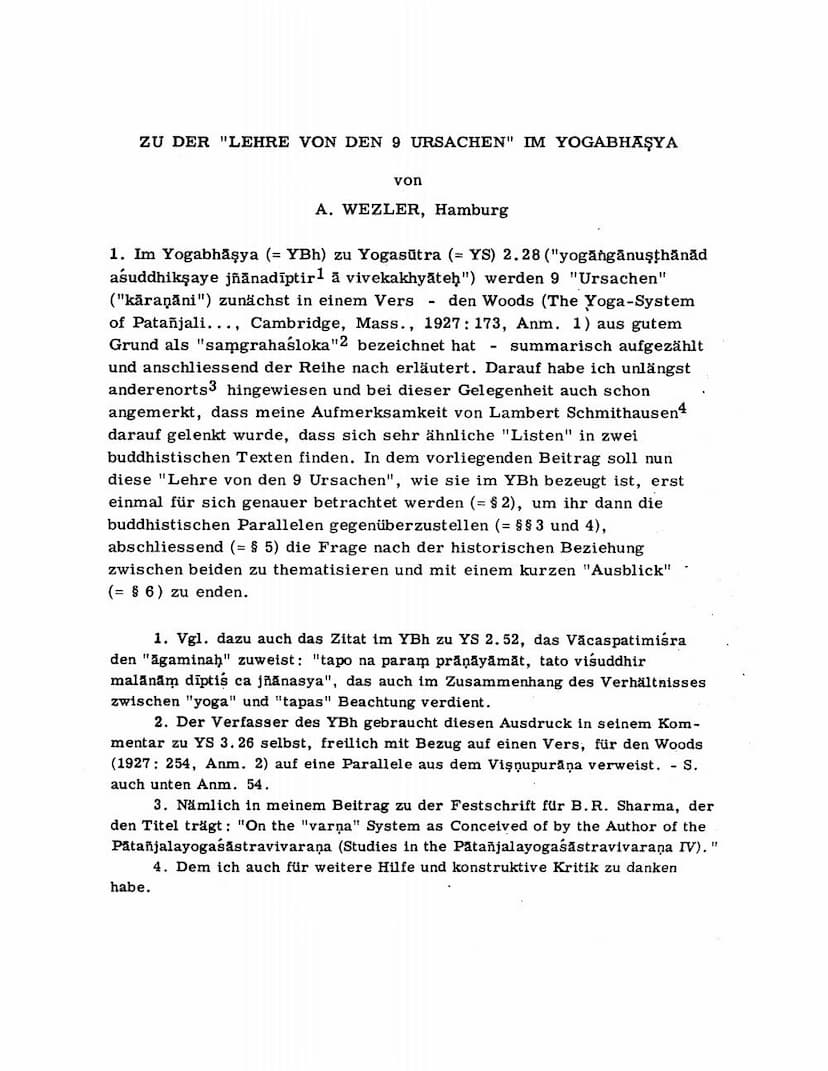
- Wezler introduces the topic by referencing YS 2.28 and its commentary in the YBh, where 9 "causes" (kāraṇāni) are listed and explained.
- He notes that Lambert Schmithausen pointed out similar "lists" in Buddhist texts.
- The article's structure is outlined:
- Detailed examination of the YBh's "Doctrine of the 9 Causes" ($ 2).
- Comparison with Buddhist parallels ($§ 3 and 4).
- Discussion of the historical relationship ($ 5).
- Concluding remarks ($ 6).
2. The Doctrine of the 9 Causes in the Yogabhāṣya (Section 2):
-
YS 2.28 and its Interpretation: Wezler begins by explaining how the YBh interprets YS 2.28, stating that the practice of Yoga's eight limbs is a cause for the removal of impurity (aśuddhi) and the attainment of discriminative knowledge (vivekakhyāti). This process is inversely proportional to the growth of knowledge, culminating in liberation.
-
The Question of "How Many Causes?": The YBh poses the question, "How many causes are there in the śāstra?" and answers "nine," introducing a summary verse (samgrahaśloka) listing these causes.
-
"Utsūtra" Deviations: Wezler observes that the introduction of this list of 9 causes goes beyond the scope of YS 2.28 itself. He calls these "utsūtra" (beyond the sutra) deviations, which he argues are important for understanding the commentator's (the Bhāṣyakāra's) broader concerns and philosophical interests.
-
The Meaning of "Śāstra": Wezler dedicates significant attention to the term "śāstra," analyzing its usage in the YBh. He concludes that "śāstra" in the YBh does not exclusively refer to the Yogaśāstra itself but rather to the broader domain of "knowledge systems" or "sciences" in general, or specifically to "liberation-oriented teachings" (mokṣaśāstra). This is crucial because it suggests the "9 causes" might originate from a broader philosophical or religious context beyond just Yoga.
-
The Summary Verse (samgrahaśloka): The verse listing the 9 causes is presented and analyzed: utpatti-sthiti-abhivyakti-vikāra-pratyaya-āptayaḥ / viyogānyatva-dhṛtayaḥ kāraṇam navadhā smṛtam.
-
Analysis of Individual Causes and Terminology: Wezler examines the YBh's explanations of each cause, highlighting potential issues with terminology and conceptual alignment with traditional Sāṁkhya-Yoga thought.
- "Utpatti" (Origin): Questions arise about the use of "utpatti" instead of "abhivyakti" (manifestation), which is the more typical Sāṁkhya-Yoga term for "emergence."
- "Abhivyakti" (Manifestation): The YBh uses "abhivyakti" to refer to light as a cause for perceiving color, a concept related to epistemology rather than the ontological "emergence" typically associated with Sāṁkhya-Yoga.
- "Vikāra" (Change/Transformation): The example given for "vikāra" (fire cooking) is noted as not being particularly typical for explaining this key Sāṁkhya-Yoga term.
- "Anvayikāraṇa" (Cause characterized by "staying-there-ness"): Wezler points out the absence of this crucial Sāṁkhya-Yoga term from the systematic list of 9 causes, despite its prominence elsewhere in the YBh. He sees this as a significant indicator that the "9 causes" doctrine might not be indigenous to Sāṁkhya-Yoga.
- "Abhivyakti" in other contexts: Wezler highlights that the term "abhivyakti" is used differently in other parts of the YBh (e.g., in relation to karma) compared to its usage in the "9 causes" doctrine, suggesting a borrowing or adaptation.
-
Suspicion of "Foreign Influence": Based on these terminological discrepancies and the "utsūtra" nature of the list, Wezler develops a strong suspicion that the "Doctrine of the 9 Causes" is not originally from Patañjala-Yoga or Sāṁkhya.
3. Buddhist Parallels (Sections 3 and 4):
- Madhyāntavibhāga-Bhāṣya (MAVBh): Wezler details a list of 10 causes found in Vasubandhu's MAVBh. He notes the close correspondence in definitions and examples with the YBh's list. He also discusses "antaraśloka" (summary verses) related to this list, which highlight further parallels and potential textual issues.
- Abhidharmasamuccaya (AS): He then presents a list of 20 causes from Asanga's AS, which includes the 10 causes from the MAVBh as its first ten. The AS list further reinforces the similarities, with some minor variations in terminology.
- Analysis of the Buddhist Lists: Wezler analyzes the order and terminology of the Buddhist lists, noting that the term "sampratyaya" (cognition/understanding) and related terms appear. He also highlights the presence of "pariṇati" (transformation) and "prakāśa" (illumination) in the Buddhist lists.
4. Historical Relationship: Yogaśāstra vs. Buddhism (Section 5):
-
Core Argument: Wezler's central argument is that the "Doctrine of the 9 Causes" in the YBh is an adaptive reception of a Buddhist concept. He bases this on several observations:
- Terminology: The YBh adopts terms like "utpatti" and "abhivyakti" from the Buddhist parallels, even where they deviate from standard Sāṁkhya-Yoga terminology.
- Examples: Many of the everyday examples provided for the causes in the YBh are similar or identical to those found in the Buddhist texts.
- Conceptual Nuances: In cases like "anyatva" (otherness) replacing "pariņati" (transformation) and the detailed treatment of "dhṛti" (support/holding), Wezler argues that the YBh commentator appears to be adapting and reinterpreting the Buddhist framework through a Sāṁkhya-Yoga lens.
- Omission of Key Terms: The absence of crucial Sāṁkhya-Yoga terms like "anvayikāraṇa" from the list further supports the idea that the list is an imported concept.
- Reduction in Number: The YBh reduces the 10 Buddhist causes to 9 by omitting "sampratyayana" (cognition/understanding). Wezler suggests this might be because the commentator did not consider this distinction as important as the Buddhists did, or perhaps it was subsumed under other categories.
- Reordering: The order of causes in the YBh differs from the Buddhist lists, but Wezler argues that this is a deliberate adaptation and doesn't negate the underlying Buddhist influence.
-
Evidence for YBh Adapting Buddhist Sources: Wezler suggests that the YBh commentator is the one doing the adapting, not the other way around, citing the YBh's use of Sāṁkhya-Yoga specific applications (like "manas for puruṣārthatā" for sthiti-kāraņa) as evidence.
5. Conclusion and Outlook (Section 6):
- Confirmation of Buddhist Influence: Wezler concludes that the "Doctrine of the 9 Causes" in the YBh is a clear example of the assimilation of Buddhist thought into Patañjala-Yoga. He notes that this aligns with broader scholarship on Buddhist influence on Indian philosophy.
- Further Research Needed: He emphasizes that while significant progress has been made, comprehensive research on Buddhist influences on the YS and YBh is still needed. He calls for a deeper analysis of the YBh's extensive content to fully understand the nuances of its author's intellectual engagement with Buddhism.
- Critique of Jacobi: He indirectly criticizes Jacobi's approach, suggesting that a proper understanding of the YBh author's attitude towards Buddhism requires a complete analysis of the text, rather than relying on isolated impressions.
- Acknowledging Common Roots: While emphasizing Buddhist influence, Wezler also acknowledges the possibility of shared roots between Yoga and Buddhism, but stresses that this doesn't negate the evidence of direct influence in specific instances like the "9 Causes" doctrine.
In essence, Wezler's article meticulously deconstructs the "Doctrine of the 9 Causes" in the Yogabhāṣya, arguing through textual analysis and comparison with Buddhist texts that this doctrine represents a significant borrowing and adaptation from Buddhist philosophical traditions, rather than an original contribution from the Yoga school.