
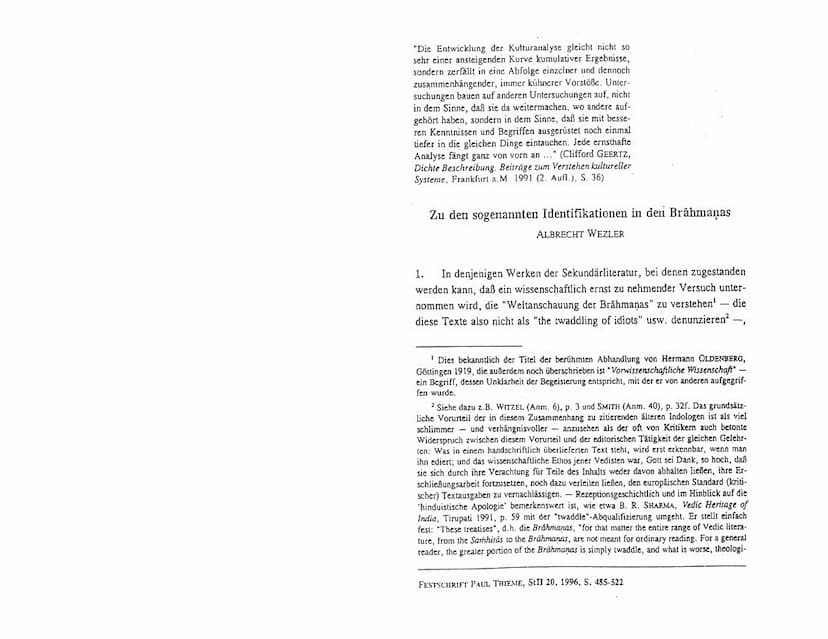
Zu Den Sogenannten Identifikationen In Den Brahmanas
Added to library: September 2, 2025
Summary
Here's a comprehensive summary of Albrecht Wetzler's article "Zu Den Sogenannten Identifikationen In Den Brahmanas" (On the So-Called Identifications in the Brahmanas), based on the provided text:
Overall Argument:
Albrecht Wetzler's article critically examines the concept of "identifications" as applied to certain sentence structures in the Brahmanas, a body of ancient Indian Vedic literature. He argues that the term "identification", as commonly used by Western Indologists, is often imprecise and fails to capture the diverse range of relationships expressed by these nominal sentences. Wetzler proposes that these sentences convey a variety of relationships, including causality, likeness, and equivalence, rather than solely strict identity. He calls for a more nuanced and systematic approach to analyzing these linguistic phenomena.
Key Points and Structure:
-
Introduction and the Problem of "Identification":
- Wetzler begins by acknowledging the prevailing use of the term "identification" in secondary literature to describe a characteristic structural element of the Brahmanas.
- He cites influential scholars like Hermann Oldenberg, Schayer, and Michael Witzel, who have extensively discussed these "identifications."
- However, Wetzler points out that no specific Sanskrit term corresponds directly to "identification" in the Brahmanas themselves. This absence of a direct term raises questions about the scholarly interpretation.
-
Witzel's Contribution and Wetzler's Critique:
- Wetzler focuses significantly on Michael Witzel's work, particularly his lecture "On Magical Thought in the Veda," which emphasizes the systematic nature of Vedic "magical thought" and the importance of these "identifications."
- Witzel himself acknowledges the lack of a specific term for "identification" in Vedic texts but asserts that for the Vedic priest and magician, these "identifications are very real."
- Wetzler notes that Witzel generally understands "identifications" in the strict sense of "being the same" or "causing to be or becoming identical."
- Wetzler then critically analyzes Witzel's interpretation using examples. He argues that Witzel's explanation of sentences like "a club are the waters" or "Indra is a bull" demonstrates a shift away from a strict definition of identity.
- In the "Indra is a bull" example, Witzel suggests that the meaning is derived from shared characteristics (strength, sexual potency), essentially treating it as a simile or metaphor, which contradicts his earlier assertion of strict identity. Wetzler argues that Witzel's explanation ultimately abandons the concept of identity for these cases.
-
Philosophical and Linguistic Nuances:
- Wetzler delves into the philosophical and logical definitions of "identity," referencing figures like Frege and Wittgenstein. He distinguishes between the "is" of predication (description) and the "is" of identity (sameness).
- He emphasizes that for a sentence to express identity in a strict logical sense, it requires singular terms on both sides of the "is" (or its equivalent) and that these terms should be interchangeable without altering the meaning.
- Wetzler applies these linguistic and philosophical distinctions to Vedic examples, showing how many "identifications" do not fit the strict criteria for identity.
-
Examining Specific Vedic Examples:
- Causal Relationships: Wetzler analyzes sentences like "paśavo hy évaité saksád eva" ("These [salt-licks] are evidently cattle") and "úsāḥ sākṣād evaínam annadyena sámardhayati" ("salt evidently provides him [the altar] richly with food"). He argues that these express causal relationships (e.g., salt is essential for cattle health and growth) rather than strict identity. He paraphrases "is" in these contexts as "means" in the sense of "has as its consequence" or "forms an indispensable prerequisite."
- Origin and Composition: He examines sentences like "prāṇáh pasáva íti" ("The animals are the life-forces") and "máno vai sárve práná(n)" ("Thought is all life-forces"). Wetzler interprets these as expressing relationships of origin or composition, akin to "Nails are iron" or "Cornflakes are corn."
- Correspondence and Analogy: The example "prajapatiḥ samvatsará ity" ("Prajapati is the year") is analyzed as expressing a relationship of correspondence or likeness, where the year is created as an "image" or "likeness" (pratimā) of Prajapati. He also touches upon the idea of names holding significant meaning for the Vedic Indian.
- Synonymity and Equivalence: He considers Kulluka's commentary on Manu, which cites the Vedic sentence "väg vai sarasvati" and interprets it as expressing synonymity or semantic equivalence. Wetzler suggests that while not strict identity, this equivalence is a plausible interpretation for some Vedic sentences.
- Metaphor and Metonymy: Wetzler revisits "Indra is a bull," concluding that it is best understood as a metaphor or simile, based on shared characteristics, rather than a statement of identity. He critiques Witzel's attempt to find a "hidden nature" or "real essence" behind such statements, calling it a petitio principii (begging the question) because it assumes identity where it is not proven. He also contrasts these with metonymy.
-
The Role of Particles:
- Wetzler briefly discusses the particle vai, noting its argumentative or reflective function, indicating that the statement is a new insight or a reasoned argument.
-
Broader Implications and Future Research:
- Wetzler concludes that the Vedic texts express a wide array of semantic relationships through nominal sentences, not just identity.
- He emphasizes the need for Indology to develop a comprehensive inventory of these relationship types.
- He acknowledges the immense task of fully cataloging and analyzing these sentences but stresses that collaborative effort is necessary.
- He also highlights the importance of considering the "timeless truth" (extratemporal) conveyed by these sentences, differentiating them from fleeting imaginative expressions, like those of playing children.
In essence, Wetzler's article is a scholarly critique of the oversimplified application of the term "identification" to Vedic nominal sentences. He argues for a more rigorous linguistic and philosophical analysis that recognizes the multifaceted nature of these expressions, which convey a spectrum of relationships beyond strict identity, including causality, likeness, origin, and equivalence.