
Yogacara Works Annotated By Vairocanaraksita
Added to library: September 2, 2025
Summary
Here's a comprehensive summary of the provided text, focusing on the identified Jain texts and the author's findings:
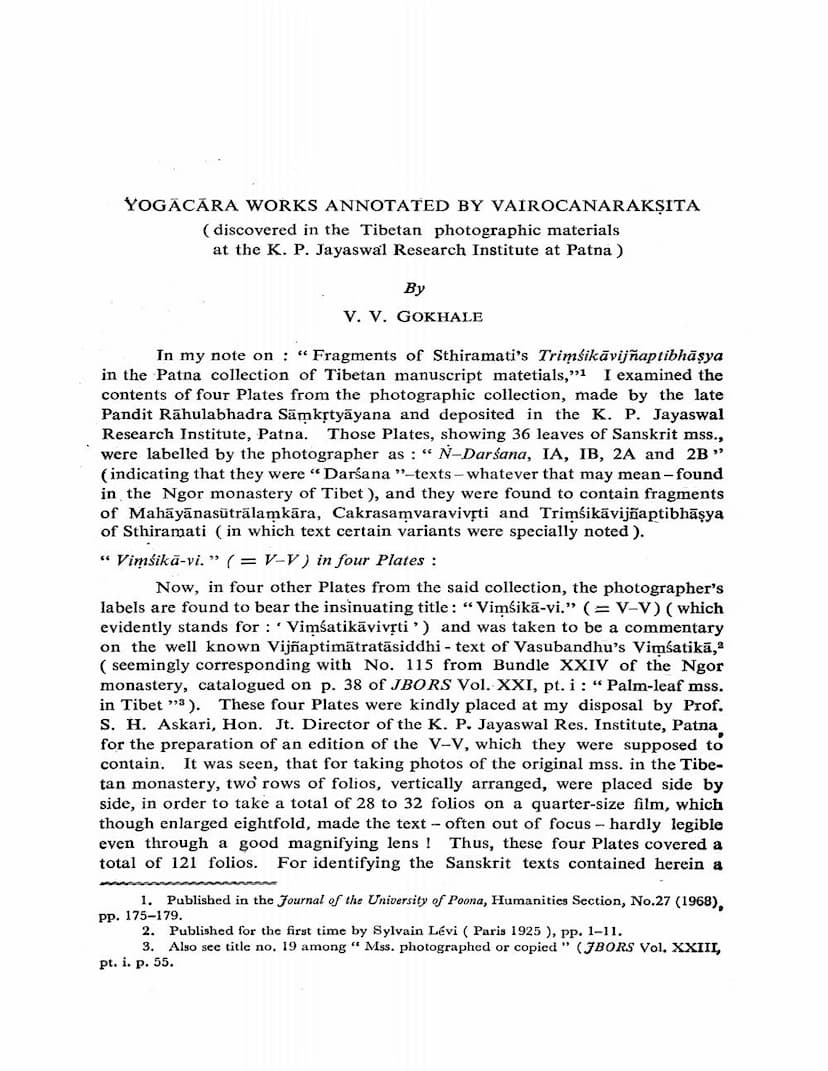
This article, "Yogacara Works Annotated By Vairocanaraksita" by V.V. Gokhale, details the examination of four photographic plates containing Sanskrit manuscript fragments from the K.P. Jayaswal Research Institute in Patna. Initially labeled as "Vimśikā-vi." (likely a commentary on Vasubandhu's Vimsatikā), Gokhale's meticulous re-arrangement and decipherment revealed that the plates actually contained annotations on several other significant Mahayana Buddhist philosophical texts, primarily attributed to Pandita Vairocanaraksita.
The core of the article is the identification and breakdown of the Sanskrit texts found on these plates:
- Misleading Label: Gokhale establishes early on that the general "Vimśikā-vi." label was misleading. While a very brief fragment that might be a commentary on Vasubandhu's Vimsatikā was found, it was so short that it likely caused the misattribution.
- Trimsikā Commentary (Uncertain): A similarly brief fragment was found that could potentially be a commentary on the Trimśikā text. However, its identification is also noted as doubtful.
- Madhyanta-vibhaga-katipaya-pada-vivṛtih: This text is identified with high certainty. It consists of "Annotations on certain words in the Madhyanta-vibhaga (of Maitreya)" and is structured into five chapters, with clear markers (figure-numerals) indicating the end of each chapter. The colophon clearly identifies the end of this work.
- Mahāyānottaratantra-tippani: This is identified as a commentary on the Ratnagotravibhāga-Mahāyānottaratantra-Śāstra. The identification is confirmed by initial phrases and subsequent gaps in the text. The colophon explicitly states this as a composition by Pandita Vairocanaraksita. The legible portions of this commentary are extensive and are suggested for further scholarly study.
- Sūtrālamkāraḥ: This text is a commentary on the Mahāyāna-sūtrālamkāra of Maitreya-Asanga. The commentary extends for a significant portion of the plates, and the colophon also clearly attributes it to Pandita Vairocanaraksita.
- Dharmadharmatā-vibhāga (Fragmentary): The final text identified is a commentary on the Dharmadharmatā-vibhāga. It appears to be a fragment with an incomplete colophon, but based on its placement and the preceding text, it is presumed to be another composition by Pandita Vairocanaraksita, possibly an annotation on "certain words."
In summary, the article reveals that the four plates, despite their initial mislabeling, contain valuable sub-commentaries (annotations) on several significant Mahayana Buddhist philosophical works: Madhyanta-vibhaga, Mahāyānottaratantra, Sūtrālamkāra, and Dharmadharmatā-vibhāga. The author Pandita Vairocanaraksita is identified as the composer of at least the latter three and likely the fourth as well. The article highlights the importance of careful archival work and decipherment in identifying and understanding these rare manuscript fragments.