
Yoga And Ayurveda
Added to library: September 2, 2025
Summary
Here's a comprehensive summary of the provided Jain text on "Yoga and Ayurveda" by R. V. Ranade:
Introduction:
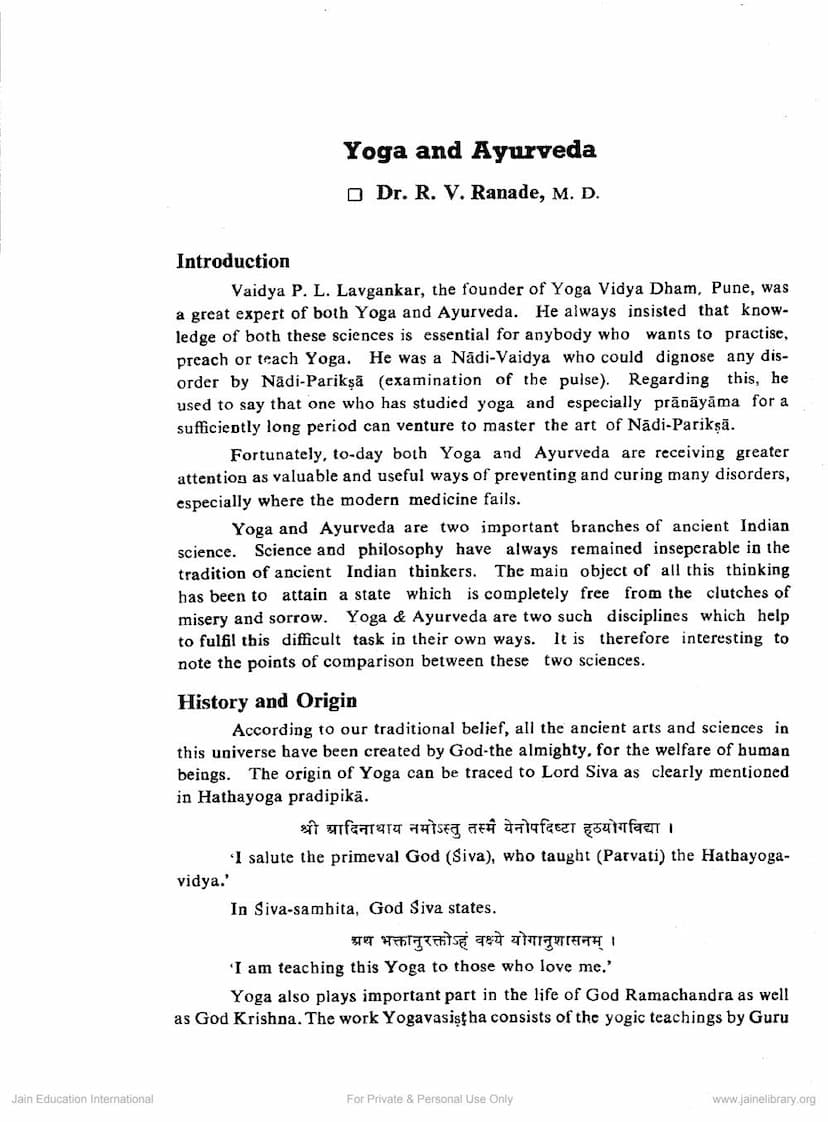
The text begins by highlighting the expertise of Vaidya P. L. Lavgankar, founder of Yoga Vidya Dham, in both Yoga and Ayurveda. Lavgankar emphasized the necessity of knowing both sciences for anyone involved in teaching or practicing Yoga. He believed that mastery of Yoga, particularly Pranayama, could lead to the skill of Nadi Pariksha (pulse diagnosis). The author notes the growing recognition of Yoga and Ayurveda as valuable tools for preventing and curing ailments, especially in cases where modern medicine falls short. Both are presented as integral branches of ancient Indian science, deeply intertwined with its philosophy, with the ultimate aim of freeing humanity from suffering.
History and Origin:
- Yoga: Tradition attributes the origin of Yoga to Lord Shiva, as stated in the Hathayoga Pradipika. Lord Shiva is also quoted in the Siva Samhita as teaching Yoga to his devotees. Yoga's importance is evident in the lives of deities like Ramachandra and Krishna, with Yoga Vasistha detailing teachings from Guru Vasistha to Ramachandra and the Bhagavad Gita presenting Krishna's yogic philosophy to Arjuna. The Vedas, considered divine in origin, are believed to contain references to yogic practices. The Rigveda's Munivarnanasukta mentions sages who achieved extraordinary powers through Pranayama. The Upanishads, particularly the Yoga Upanishads (like Jabala Darshana, Shandilya, and Nadabindu), are also recognized as significant sources of yogic knowledge.
- Ayurveda: The creation of Ayurveda (the science of life) is attributed to Lord Brahma. Caraka Samhita mentions Brahma's extensive work on Ayurveda. The knowledge was passed down through Daksha Prajapati, the Ashvinikumars (divine physicians), Lord Indra, and then Dhanvantari. Dhanvantari's disciples included Sushruta and Bhoja, who specialized in surgery, and Bharadvaja or Atreya Punarvasu, who taught medicine. Kashyapa and Vasistha were noted for their mastery of pediatric medicine. The Rigveda contains references to the therapeutic skills of the Ashvinikumars, anatomical descriptions, and the concept of the three doshas (Kapha, Vata, Pitta), along with mentions of medicinal plants. The Rigvedic period is estimated to be 4,000 to 6,000 BC. The Atharvaveda further elaborates on Ayurveda, discussing the Tridosha theory, digestion, urine formation, and spermatogenesis. It also includes details on disease symptoms, microorganisms, and treatments like herbs, chemicals, surgery, and Bhuta-vidya (demonology). Ayurveda is thus considered an Upaveda of the Atharvaveda.
Common Link in History:
A notable historical connection is found in the roughly contemporaneous existence of Agniveshatantra (around 1000 BC), a foundational Ayurvedic text, and the works of Charaka (who wrote Charaka Samhita based on Agniveshatantra and his own experiences), the grammarian Panini, and Patanjali. Patanjali is believed to have compiled and systematized yogic teachings from Vedic and Upanishadic literature, grounding them in Samkhya philosophy. Historical evidence suggests these three figures might have been the same person, supported by similarities in their writing styles.
Basic Principles:
Both Yoga and Ayurveda share the fundamental principle of aiming for complete physical and mental health to achieve freedom from suffering.
- Yoga: Patanjali defines Yoga as "Yogah chittavritti nirodhah" (Yoga is the restraint of mental operations). This means calming the mind's fluctuations to achieve inner clarity and well-being. The emphasis on mental steadiness is also reflected in the definition of Asana as "Sthira sukham asanam" (A posture should be steady and pleasurable), highlighting the connection between bodily stability and mental happiness.
- Ayurveda: Ayurveda also recognizes the inseparable link between the body and mind, stating that "Shariram hi manah anuvidhiyate manashcha shariram" (The body follows the mind, and the mind follows the body). Health is defined by balanced doshas (humors), well-functioning agnis (digestive fires), balanced dhatus (tissues), proper excretory functions, and cheerful soul, senses, and mind. The Ayurvedic principle of Swasthavritta (maintenance of health) emphasizes dedication to God, wishing welfare to all, good deeds, and avoiding violence and theft.
Comparison of Moral and Ethical Principles:
- Yoga: Prescribes Yamas (social disciplines) like Ahimsa (non-violence), Satya (truthfulness), Asteya (non-stealing), Brahmacharya (continence), and Aparigraha (non-greediness). It also includes Niyamas (personal behaviors) such as Saucha (purity), Santosha (contentment), Tapa (austerity), Swadhyaya (self-study), and Ishwarapranidhana (dedication to God).
- Ayurveda: The principles of Swasthavritta in Ayurveda align closely with these yogic ethical guidelines, advocating for similar positive behaviors and spiritual dedication. This shared emphasis on ethical conduct for good mental health is deemed highly significant.
Anatomy and Physiology:
- Yoga: The concept of 'Prana' is central to Yoga and Ayurveda, a vital life force not directly mirrored in Western medicine. Yogic descriptions of the body are often mystical, based on higher yogic experiences. The body is understood as arising from the five Mahabhutas (earth, water, fire, air, ether) and comprising a gross body (Sthoola Deha, or Annamaya Kosha) and a subtle body (Sukshma Deha, with Pranamaya, Manomaya, and Vijnanamaya Koshas). The body is also described as having sensory and motor organs, five Pranas, and the mind and intellect. Prana flows through Nadis (channels), with 72,000 mentioned, originating near the umbilicus. Fourteen major Nadis are described, with Ida, Pingala, and Sushumna being the most important. Ida and Pingala are modernly equated with the autonomic nervous system, and Sushumna with the spinal cord. Chakras, described as power or relay stations along the Sushumna, are linked to nerve plexuses or endocrine glands. The text mentions various Chakras, typically seven, but also others, and their connection to Prana and their influence on physical activities through the mind. Yogavasistha also describes the body as made of the five Mahabhutas and functions driven by Kundalini Shakti within the Sushumna, characterized by vibrations, touch, and consciousness.
- Ayurveda: Ayurvedic anatomy is more empirically based on observations from dissections and surgical procedures. It also views the body as arising from the five Mahabhutas, from which the Sapta Dhatus (seven elements: lymph, blood, muscle, fat, bone, marrow, sperm) are formed. The five Pranas (Prana, Apana, Udana, Samana, Vyana) aid in circulation and digestion, transforming food into these elements. The three doshas (Kapha, Vata, Pitta) are crucial to this metabolic process. Ayurvedic anatomy and physiology are considered more straightforward.
Pathogenesis (Origin of Disease):
Modern medicine increasingly recognizes the mind's role in disease causation, categorizing many conditions as psychosomatic. Yoga and Ayurveda are presented as potent disciplines that can counteract the aging process and promote youthful vitality.
- Yoga: Yogavasistha suggests that a disturbed mind (chitta-vaidhurya) leads to bodily instability (deha-samkshobha), disrupting Prana balance (prana-vaishamya). This affects the Nadis and digestion, leading to Dosha imbalance and disease.
- Ayurveda: Caraka's pathogenesis aligns with this, stating that a loss of true knowledge (atatvajnana) leads to a lack of sensory control, making one susceptible to temptation and mistakes. This results in a loss of bodily lightness and ease of function, disturbing the Nadis and Prana flow, causing Dosha imbalance and disease.
Treatment and Cure:
The ultimate goal of both sciences is liberation from mental (Adhi) and physical (Vyadhi) suffering.
- Yoga: The primary prevention in Yoga lies in observing Yamas and Niyamas, leading to Raja Yoga for mental tranquility. For common individuals, Hatha Yoga offers a path through Asanas, Pranayama, Mudras, Bandhas, and six cleansing techniques (Shatkriyas: Kapalbhati, Dhauti, Nauli, Neti, Basti, Trataka). These practices promote bodily and mental steadiness, tranquility, and health. The Hathayoga Pradipika lists signs of perfection in Hatha Yoga, including physical slimness, facial brightness, clear eyes, freedom from disease, control over bodily fluids, stimulated digestive fire, and purification of Nadis. Specific Asanas like Mayurasana are cited for their ability to cure various diseases, balance humors, enhance digestion, and even neutralize poison. Pranayama is credited with controlling all diseases, and cleansing practices like Dhauti are effective against respiratory ailments, spleen disorders, leprosy, and other phlegm-related diseases. The text notes modern medicine's recognition of meditation's benefits for various disorders. In essence, yogic practices, under expert guidance, can prevent or control most ailments.
- Ayurveda: The preventive aspect of Ayurveda, through Swasthavritta, involves dietary and behavioral rules, daily (Dinacharya) and seasonal (Ritucharya) routines. The Panchakarmas (five cleansing procedures: Basti, Virechana, Vamana, Nasya, Raktamokshan) are comparable to Yoga's Shatkriyas. Ayurveda prioritizes Pathya (correct behavior) over drugs, believing that proper conduct can negate the need for medication. However, when necessary, Ayurveda prescribes specific drugs tailored to the ailment and individual constitution (Prakruti).
Conclusion:
By following the principles of Yoga and Ayurveda, individuals can achieve holistic health. The text concludes with the aspiration, "Sarve sukhihantu, sarve santu niramayah" (May all be happy, may all be free from disease).