
Yaska And Sentence Beginning Ofsabdabodha
Added to library: September 2, 2025
Summary
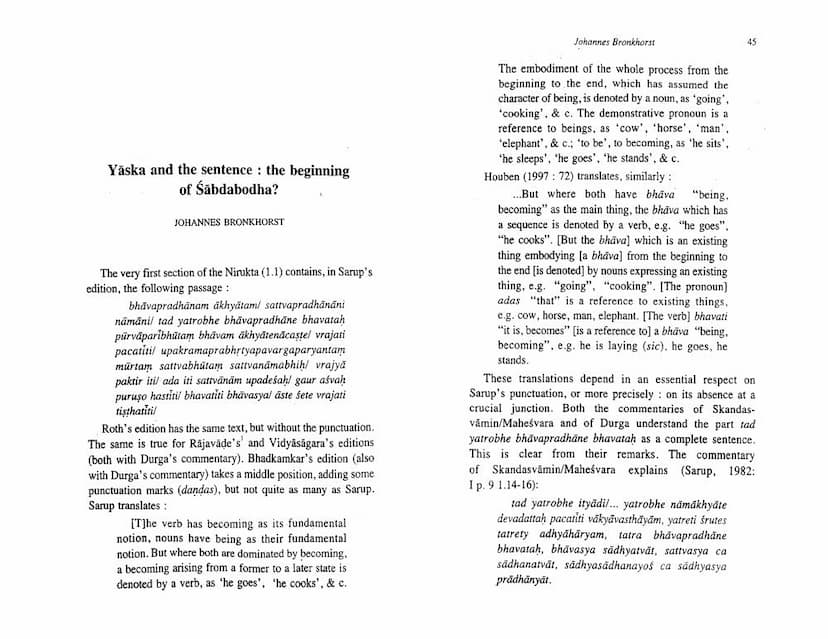
This document, titled "Yaska and the sentence: the beginning of Sābdabodha?" by Johannes Bronkhorst, delves into the interpretation of a crucial passage in Yaska's Nirukta (1.1). The core of the debate revolves around the meaning and grammatical function of the sentence: "bhāvapradhānam ākhyātam/ sattvapradhānāni nāmāni/ tad yatrobhe bhāvapradhane bhavatah..." (A verb has 'becoming' as its fundamental notion, nouns have 'being' as their fundamental notion. But where both have 'becoming' as their fundamental notion...).
The author highlights a significant divergence in interpretation among scholars, primarily concerning whether the phrase "tad yatrobhe bhāvapradhane bhavatah" should be treated as a complete, standalone sentence or as an integral part of the ongoing explanation.
Key Interpretations and Debates:
-
Sarup and Gune's Interpretation: They view the passage as a continuous explanation. They argue that Yaska is addressing abstract nouns (like vrajyā 'going', paktih 'cooking') which, while grammatically nouns (nāmāni), seem to exhibit the characteristics of verbs (ākhyāta) due to their emphasis on bhāva (becoming/action). According to this view, Yaska is suggesting that in such cases, the verb denotes an incomplete or changing bhāva (pūrvāparibhūtam bhavam), while nouns denote a complete or materialized bhāva (mūrtam sattvabhūtam). Gune critically questions whether Yaska was even concerned with the concept of the sentence (vākya) or the predication of sentential meaning, suggesting that commentators later imposed such ideas.
-
Durga, Skandasvamin/Maheśvara, and Roth's Interpretation: These scholars, along with others like Nilakantha Gårgya and Rudolph Roth, interpret "tad yatrobhe bhāvapradhane bhavatah" as a distinct sentence. They believe Yaska is stating that when both nouns and verbs appear in a sentence, then bhāva (activity or becoming) is the principal element. This interpretation is seen as foreshadowing later developments in Indian linguistics, particularly the concept of sābdabodha (verbal cognition or understanding of sentence meaning), where the verb or verbal root is considered the primary qualifier in a sentence. Durga, in particular, emphasizes that in the process of explaining a sentence, the verb is paramount, followed by the noun.
The Role of "ācaste":
A significant point of contention is the verb "ācaste" (expresses/denotes). Bronkhorst meticulously examines its usage in the Nirukta. He observes that "ācaste" typically has a definite subject, whereas the plural form "ācaksate" often has an unspecified subject ("they" or "one"). This linguistic observation is crucial for evaluating the proposed interpretations of the passage.
- Sarup's proposed reconstruction of the Sanskrit text, using "ācaste," necessitates supplying a subject, which Bronkhorst finds less convincing given Yaska's typical style.
- The interpretation that treats "tad" as the subject of "ācaste" is also explored, suggesting that "tad" refers to the sentence itself, where both noun and verb have bhāva as principal. However, Bronkhorst points out difficulties with this interpretation, including Yaska's preference for placing relative clauses before the element they relate to, which might suggest "tad" is used adverbially.
Connection to Sābdabodha:
The central theme of the paper is the potential for this Nirukta passage to be the "earliest seed" of the later sābdabodha doctrine. The author discusses how later grammarians, like Bhartrhari, developed the idea of hierarchical meaning within sentences, with the verb's meaning often being central.
Bronkhorst's Argument and Conclusion:
Bronkhorst leans towards Gune's critique, suggesting that the interpretation of the passage as being about sentence structure and the primacy of the verb within a sentence might be anachronistic. He argues that Yaska's focus was primarily on individual words (pada) and their etymology, rather than the sentence as a unit of meaning. The commentaries that see the sābdabodha-like development are likely products of later linguistic thought, possibly post-dating Bhartrhari.
Ultimately, Bronkhorst concludes that while the passage is stylistically unusual for Yaska, Gune's points about Yaska's lack of explicit focus on sentences are compelling. He suggests that the commentators likely interpreted the passage through the lens of later philosophical and linguistic developments, potentially projecting their own ideas onto Yaska's text. The precise interpretation remains debated, but the passage is significant for its potential to illuminate the early stages of theories about sentence meaning in ancient India.