
Xuanzangs Proof Of Idealism
Added to library: September 2, 2025
Summary
This article, "Xuanzang's Proof of Idealism (vijñaptimātratā)" by Eli Franco, critically examines earlier scholarly interpretations of a famous syllogism presented by the Chinese Buddhist monk Xuanzang, aiming to demonstrate the Yogācāra idealist doctrine of "Consciousness Only." Franco argues that previous analyses, particularly by Christoph Harbsmeier and Arthur Waley, failed to grasp the nuances of Indian Buddhist logic, leading to misinterpretations of Xuanzang's argument.
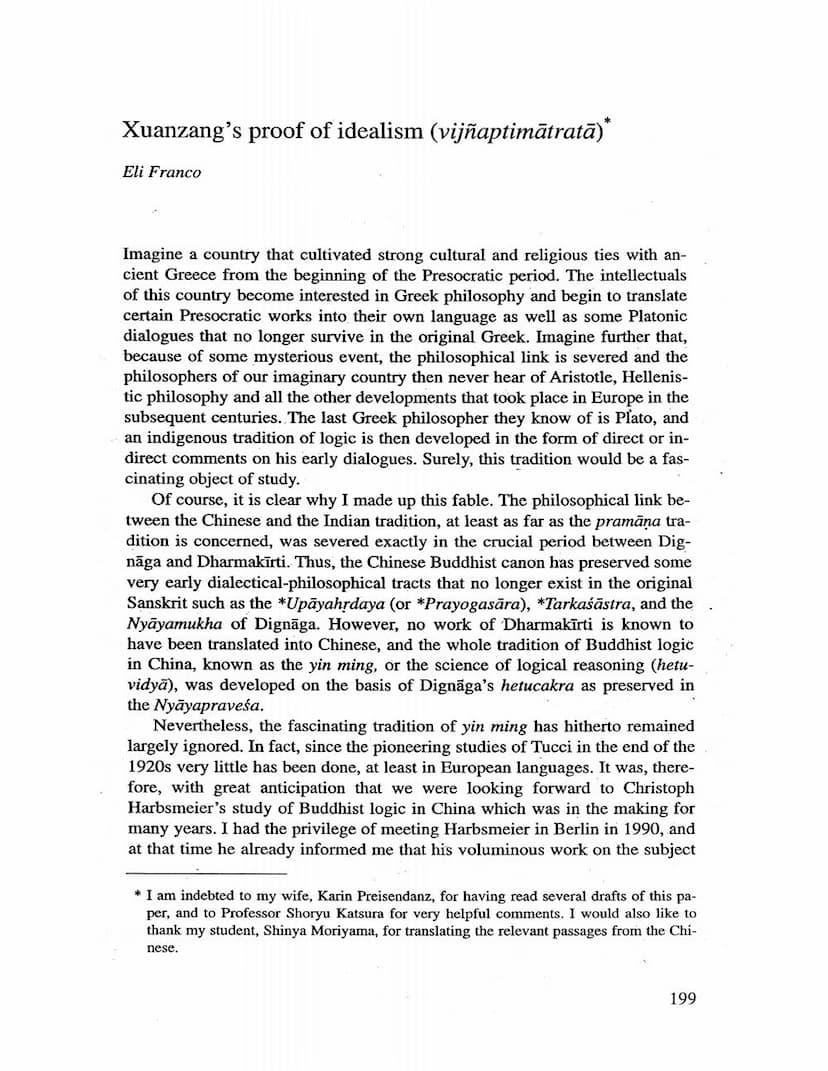
Franco begins by highlighting the historical disconnect between Chinese and Indian Buddhist philosophical traditions, particularly in the period between Dignāga and Dharmakīrti. He notes that Chinese Buddhist logic (yin ming) was primarily based on Dignāga's work, as Dharmakīrti's writings were not translated into Chinese. This, he suggests, is why works like Dignāga's Nyāyapraveśa are crucial for understanding Chinese Buddhist logic.
The author then critiques Christoph Harbsmeier's study of Chinese Buddhist logic, deeming it a disappointment due to its lack of historical information and insight into the subject matter. Franco specifically criticizes Harbsmeier's attempt to interpret Chinese Buddhist logic without adequate understanding of its Indian origins, accusing him of misinterpreting Xuanzang's key argument for Consciousness Only.
Franco then delves into Xuanzang's syllogism, presenting a more accurate literal translation and explaining its logical structure based on Dignāga's theory of trairūpya (three characteristics of a valid reason). He argues that Xuanzang's argument, while delivered in China and preserved in translation, is fundamentally Indian in its logical framework.
The article meticulously breaks down the three conditions of trairūpya:
- Presence in the subject of inference (pakṣa): The reason must be present in the subject under consideration.
- Presence in the universally accepted case (sapakṣa): The reason must also be present in things that possess the property being proved.
- Absence from the universally rejected case (vipakṣa): The reason must be absent from things that do not possess the property being proved.
Franco illustrates this with a classic example: "This mountain has fire because it has smoke." He emphasizes that Dignāga's inferences are not deductive in the Western sense, as the subject of inference is excluded from both the sapakṣa and vipakṣa at the time the inference is made. This exclusion, he explains, is what makes the inference non-deductive.
Applying this framework to Xuanzang's argument, Franco identifies the elements based on the eighteen dhātus (elements of existence) in Buddhist philosophy. He argues that Xuanzang's thesis is that visual objects (rūpa, dhātu 2) are not separate from visual consciousness (cakṣurvijñāna, dhātu 3). The reason provided is that visual objects are "not the sense of vision" (cakṣurindriya, dhātu 1), while also being "in the visual sphere" (dhātus 1-3). This nuanced qualification, Franco asserts, is crucial for satisfying the trairūpya conditions.
Franco then refutes Harbsmeier's interpretation, showing how it distorts the original meaning of Xuanzang's reason and example. He also addresses other scholars like Arthur Waley and Hajime Nakamura, who also struggled to make sense of the argument, attributing their difficulties to a lack of familiarity with Indian Buddhist logic.
Finally, Franco discusses a counter-argument proposed by the Korean patriarch Wönhyo, which attempts to invalidate Xuanzang's inference by presenting a contradictory syllogism that also adheres to the trairūpya rules. Franco analyzes Wönhyo's argument and suggests that, according to the established rules, it may indeed succeed in annulling Xuanzang's proof, though he acknowledges further research is needed to definitively confirm this.
In essence, Franco's article provides a detailed and scholarly reinterpretation of Xuanzang's famous argument, emphasizing its grounding in the sophisticated logical systems developed by Dignāga and highlighting the importance of understanding the historical and philosophical context of Indian Buddhist logic for accurate scholarly analysis.