
Words For Violence In Seniors Of Jaina Canon
Added to library: September 2, 2025
Summary
Here's a comprehensive summary of Colette Caillat's article, "Words for Violence in the 'Seniors' of the Jaina Canon," based on the provided text:
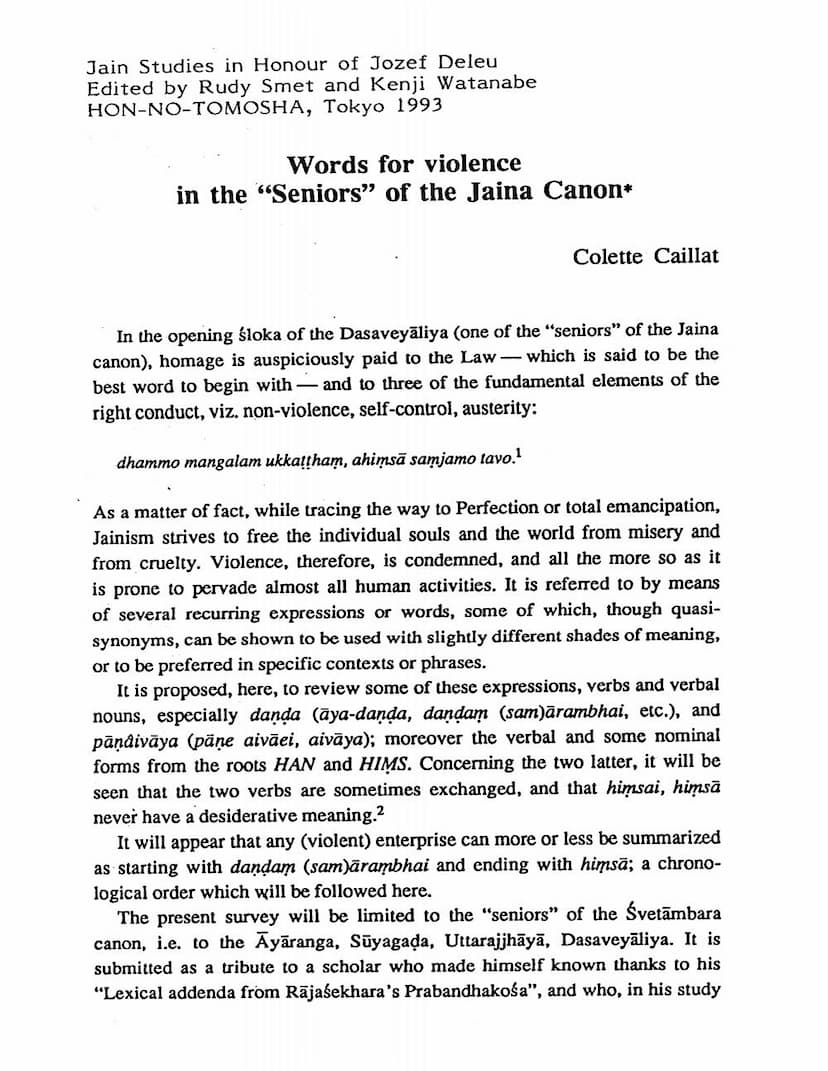
This article, written by Colette Caillat, explores the multifaceted vocabulary used to express violence within the foundational texts of the Svetambara Jaina canon: the Āyāranga, Sūyagaḍa, Uttarajjhāyā, and Dasaveyāliya. Caillat's analysis focuses on tracing the semantic range and nuances of key terms, aiming to understand how Jainism conceptualized and condemned violence, which it saw as pervasive in human activities.
The article begins by highlighting the foundational importance of ahimsā (non-violence) in Jainism, alongside samjama (self-control) and tapas (austerity), as essential components of the path to liberation. Violence is seen as a root cause of suffering and cruelty, and Jain texts employ a rich vocabulary to describe its various facets.
Caillat's survey focuses on three main lexical areas:
-
Danda:
- Literal Meaning: Initially understood as a "stick," "club," or "staff," danda also served as a tool of violence, an insignia of power, and a means of punishment.
- Figurative Meanings: From its literal sense, danda extends to signify "blow" (physical, moral, or spiritual), "punishment," and more broadly, any "act of violence" or "cruelty."
- Withdrawal from Violence: The phrase "laying down the rod" (nikkhittadanda, nihāya dandam) becomes a metaphor for renouncing violence and cruelty.
- Danda-samāyāna: These are five categories of aggressive undertakings, encompassing actions motivated by self-interest, lack of interest, alleged injury, accident, or error in judgment. They all imply grave, often fatal, injury.
- Āya-danda: This term is analyzed in detail, with a focus on differentiating its interpretation. While traditional exegesis and phonetic analysis suggest a meaning related to "self-destruction" (ātma-danda), Caillat, referencing W.B. Bollée's work, argues persuasively for a meaning of "brutal" or "violent." This is supported by contextual analysis where āya-danda describes aggressive and destructive behavior towards others, rather than a purely self-inflicted harm. The article explores the linguistic parallels with Sanskrit and Pali to solidify this interpretation.
- Dandam (sam)ārambhai: This phrase means "to undertake," "to engage in," or "to set in motion acts of violence." It describes the initiation of violent activities, which are seen as harmful to both the perpetrator and the victim. The renunciation of this action is a core aspect of Jaina ascetic practice.
-
(-)Atipāta:
- Core Meaning: This term, often found in the compound pāṇātipāta (or pāṇaivāya in Ardhamāgadhī), specifically refers to the "injury" or "destruction of living beings."
- Connection to Vows: It is directly linked to the first mahāvrata (great vow) of Jainism: abstention from injuring any living being. The Jaina vow mirrors the Buddhist precept of abstaining from killing living things.
- Verb Forms: The verbal forms, particularly aivāya (Amg) and atipāta (Pa), denote the act of killing or causing destruction. The article notes the frequent use of these terms in negative contexts, emphasizing the prohibition of harm.
- Archaic and Technical: Pāṇātipāta is presented as an archaic and technical term, perhaps referring to the destructive process itself. It lacks a regular privative counterpart like ahimsā derived from himsā.
-
HAN:
- Vitality and Range: The root HAN is described as highly vital and productive in the Jaina canon, with numerous verbal forms. It carries a broad semantic range, encompassing "to strike," "to hit violently," and generally any "form of aggression" or "violence," including acts resulting in death.
- Stereotyped Phrases: HAN often appears in lists of violent actions, emphasizing the direct physical harm inflicted.
- Synonymy with HIMS: The article notes that HAN is often interchangeable with or glossed by forms of HIMS in commentaries and textual parallels, suggesting a significant overlap in meaning.
- Causative Forms: Causative forms like ghāyae highlight the act of "causing to kill" or "causing to destroy."
-
HIMS:
- Core Concept: HIMS and its derivatives, especially himsā, primarily denote "injury" or "doing harm" to living beings.
- Association with the First Vow: Like atipāta, himsā is intrinsically linked to the fundamental Jaina principle of non-violence.
- Negative Constructions: The article observes that verbal forms of HIMS are frequently used in negative sentences (e.g., na himsae), underscoring the imperative of abstaining from harm. The privative forms (ahimsā, avihimsa) carry a strong positive connotation of compassion and adherence to the Law.
- Semantic Focus: HIMS is characterized as focusing on the physical injury resulting from violence and emphasizes the complete exclusion of injury.
Conclusion:
Caillat concludes that the Jaina canon employs a rich and nuanced vocabulary to express violence, with terms like danda signifying the instrument and initiation of aggression, pāṇātipāta and himsā denoting the act and result of injury to life, and HAN serving as a versatile and frequently used term for striking and violent action. The consistent emphasis on non-violence (ahimsā) through grammar, vocabulary, and style establishes Jainism from its early stages as a doctrine of non-violence (ahimsā-samaya). The article demonstrates how these terms, particularly the contrast between the initiation (prāṇārambha) and culmination of violence (vihimsā) versus their absence (anārambho prāṇānam, avihīsā), are crucial for understanding the ethical core of the Jaina tradition.