
Wisdom In Jain Tradition
Added to library: September 2, 2025
Summary
Here's a comprehensive summary of Dr. Nalini Joshi's paper "Wisdom in Jain Tradition," based on the provided text:
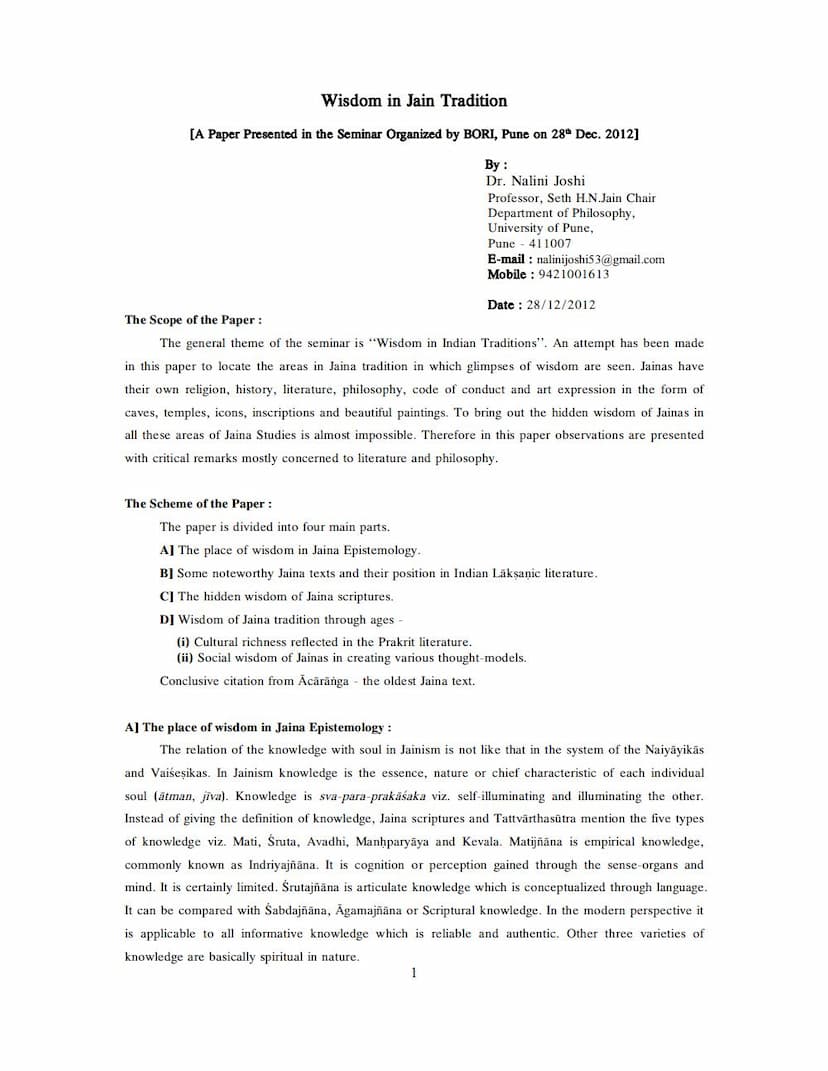
Dr. Nalini Joshi's paper, "Wisdom in Jain Tradition," presented at a seminar on "Wisdom in Indian Traditions," aims to explore the multifaceted wisdom embedded within the Jain tradition. Recognizing the impossibility of covering all aspects of Jainism (religion, history, literature, philosophy, conduct, and art), the paper focuses primarily on literature and philosophy, offering critical observations.
The paper is structured into four main parts:
A. The Place of Wisdom in Jaina Epistemology: Jainism views knowledge not as an external acquisition but as an intrinsic characteristic of the soul. The soul is described as "sva-para-prakāśaka," meaning it illuminates itself and others. Jaina epistemology outlines five types of knowledge:
- Matijñāna: Empirical, sensory knowledge gained through sense organs and the mind.
- Śrutajñāna: Articulate, conceptualized knowledge conveyed through language. This is comparable to scriptural or informative knowledge.
- Avadhijñāna, Manhparyayajñāna, and Kevalajñāna: These are the three higher, spiritual forms of knowledge.
The paper highlights the Nandīsūtra as a significant text dedicated to Jaina epistemology. It discusses the "fourfold intellect" (Caturvidha Buddhi) described in the Nandīsūtra, which contributes to the concept of wisdom:
- Autpattiki Buddhi: Inborn intellect (comparable to IQ).
- Vainayiki Buddhi: Knowledge acquired through proper training and guidance from a guru.
- Karmajā Buddhi: Skill developed through rigorous practice.
- Pāriņāmiki Buddhi: Knowledge gained through lifelong experiences, which grows with age.
The paper emphasizes that wisdom is linked to both empirical knowledge (Mati) and articulate knowledge (Śruta), particularly through the concept of "Laukika Śruta" (secular knowledge derived from non-Jaina sources), which inspired the development of Jain secular literature.
B. Some Noteworthy Jaina Texts and Their Position in Indian Lākṣaṇic Literature: This section critically examines Jaina contributions to what is termed "Lākṣaṇic Literature" (literature dealing with specific subjects or sciences). The author notes that while the history of Jaina literature lists numerous subjects and texts, some lists are unnecessarily long, and some entries are based on conjecture rather than direct study. However, several Jaina contributions are highlighted:
- Grammar: While Sanskrit grammars by Jainas are often commentarial, Canda's Prākrtalaksana is recognized as the first Prakrit grammar, influencing later works by Vararuci and Hemacandra. Hemacandra's Haima-prakrta-vyākarana is still studied. Jainas wrote grammars of Prakrit and even Kannada in Sanskrit, viewing Sanskrit as a pan-Indian academic language, not a sacred one.
- Lexicons: Inspired by Nighantus and Niruktas, Jaina lexicons are significant, especially for Prakrit. Notable works include Dhanapāla's Pāiyalacchināmamālā and Hemacandra's Abhidhānacintāmaņināmamālā and Deśīnāmamālā. The paper also acknowledges Padalipta's earlier Desikośa.
- Philosophy: Vācaka Umāsvāti's Tattvārthasūtra is a crucial work that systematized Jaina philosophical concepts in Sanskrit aphorisms, a testament to his genius in bridging Prakrit and Sanskrit scholarly traditions.
- Doctrine of Karman: Jainism's detailed development of the Karma doctrine, forming the backbone of its philosophy and conduct, is a significant area of wisdom, leading to a dedicated Karma-literature.
- Dhyāna and Yoga: Jaina authors have contributed to this field, with Haribhadra being particularly noted for synthesizing Jaina Yoga with Brahmanic and Buddhist traditions. The modern development of Prekṣādhyāna is also mentioned.
- Astrology and Nimitta (Prognostics): Canonical texts like Sūryaprajñpti and Candraprajñapti point to early Jaina engagement with these subjects. Despite the negation of fortune-telling for monks, the academic interest in these branches is evident in the preserved manuscripts.
- Logic (Nyāya): Jainas entered the field of logic later than Buddhists and Brahmins. Siddhasena's Sanmati-tarka is a key Prakrit work. The development of Syādvāda and Saptabhaṅgī by scholars like Akalanka, Samantabhadra, and Hemacandra provided a unique philosophical framework for argumentation, rooted in Anekāntavāda. Hemacandra's Pramāna-mīmāmsā and Yasovijaya's Jaina Tarkabhāṣā (in Navya-nyāya style) are significant contributions.
- Ayurveda: While Caraka, Suśruta, and Vāgbhaṭa remain primary, Ugrāditya's Kalyāṇakāraka is a remarkable Jaina work that followed Jaina dietary and medicinal rules. The paper traces the evolving Jaina attitude towards Ayurveda, from negation to acceptance in exceptional cases, and finally to producing dedicated works, showcasing flexibility and wisdom.
- Mathematics: While independent mathematical treatises are not found before Mahāvīrācārya's Ganitasarasamgraha (which scholars consider superior to some of Brahmagupta and Bhaskarācārya's works), Jaina cosmology, karma doctrine, and lifespan calculations involved significant numerical and measurement concepts. Thakkura Pheru's Ganitasārakaumudi and his treatises on various scientific and technical subjects are highlighted for their unique contribution and use of colloquial terminology.
- Political Science and Ethics: Somadevasūri's Nītivākyāmîta is noted as a secular and classical Sanskrit work in the tradition of Kautilya's Arthaśāstra. His Yaśastilakacampū is a rich source of cultural data.
- Commentarial Literature: Jainas are recognized for their extensive commentarial works on both Jaina and non-Jaina texts, often without sectarian bias. Works like Amitagati's Kāvyaprakāśakhandana and Siddhacandragani's commentary on Bānabhatta's Kādambari are examples of this secular contribution.
C. The Hidden Wisdom in Jaina Scriptures: This section points to the profound wisdom present in early Prakrit texts, which, unfortunately, did not always develop into fully recognized scientific branches due to socio-religious factors. The increasing renunciatory and moksha-centric focus of later Jainism also impacted the development of empirical knowledge. Key insights include:
- Atomism: Jaina concepts of pudgala and paramānu (atoms) in texts like the fifth chapter of Tattvārtha are considered more subtle and closer to modern physics than some other ancient Indian theories.
- Biological Sciences: The Jaina emphasis on innumerable species and a detailed classification of living beings based on various criteria (liberation, movement, mind, destiny, etc.) demonstrate profound biological insight. Concepts like sammūrcchana are comparable to asexual reproduction or cloning, and genetic properties are linked to descriptions of Nämakarman.
- Environmental Sensitivity: Jainism's intrinsic "pro-environmental" nature, extending sensitivity to all bio-forms, supports preservation and conservation. The interpretation of the principle "live and let live" in light of commentaries on Tattvärtha aligns with Darwinian concepts of interdependency.
- Anekantavāda: This Jaina theory of "multiple facets of reality and truth," often translated as non-absolutism or relativity, is compared to Einstein's theory of relativity, with a quote from Einstein expressing admiration for Jainism.
D. Wisdom of Jaina Tradition Through Ages: The concluding section highlights:
- Cultural Richness in Prakrit Literature: Prakrit literature, particularly narrative forms, offers a rich tapestry of Indian culture, reflecting the aspirations of common people and providing insights into social customs, beliefs, and rituals.
- Social Wisdom in Creating Thought-Models: As a minority community, Jainas have developed models for conflict resolution and peace that align with their philosophical framework. These "thought-models" include:
- The comprehensive model of Anekāntavāda.
- The model of suitable language.
- The model of choosing less harmful options.
- The model of peaceful interaction with rulers.
- The model of adaptation in mythology, art, and social conditions.
The paper concludes with a profound citation from the Acaranga Sutra, emphasizing the core Jaina principle of non-violence towards all sentient beings.