
William James Et Son Darwinisme Religieux
Added to library: September 2, 2025
Summary
Here's a comprehensive summary of the provided Jain text, focusing on the content about William James and his "religious Darwinism":
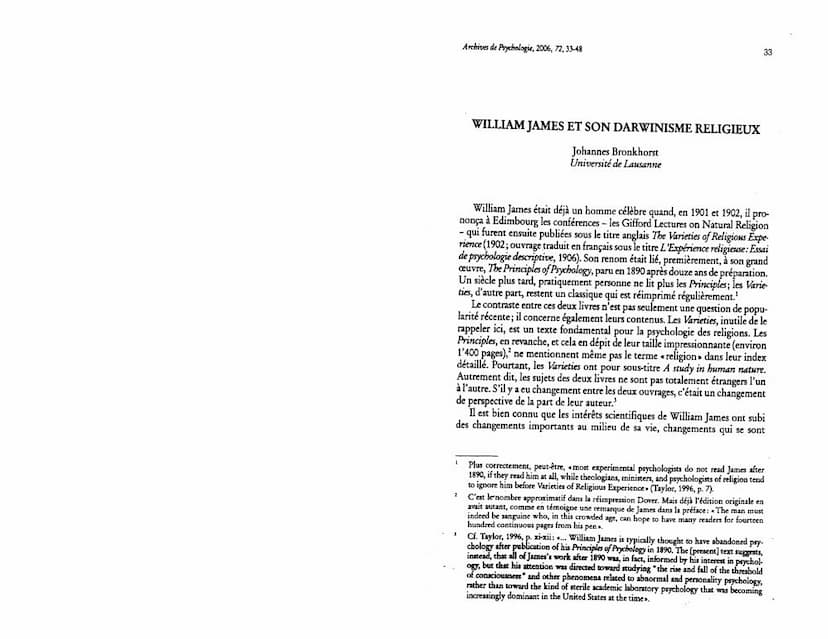
The article "William James Et Son Darwinisme Religieux" by Johannes Bronkhorst examines the evolution of William James's thought, particularly his engagement with Darwinism, and how this influenced his views on religion.
James's Early Engagement with Darwinism:
- Familiarity: James was deeply familiar with Darwinism from his early career. His first publications in 1865 were reviews of books on Darwin, and in 1868, he reviewed Darwin's Origin of Species itself.
- Harvard Influence: While studying at Harvard in the 1860s, James was exposed to the intense debates surrounding Darwin's ideas. He sided with professors who embraced Darwinism, like Jeffries Wyman, and developed a disdain for opponents like Louis Agassiz.
- Acceptance of Scientific Darwinism: James generally accepted the core tenets of scientific Darwinism, though he held some minor reservations.
The Rise of Social Darwinism and James's Discomfort:
- Social Darwinism Defined: Bronkhorst defines "social Darwinism" as the application of scientific Darwinism to society, often with a prescriptive rather than descriptive intent. It typically advocates for economic laissez-faire and opposition to aid for the poor, often associated with Herbert Spencer's "survival of the fittest."
- James's Rejection of Social Darwinism: James strongly disagreed with social Darwinism, especially its justification for practices like rampant capitalism and colonialism prevalent in his era. He found the methods of figures like John D. Rockefeller "abominable" and argued in his 1880 review of Spencer's Data of Ethics that survival itself is not an objective good; it requires a subjective feeling of wanting to survive or an ethical proposition that it is good to feel that way. He saw "survival of the fittest" more as a description than a moral imperative.
- Critique of the "Progress" Narrative: James was also troubled by the widespread belief in progress, which many equated with the theory of evolution. He observed how this belief was displacing traditional religion for many and creating a "new sort of religion of Nature."
The Emergence of "Religious Darwinism":
- James's Search for Religion: James was actively seeking a religion he could believe in, a "best religion." He saw that social Darwinism was seeking a "best society," believing Darwinian mechanisms could achieve it.
- Applying Darwinian Mechanisms to Religion: In his The Will to Believe (1897), James controversially suggested that Darwinian mechanisms, specifically "survival of the fittest," could also be applied to religion. He argued that the free competition and open application of various religious faiths to life would be the most favorable conditions for the "survival of the fittest" religions. This is what Bronkhorst terms "religious Darwinism."
- The Role of the "Science of Religions": James later addressed the challenges of comparing subjective religious experiences. In The Varieties of Religious Experience (1902), he proposed that the "Science of Religions" could play a role similar to natural selection in scientific Darwinism. This science would sift through religious ideas, eliminate the scientifically absurd, and refine hypotheses, potentially leading to the identification or creation of the "best" religion.
- James's Apprehensions: Despite this proposal, James harbored reservations. He noted that the conclusions of the Science of Religions could be as adverse as they were favorable to the truth of religion's essence. He also acknowledged that the Science of Religions, while a tool for identifying the best religion, could not replace living religion itself.
Bronkhorst's Critique and Modern Perspective:
- Critique of James's Religious Darwinism: Bronkhorst argues that James's concept of religious Darwinism, while an interesting intellectual exercise, is problematic. He notes that in an era of religious conflict, the idea of the "fittest" religion winning through competition seems naive.
- Divergence from James: Bronkhorst contrasts James's time with the present, where social Darwinism is largely rejected, and science is not necessarily tied to exploitative policies. He suggests that modern society can embrace scientific progress and social justice simultaneously, without relying on religion as a necessary counterbalance.
- Better Uses of Darwinism in Religion Studies: Bronkhorst concludes that while James's specific application of Darwinism to religion was flawed, Darwinian theory itself remains valuable for understanding human development, including religious phenomena. He believes that the Science of Religions should focus on understanding the common elements across religions, contributing to a better understanding of human nature, rather than trying to identify or create a "best" religion. He also touches on current research exploring the survival value of religion, a domain different from James's direct focus.
In essence, Bronkhorst's article traces James's intellectual journey from embracing scientific Darwinism, to rejecting its social applications, and then to his innovative, though perhaps flawed, attempt to apply Darwinian principles to the realm of religious belief and practice.