
Who Is Byan Chub Rdzu Phrul
Added to library: September 2, 2025
Summary
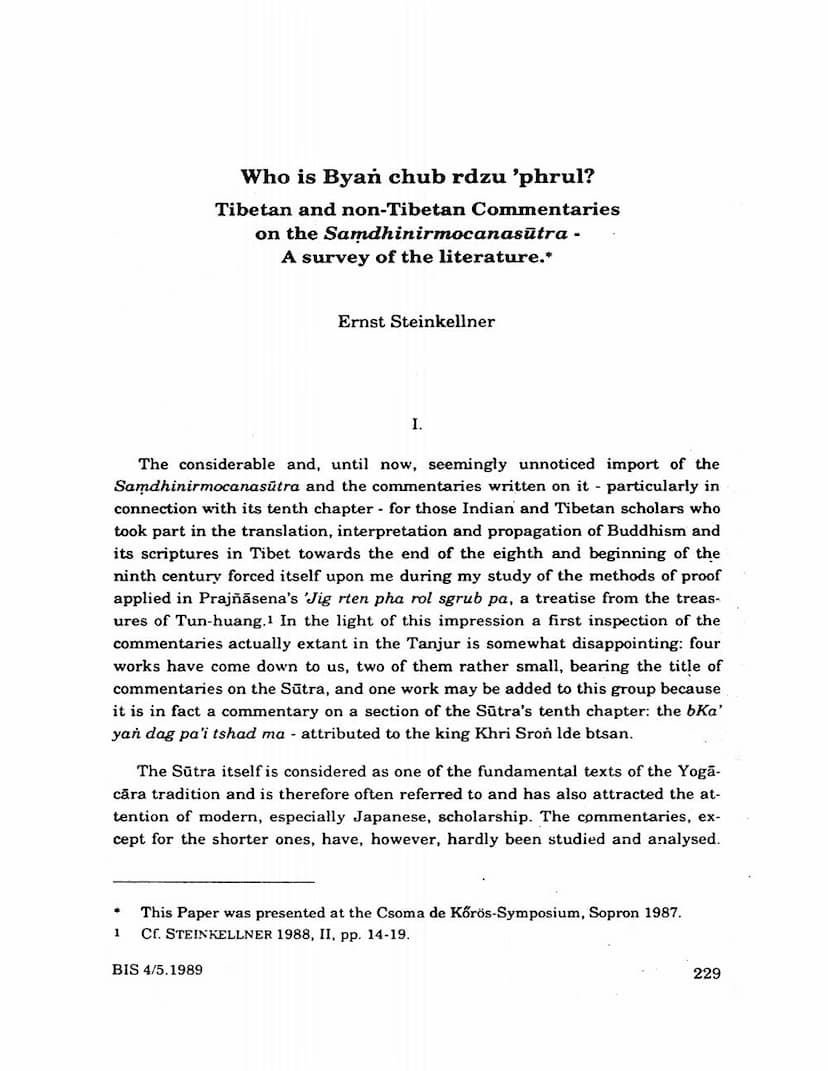
This document is an article by Ernst Steinkellner titled "Who is Byan chub rdzu 'phrul? Tibetan and non-Tibetan Commentaries on the Samdhinirmocanasūtra - A survey of the literature." It focuses on the Samdhinirmocana-sūtra, a fundamental text of the Yogācāra school, and the commentaries written on it, particularly in the context of early Tibetan Buddhism.
Here's a summary of the key points:
1. Significance of the Samdhinirmocana-sūtra and its Commentaries:
- The article highlights the considerable, but previously unnoticed, importance of the Samdhinirmocana-sūtra and its commentaries for the formation of Tibetan Buddhist culture in the late 8th and early 9th centuries.
- The tenth chapter of the Sūtra is identified as particularly crucial, as it provides a comprehensive exegetical system that served as a model for interpreting the Buddha's teachings.
- This system was vital for Buddhist monks spreading Buddhism in new cultural environments, especially in a missionary context.
2. Extant Commentaries: Steinkellner surveys four extant commentaries found in the Tibetan Tanjur, as well as one that comments on a section of the tenth chapter:
- Asanga's Samdhinirmocana-bhāṣya: A very short commentary, translated around 800 CE. Its authenticity as authored by Asanga is questioned.
- Ārya-maitreya-kevala-parivarta-bhāṣya of Ye ses sñin po (= Jñanagarbha): This commentary focuses on the eighth chapter of the Sūtra. A significant portion of the article is dedicated to discussing the identity of its author, Jñanagarbha/Ye ses sñin po. Steinkellner argues that evidence suggests this Jñanagarbha was likely a Tibetan lotsava rather than an Indian pandit, based on translation collaborations and a different name appearing in Tibetan catalogues.
- Ārya-gambhirasamdhinirmocana-sūtra-ṭikā of Wen tshig (Chinese Yuan-ts'ê): This is the largest of the extant commentaries. It was translated into Tibetan by the Chinese monk Fa-tch'eng. The article notes that this commentary exhibits the Tibetan analytical system of "sections" (sa bcad), suggesting this technique might have Chinese origins rather than Indian or Tibetan.
- Ārya-samdhinirmocana-sūtra-sya vyākhyāna of Byan chub rdzu 'phrul: This is an extensive commentary, with a significant portion dedicated to the tenth chapter. The central question of the article, "Who is Byan chub rdzu 'phrul?", is addressed. Steinkellner identifies this figure with King Khri Sron lde btsan, based on analysis of the name's components (Bodhisattva nature and magical powers) and corroborating evidence from Bu ston's writings. However, it's noted that this is the only instance where the king is credited as the author of this specific commentary, and it doesn't appear in catalogues of the king's works. Bu ston himself suggested the author might be Klu'i rgyal mtshan.
- bKa' yan dag pa'i tshad ma las mdo btus pa of Khri Sron lde btsan: This work is a commentary on a section of the tenth chapter, specifically the "four methods" (rigs pa bzhi). While attributed to King Khri Sron lde btsan, the scholarly consensus is that the king did not actually compose it, but rather commissioned it. It is seen as an important text for the practical life of missionaries and for structuring the dissemination of dharma.
3. Lost Commentaries: The article also mentions lost commentaries listed in older catalogues but missing by the time of Bu ston's compilation. Their existence reinforces the importance of the Sūtra tradition during the early Tibetan Buddhist period.
4. Significance for Tibetan Buddhist History:
- A significant portion of the identified works (nine out of ten) were already known in the oldest Tibetan literature catalogues.
- By Bu ston's time, only five of these were still extant, indicating a substantial loss of this literature over the centuries.
- A notable number of these works are attributed to Tibetan authors or commissioned by Tibetan kings, underscoring the active role of Tibetans in the development of Buddhist scholarship.
- Except for one translation and one commentary on an earlier chapter, the heavy emphasis on the tenth chapter by most commentators is a key observation.
- The tenth chapter is described as a "great summa of Buddhist hermeneutics," providing detailed categories for textual exegesis and demonstrating the "truth and authority" of the teachings. This required the development of specialized terminology, which was a major task for the scholars of that era.
- The study of these commentaries is deemed unavoidable for understanding the development of early Tibetan Buddhist vocabularies and semantics, particularly in light of King Khri Sron lde btsan's decision to establish Buddhism in Tibet.
In essence, Steinkellner's article argues that the Samdhinirmocana-sūtra and its commentaries played a foundational role in the early development and systematization of Buddhist thought and practice in Tibet, and that understanding the literature surrounding it is crucial for understanding this period of Tibetan history.