
Western Discovery Of Jain Temple Libraries
Added to library: September 2, 2025
Summary
Here's a comprehensive summary of "The Western Discovery of Jain Temple Libraries" by Donald Clay Johnson:
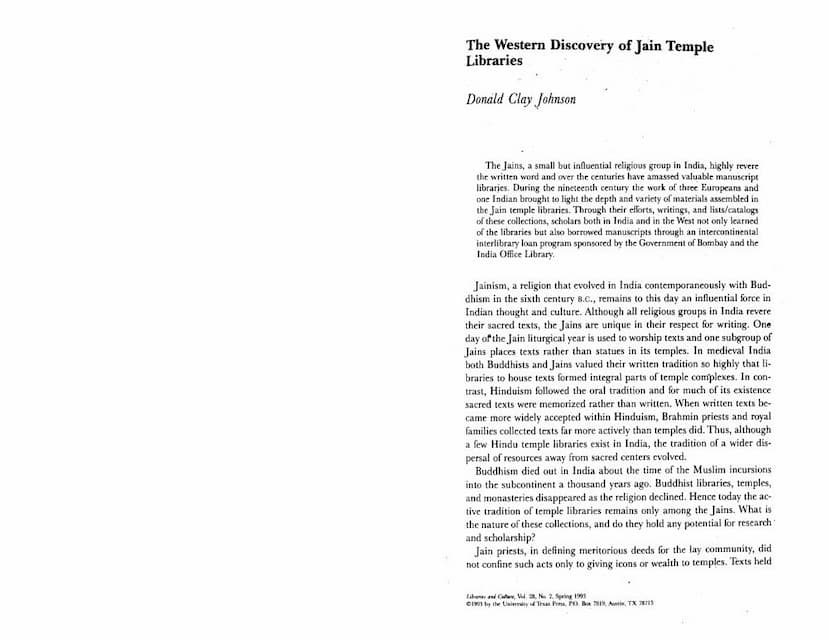
This text details the significant, yet often overlooked, role of Jain temple libraries in making ancient Indian literature, particularly Sanskrit texts, accessible to Western scholarship in the 19th century. Jainism, an ancient Indian religion that evolved alongside Buddhism, holds a unique and deep reverence for the written word. This veneration led to the accumulation of vast and valuable manuscript collections within their temple complexes.
The Genesis of Western Interest:
- Jain Reverence for Texts: Unlike some other Indian religions that emphasized oral traditions, Jains actively commissioned, copied, and preserved texts. This practice was driven by the need to propagate the teachings of their numerous subsects, and temples became central repositories for these precious manuscripts, as Jain monks, who traveled extensively, could not carry large collections.
- Preservation and Access: The financial prominence of the Jain community enabled them to support these libraries. The religious nature of the collections, coupled with a relatively modest number of users (primarily monks), contributed to the excellent physical preservation of the manuscripts, making them attractive to early European scholars.
- The Sanskrit Awakening in Europe: The 18th century saw a paradigm shift in Western linguistics and philology with Sir William Jones's discovery of the connection between Sanskrit, Greek, and Latin. This sparked a fervent demand for Sanskrit manuscripts in Europe, which were largely unpublished and scarce.
Key Figures and Their Contributions:
The text highlights the efforts of three Europeans and one Indian who were instrumental in bringing these Jain temple libraries to Western attention:
-
Colonel James Tod (1839): Known for his chronicles of the Rajputs, Tod was among the first to document the existence and potential importance of Jain temple libraries, specifically mentioning the Hemachandra Bhandar in Patan. Although he didn't personally enter the library, his account, which described its administrative structure, cataloging efforts, and even a circulation policy, revealed that these collections possessed many characteristics of modern libraries. He noted the challenges in accessing these "scrupulously guarded" deposits.
-
Georg Bühler (1860s-1880s): A highly influential Sanskrit scholar and librarian, Bühler played a pivotal role. Appointed by the Government of Bombay, he was tasked with collecting and preserving Sanskrit manuscripts. His fluency in Sanskrit and deep respect for Indian culture allowed him to gain the trust of local communities, leading to the discovery of numerous Jain manuscripts. He successfully obtained access to collections in areas like Cambay and Ahmedabad, and crucially, with the support of the Government of India, he extended his searches into Princely India, including Jaiselmer.
-
Hermann Jacobi: Accompanying Bühler on his trip to Jaiselmer, Jacobi, a German scholar, became a leading authority on Jain culture. The Jaiselmer collection, largely relocated to protect it from Muslim invasions, contained incredibly old manuscripts, including one dated A.D. 1103, which was then the oldest known manuscript in India.
-
Ramkrishna Gopal Bhandarkar (1880s): A prominent Indian scholar trained in Western methods, Bhandarkar continued the manuscript search work after Bühler's retirement. He documented changes in library administration and identified further Jain libraries, noting that the treasures of Gujarat were "inexhaustible."
-
Peter Peterson (1880s-1890s): Taking over the northern searches, Peterson's experiences mirrored Tod's and Bühler's regarding the difficulties of accessing these libraries. He encountered clandestine dealings and extreme measures to prevent access, such as the Hemachandra Bhandar being bricked up by its keeper to prevent entry. Despite these challenges, he managed to study collections that had been impounded due to legal disputes.
The Intercontinental Loan Program:
The Government of India's 1868 act funding manuscript searches laid the groundwork for a remarkable intercontinental interlibrary loan program (1869-1913). The Government of Bombay sent collected manuscripts to the India Office Library in London, which then loaned them to scholars in Europe and the United States. This program facilitated the study of Jain texts by scholars like Ernst Leumann, Johannes Hertel, and Georg Bühler himself, significantly advancing Jain studies in the West.
Challenges and Legacy:
Despite the efforts of these scholars, gaining consistent access to the most important Jain temple libraries, particularly the Hemachandra Bhandar in Patan, remained a persistent challenge due to the guarded nature of these collections. The program to search for Sanskrit manuscripts, though eventually discontinued, is seen as a testament to the Indian government's commitment to preserving India's cultural heritage, predating similar efforts in the West.
In conclusion, the "Western Discovery of Jain Temple Libraries" underscores the vital role these unique Jain repositories played in bridging the gap between ancient Indian knowledge and Western scholarship. The dedicated work of individuals like Tod, Bühler, Bhandarkar, and Peterson, supported by governmental initiatives, not only brought to light the richness of Jain literature but also ensured its survival and accessibility for future generations of researchers, both in India and globally. The text emphasizes that without their efforts, much of this literary heritage might have been lost.