
Water And Ocean
Added to library: September 2, 2025
Summary
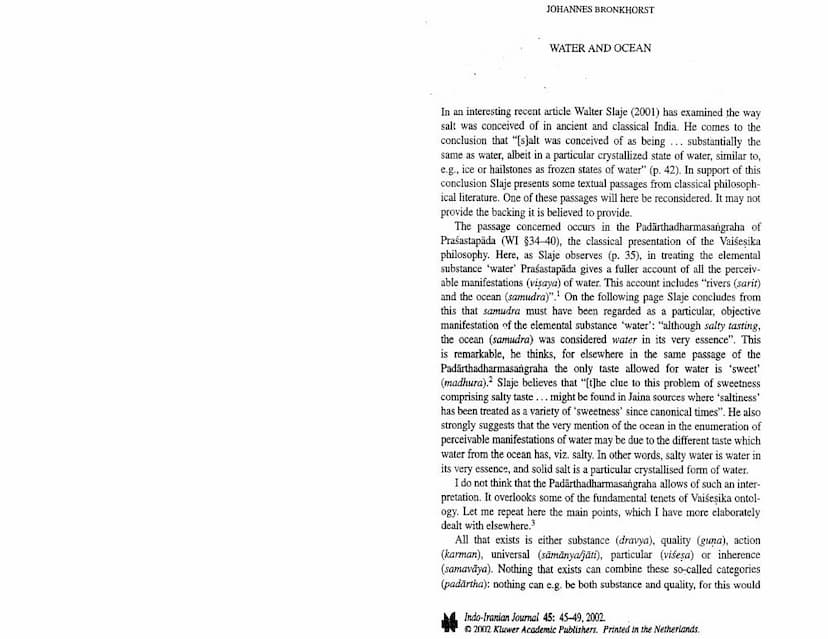
Here's a comprehensive summary of Johannes Bronkhorst's article "Water and Ocean," focusing on its analysis of the Vaiśeṣika philosophy's ontological categorization:
Core Argument:
Johannes Bronkhorst's article challenges Walter Slaje's interpretation of classical Indian philosophical texts, specifically the Padārthadharmasangraha of Prasastapāda (a foundational text of Vaiśeṣika philosophy). Slaje suggested that the inclusion of the ocean (samudra) among the manifestations of water in this text implied a view where saltiness was considered a variation of sweetness, and that the ocean was essentially water, albeit in a particular (salty) state. Bronkhorst argues that this interpretation misunderstands the fundamental tenets of Vaiśeṣika ontology, particularly its strict categorization and the concept of "mixture of universals" (jatisamkara).
Key Vaiśeṣika Ontological Principles Explained:
Bronkhorst reiterates the core principles of Vaiśeṣika philosophy relevant to his argument:
- Categories (Padārtha): Reality is divided into distinct categories: substance (dravya), quality (guna), action (karman), universal (sāmānya/jāti), particular (viśeṣa), and inherence (samavāya). Critically, nothing can belong to more than one category simultaneously.
- Substance (Dravya) and its Subdivisions: Substances are further subdivided, with the five elements (earth, water, fire, wind, ether) being the most fundamental. An entity can only be one of these elements; it cannot be both earth and water, for instance.
- Prohibition of Jatisamkara: This is a crucial concept. It means that at any level of classification, an entity cannot be simultaneously classified under different universals. For example, a specific tree cannot be both a "Simśapā tree" and a "Palasa tree." This prohibition applies to all aspects of categorization.
- The Problem of Composite Objects: This strict categorization raises a question about how to classify objects that, in our everyday understanding, are clearly composed of multiple elements (e.g., a human body made of earth and water).
- Vaiśeṣika's Solution: Contact (Samyoga): The Vaiśeṣika solution is that such composite objects are fundamentally classified as one primary substance, with the other components being merely in contact (samyoga) with it, not inherent (samavāya) in it. For example, a body is considered primarily earth, and water or other substances are in contact with it. This applies even to organs.
- Prasastapāda's Use of Language: Bronkhorst emphasizes that for Vaiśeṣika thinkers like Prasastapāda, the existence and classification of things are often directly informed by the existence of words for them in Sanskrit. If there's a word for something, it's considered to exist and needs to be categorized.
Re-interpreting the Ocean and Saltiness:
Applying these principles, Bronkhorst re-examines the passage concerning water and the ocean:
- The Ocean as Water: The ocean is recognized as a substance because there is a word for it. The most fitting substance category is water.
- The Taste of Water and the Ocean: According to Vaiśeṣika, water has a single taste: "sweet" (madhura). The ocean, however, is salty (lavana). This presents a seeming contradiction within the Vaiśeṣika framework if the ocean is purely water.
- Bronkhorst's Explanation (Vaiśeṣika Style): The salty taste of the ocean is not a fundamental characteristic of the essence of water in Vaiśeṣika. Instead, it's explained by the contact of the ocean (as water) with earth that possesses the salty taste. Even though the ocean is essentially water, it is in contact with a form of earth that has saltiness. Therefore, the salty taste "does not strictly belong to the ocean" itself, but rather to the earth in contact with it, analogous to how gold (classified as fire) has a cool touch due to contact with earth.
- Why the Ocean is Mentioned with Water: The mention of the ocean as a manifestation of water is simply because there is a common noun "ocean" denoting something that is, at its essence, water, even if it has qualities derived from contact with other substances. It's a linguistic classification driving the ontological one.
Conclusion:
Bronkhorst concludes that Slaje's interpretation, while acknowledging the textual evidence, fails to adhere to the strict internal logic of Vaiśeṣika philosophy. While it might be true that some ancient Indians viewed salt as essentially water, Prasastapāda, within the framework of the Padārthadharmasangraha, did not hold this view for the ocean. His categorization is based on a system that prioritizes distinct categories and explains perceived composite qualities through the concept of contact with other substances, rather than a blurring of essential natures. The article highlights the importance of understanding the systematic possibilities within philosophical texts before resorting to explanations based on presumed traditional beliefs.