
Vyaktitva Ke Samgra Vikas Ki Disha Me Jain Shiksha Pranali Ki Upayogita
Added to library: September 2, 2025
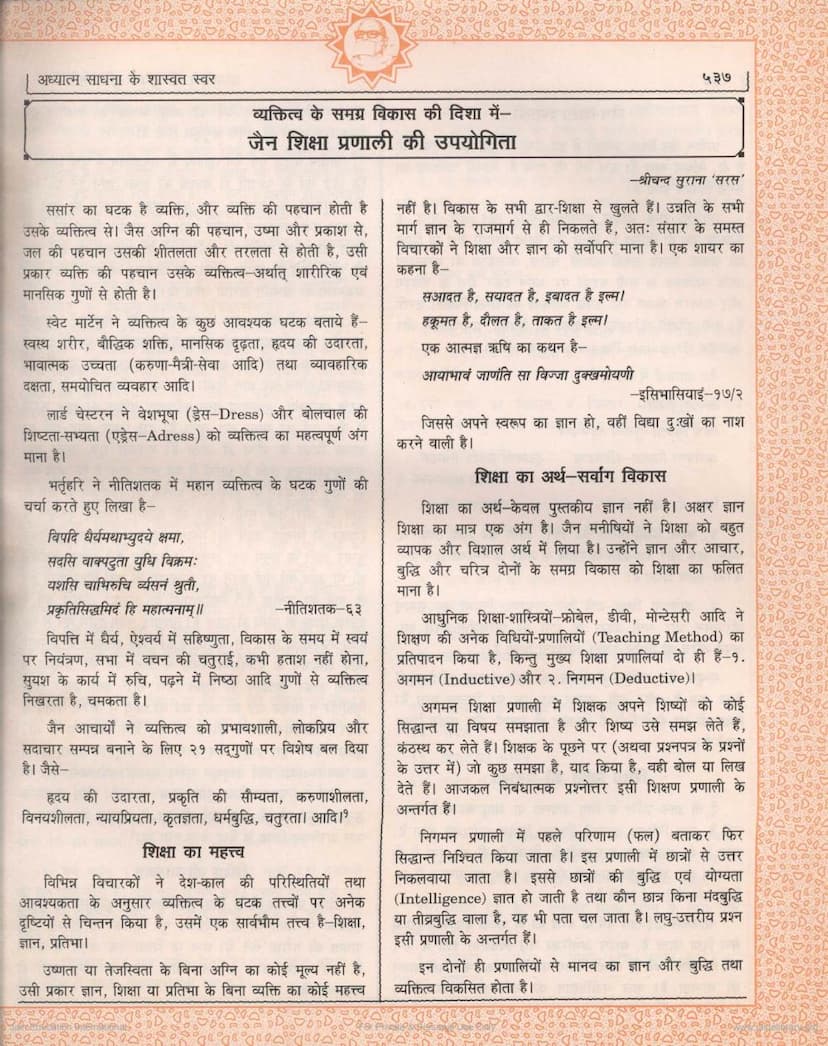
Summary
Here's a comprehensive summary of the provided Jain text, "Vyaktitva ke Samgra Vikas ki Disha me Jain Shiksha Pranali ki Upayogita" (The Utility of the Jain Education System in the Direction of Holistic Personality Development) by Shreechand Surana, in English:
This text, authored by Shreechand Surana, explores the profound utility of the Jain education system in achieving the holistic development of an individual's personality. It emphasizes that a person is identified by their personality, just as fire is known by its heat and light, and water by its coolness and fluidity. True education, according to Jain philosophy, goes beyond mere bookish knowledge and encompasses the development of both knowledge (Gyan) and conduct (Achar), intellect (Buddhi) and character (Charitra).
The author begins by highlighting various thinkers' perspectives on the essential components of personality.
- Modern Educationists: Mentioned are Froebel, Dewey, and Montessori, who proposed various teaching methods, broadly categorized into Inductive (Agman) and Deductive (Nigaman).
- Inductive: Where a teacher explains a principle, and students grasp and reproduce it.
- Deductive: Where the outcome is presented first, and then the principle is explained, allowing for student-driven understanding and assessment of their intelligence.
- Jain Acaryas: They identified specific qualities that contribute to a strong personality, citing 21 virtues like generosity, gentleness, compassion, humility, justice, gratitude, religious inclination, and shrewdness.
- Western Thinkers:
- William James: Noted qualities like a healthy body, intellectual power, mental fortitude, generosity of heart, emotional elevation (compassion, friendship, service), and practical efficiency.
- Lord Chesterfield: Emphasized dress (address) and speech etiquette (address) as crucial aspects of personality.
- Bhartrihari: In his Nitishatak, described qualities like patience in adversity, tolerance in prosperity, self-control in development, eloquence in assemblies, courage in battle, interest in success, and dedication to learning as contributing to a great personality.
The text then delves into the importance of education, stating that it is a universal element acknowledged by thinkers across different eras. Without knowledge and education, an individual has no value.
Age of Education and Eligibility:
- Ancient Jain Practices: The tradition of imparting literacy began after the Mundan Sanskar (hair-cutting ceremony), typically around the fifth year. The Raghuvansha and Kautiliya Arthashastra support this practice. The learning process involved mastering the alphabet, then numbers, and subsequently mathematics, often taking three years.
- Lord Rishabhdev: The text references Lord Rishabhdev, who is said to have taught his eldest daughter Brahmī the alphabet and his other daughter Sundari arithmetic.
- Ideal Age: Jain Acharyas like Jinacharya and Hemachandracharya suggest that by the age of eight, a child becomes ready for education. Historical examples like Mahabal Kumar, Meghkumar, and Aniyas Kumar undergoing education in Gurukulas are cited. Even Lord Mahavir was sent for his initial education at the age of eight.
- Eligibility: Before admission, a guru would assess the student's aptitude and suitability. Education is compared to nectar, which can only be absorbed by a worthy recipient. Factors like disposition, modesty, peace, and simplicity are considered essential.
Two Types of Education (Sikkha Dviha): The text highlights two main categories of education as described in Jain scriptures:
- Grahan Siksha: This involves acquiring knowledge of scriptures, correct pronunciation, reading, understanding the meaning of words in the context of time and place.
- Asevana Siksha: This pertains to the practical application of knowledge, adherence to vows and principles, and maintaining a pure character by avoiding faults.
Qualities of an Ideal Student: The Jain system emphasizes several qualities for a student to be eligible for education and to benefit from it:
- Austerity and Restraint: Avoidance of vices, sensory indulgence, and control over desires.
- Eight Essential Qualities: According to the Sthananga Sutra, a student should be:
- Vinit: Modest and obedient.
- Vikruti-Apratibaddh: Speech-restrained and disciplined.
- Vyashamit: Of a calm and composed disposition.
- Amayavi: Simple-hearted and free from deceit.
- Fifteen Criteria for Eligibility (by Acharya Jinacharya): These include curiosity, faith, humility, willingness to listen and serve, attentiveness, retention capacity, memory, reasoning ability, critical thinking, decision-making, self-control, absence of negligence, innate talent, and perseverance.
- Ineligibilities: The text also lists factors that prevent a person from receiving education, such as ego, anger, negligence (sleep, addiction), illness, and laziness.
Importance of Vinaya (Modesty/Discipline):
- Foundation of Education: Vinaya (modesty, respect, discipline) is considered paramount in the Jain education system. Only a modest student can receive knowledge from teachers, and their learning becomes fruitful.
- Guru-Shishya Relationship: The text stresses the importance of a respectful and devoted relationship between the guru and the shishya (student). The student should follow the guru's teachings, understand their intentions, and approach them with humility.
- Behavioral Etiquette: Detailed guidelines are provided on how a student should behave around their guru, including not speaking out of turn, sitting respectfully, and not touching the guru. The exemplary conduct of Gandhar Gautam is cited as an ideal.
- Four Characteristics of Vinaya: Rising when the guru arrives, joining hands, offering a seat, and showing devotion and attentive service.
Questioning and Gratitude:
- Method of Asking Questions: Students are advised to ask questions respectfully, standing up with folded hands from their seats, not while lying down or sitting casually.
- Gratitude: The text emphasizes the importance of expressing gratitude to the guru after receiving knowledge.
- Student's Objectives: A student should approach learning with specific noble aims: to gain self-knowledge, to calm the mind, to establish oneself in righteousness, to help others achieve righteousness, and to understand the true nature of reality.
Holistic Education:
- Beyond Academics: Jain education was not limited to spiritual knowledge but also included practical arts and sciences like textile manufacturing, architecture, agriculture, music, politics, drama, wrestling, and even arts of pleasure. The goal was to equip students for a respectable livelihood and contribution to society.
- Contrast with Modern Education: The text contrasts the holistic approach of ancient Jain education with modern education, which it deems largely focused on degree attainment and employment. The primary objective of ancient education was the balanced and all-round development of the student's personality, not just vocational training.
- Self-Realization: The ultimate purpose of education is also seen as self-realization and attaining peace of mind, which cannot be achieved by material possessions alone.
Conclusion: The author concludes that ancient Indian, and particularly Jain, education systems were designed for the multifaceted development of personality. The text highlights that the strengths of this ancient system, which were suited to the Indian climate and psyche, need to be studied and adapted for today's educational paradigms. By developing the individual's personality, society as a whole progresses. The teacher is likened to a sculptor who awakens the dormant potential within the student, making them radiant and powerful. The text implicitly calls for a re-evaluation and integration of these timeless principles into contemporary education.