
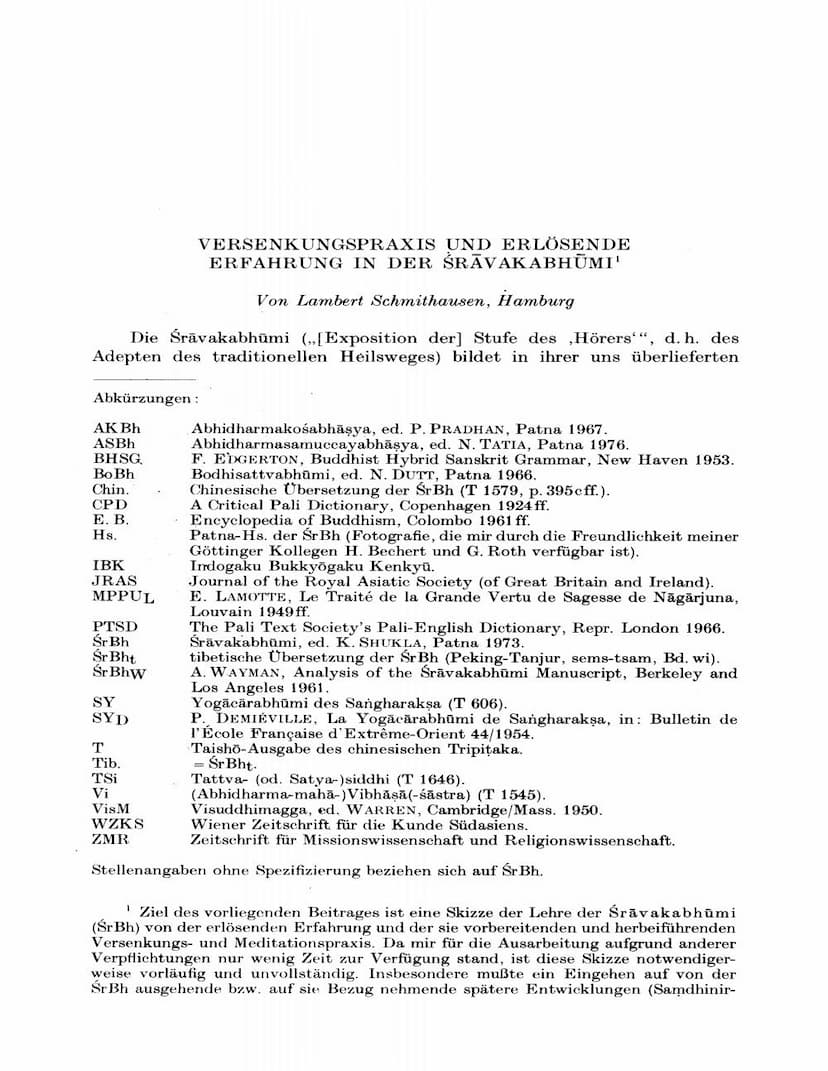
Versenkungspraxis Und Erlosende Erfahrung In Der Sravakabhumi
Added to library: September 2, 2025
Summary
This document is an excerpt from Lambert Schmithausen's scholarly work titled "Versenkungspraxis Und Erlosende Erfahrung In Der Sravakabhumi" (Contemplative Practice and Liberating Experience in the Sravakabhumi). The Sravakabhumi, meaning "Exposition of the Stage of the Hearer," is a significant chapter within the larger Yogacarabhumi text, attributed to the Mahayana master Asanga.
Schmithausen's article aims to outline the Sravakabhumi's teachings on liberating experience and the contemplative and meditative practices that lead to it. He acknowledges the preliminary and incomplete nature of his sketch due to time constraints, noting that further developments and complex interpretative issues within the Sravakabhumi itself remain to be fully explored.
The author highlights a key tension within the Yogacarabhumi, which presents two distinct views of liberating experience:
- Traditional/Hinayana View: Liberating experience is attained through successive, accurate insight into the Four Noble Truths.
- Mahayana View: Liberating experience is the direct apprehension of an inexpressible, unified true essence (tathata) of all phenomena.
The Sravakabhumi, as a text dedicated to traditional, Hinayana-oriented spirituality, naturally emphasizes the former. However, Schmithausen points out that the text is not entirely straightforward, containing elements that raise further questions. He notes discrepancies between the detailed descriptions of the path to liberation in later books of the Sravakabhumi and the theories presented in its second book, which posit a unified structure for all contemplative and meditative practices.
Schmithausen then outlines the contemplative and meditative practices discussed in the Sravakabhumi, categorizing them into three main complexes:
-
Five Preparatory Exercises: These exercises are designed to combat specific personality flaws. For example:
- Raga (lust/desire): Practice of the "repulsive" (aśubhā), meditating on the impurity of the body or decaying corpses.
- Dvesha (hatred/aversion): Practice of "friendliness" (maitrī).
- Moha (delusion/misorientation): Contemplation of "dependent origination" (pratītyasamutpāda).
- Pride: Analytical breakdown of elements (dhātuprabheda).
- Excessive mental wandering (vitarka): Mindfulness of breathing (ānāpānasmṛti).
These exercises also serve to induce a state of mental collection (cittaikāgratā) or concentration (manaskāra). The text explains that these practices, while historically independent, follow a similar pattern. Schmithausen focuses on the "practice of the repulsive" as a detailed example. This practice involves:
- Preparation: Imprinting characteristic marks (nimitta) of the object of meditation (e.g., a decaying corpse).
- Attaining Calm (samatha): Focusing on non-distraction (avikṣepa) without a specific object. This state is described as objectless, free from conceptual activity (nirvikalpa), peaceful, and joyful.
- Transition to Insight (vipaśyanā): Shifting from the undifferentiated state of calm to an object with specific characteristics (savikalpam ālambanam), such as the repulsive image of a corpse, through deliberate visualization (adhimuc-). This "contemplation" is initially described as merely following the image (nimittamātraanusārin).
Schmithausen delves into the nuances of these practices, discussing techniques for achieving clarity in visualization, such as the repeated "erasure" (vibhāvanā) and reproduction of mental images. He also explores the concept of "extending" (vaddhana) the meditative object, a practice seen in Kasina exercises and potentially relevant to the Sravakabhumi's corpse contemplation.
A key point of discussion is the ultimate culmination of the "practice of the repulsive." Some passages suggest a progression beyond visualization to a direct, "supernormal" perception of the actual object. Schmithausen questions the necessity and logic of this in the context of corpse contemplation, which is already observable in reality. He speculates on possible reasons for this, including the dangerous nature of charnel grounds, changes in burial customs, or the need to train a "supernormal" perception faculty. He also considers the possibility that this focus on direct perception might be an analogical or mechanical inclusion from the "supramundane path."
-
The "Worldly Path" (laukiko mārgaḥ): This path involves detaching oneself from a particular level of existence by understanding its coarseness (audārika) in comparison to the next higher level. For instance, the realm of desire (kāmadhātu) is considered coarser than the first dhyāna (concentration) in the realm of form (rūpadhātu). The text addresses the dilemma of needing to be free from lower-realm defilements to enter higher states. It suggests that gaining insight into this coarseness and the peacefulness of higher realms is possible before physically entering them, through contemplation and meditation on these characteristics. However, the detailed description of the "worldly path" in Book 4 of the Sravakabhumi does not explicitly mention direct perception as the outcome, but rather the arising of a path (mārga) that leads to the elimination of defilements. The worldly path offers only temporary freedom from defilements, not the eradication of their root causes (bija).
-
The "Supramundane Path" (lokottaro mārgaḥ): This path can be pursued either after the "dhyanas" (worldly path) or directly from the concentration achieved through preparatory exercises. Its object is the Four Noble Truths. The text emphasizes the insight into the truth of suffering (duḥkha) as paramount, leading to an initial certainty about impermanence, suffering, and non-self. This insight is then to be deepened through meditation.
A crucial point here is the role of the "self-view" (asmimāna) that can arise during meditative contemplation, leading to emotional resistance towards Nirvana. The Sravakabhumi proposes a method of self-observation, making the meditative acts themselves objects of contemplation, recognizing their impermanence and lack of self. This leads to a state where subject and object are equal (samasamālambyālambaka).
The text then describes a state of profound mental calm (samatha), free from all activity (anabhisamskāra) and conceptualization (nirvikalpa), where the mind appears to have ceased to exist but hasn't. This state is described with rich, comparative language and seems to allude to a direct experience.
Immediately after emerging from this state, the practitioner directs attention back to the Four Noble Truths and achieves the first "supramundane insight," characterized as a definitive and direct realization of these truths, even those usually beyond normal perception (like those of higher realms). This insight is also called "nirvikalpa."
Schmithausen notes that the use of "nirvikalpa" for the Hinayana liberating experience is noteworthy, as it later becomes a technical term for the Mahayana experience. He suggests that the Sravakabhumi might be incorporating Mahayana concepts inclusively, positioning this state of deep mental calm as a precursor, rather than the ultimate liberating experience itself.
He speculates that this profound calm, described with vivid language, represents an actual, living experience. The article concludes by noting the similarities between this state and descriptions found in contemporary Theravada Buddhism, suggesting a shared experiential basis that different traditions interpret differently. The Sravakabhumi, in this view, might be downplaying the transcendental aspect of this experience, while Mahayana texts might be overemphasizing it. This leads to a contemplation of the fundamental problem of interpreting the metaphysical claims of mystical experience, a problem that remains even with the subjective conviction of the experiencer.