
Vakrokti Jivita Of Kuntaka
Added to library: September 2, 2025
Summary
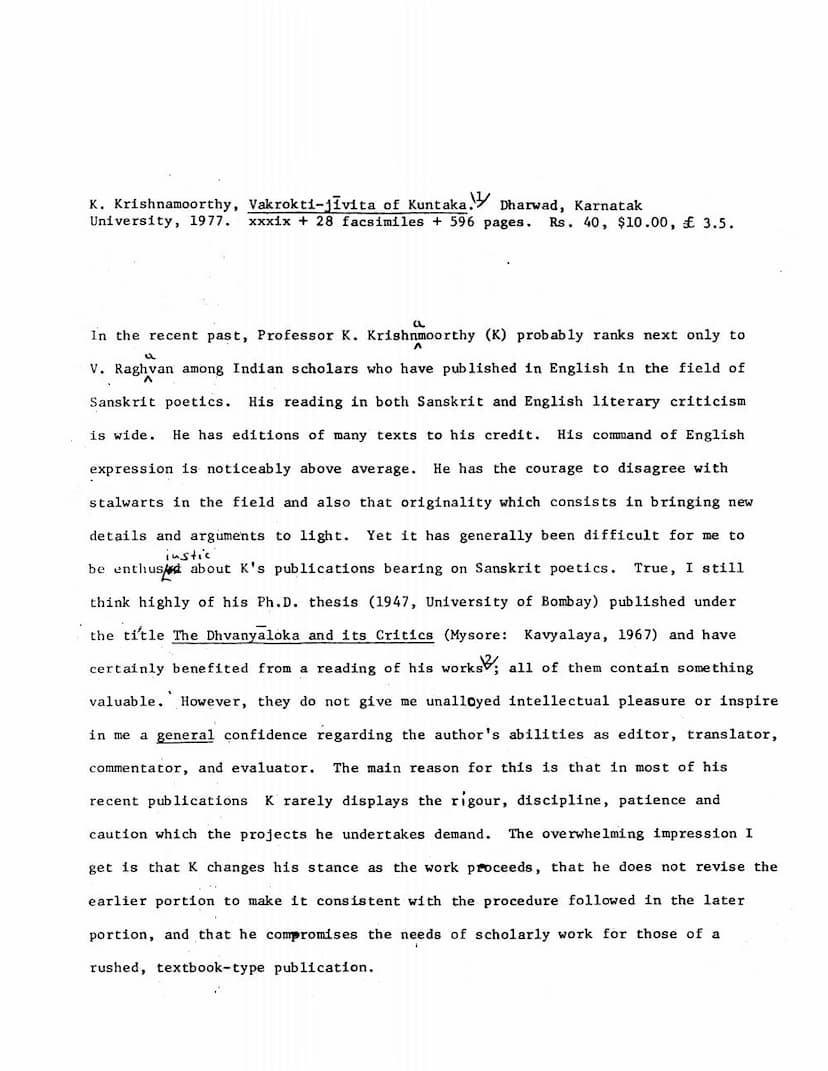
Here's a comprehensive summary of the provided text, focusing on the review of K. Krishnamoorthy's edition of Kuntaka's Vakrokti-jivita:
Overall Assessment:
The review, written by Ashok Aklujkar, is overwhelmingly critical of K. Krishnamoorthy's (K) edition of Kuntaka's Vakrokti-jivita (VJ). While acknowledging K's extensive reading and courage to disagree with established scholars, Aklujkar finds K's work lacking in scholarly rigor, discipline, patience, and caution. The reviewer concludes that K's edition is far from definitive or reliable and that a more rigorous new edition is urgently needed for progress in Kuntaka studies.
Key Criticisms of K's Edition:
-
Methodological Deficiencies in Textual Criticism:
- Inadequate Use of Manuscript Material: K failed to acquire photocopies of previously known Jaisalmer manuscripts and the Madras transcript, opting instead to work with transcripts of transcripts. He also did not establish the relationship between the newly discovered Jaisalmer leaves and the older manuscript material.
- Lack of Critical Apparatus: The edition does not establish objective criteria for accepting or rejecting readings, nor does it clearly describe the text sources. Aklujkar had to piece together disjointed statements to understand K's sources.
- Unsatisfactory Recording of Variants: K mechanically relegates De's readings to footnotes in the initial portion, making the text problematic and inconsistent with his translation. In the latter part, he inconsistently refers to manuscripts and uses parentheses without clear explanation.
- Weak Definition of "Critical Edition": Aklujkar suggests K uses a "weaker" definition of a critical edition, where simply basing it on more than one manuscript and reporting some variants suffices, rather than establishing objective grounds for readings.
- Burden Shifted to the Reader: K's lack of guidance and inconsistent annotation forces the reader to undertake significant comparative work or risk being misled.
-
Issues with the Textual Presentation:
- Inconsistent Handling of De's Edition: K's practice of relegating De's readings to footnotes in the first part and then largely abandoning this in the résumé portion is criticized.
- Mysterious Omissions and Additions: K's text includes unexplained omissions of passages found in De's edition and inexplicably adds sentences or phrases without explanation or clear sourcing.
- Misplaced or Incorrectly Sequenced Material: K did not recognize issues with the sequencing of manuscript leaves, leading to interrupted discussions and irrelevant content.
- Misidentification of Quotations and Definitions: K misidentifies quotations and misses obvious textual markers for definitions.
- Haphazard Tracing of Quotations: While K deserves credit for tracing some sources, his approach is haphazard, missing important connections and providing less informative notes than De in some instances.
-
Problems with the Translation:
- Inconsistent Literalness and Freedom: The translation is sometimes literal and sometimes free, aiming for literary effect over faithfulness.
- Disregard for Textual Problems: The translation proceeds as if there are no interpretive issues, lacking uncertainty indicators or explanatory notes for complex ideas.
- Inaccuracies and Misinterpretations: The translation includes inaccuracies, such as the omission of "Or" and a failure to distinguish between "sabda" (word) and "quality." It also presupposes readings not always found in K's constituted text.
-
Uncertainty Regarding the Work's Extent:
- Aklujkar criticizes both K and De for not adequately investigating the original extent of the VJ based on internal references and cross-references within the text. K's arguments for the work being nearly complete are found unconvincing.
Positive Aspects Acknowledged (though overshadowed by criticism):
- Availability of Preserved Text: K's edition makes the available text of the VJ accessible in its entirety.
- Occasional Improvements: K does provide some improvements and corrected readings compared to De's edition.
- Tracing New Sources: K deserves credit for tracing some sources of Kuntaka's passages and identifying quotations in later works, which is an advance over De.
Conclusion of the Review:
Aklujkar concludes that K's edition is not definitive or reliable, highlighting the need for a rigorously executed new edition. He expresses a desire that K's work does not lead to complacency among Sanskrit poetics specialists, emphasizing that Kuntaka's work requires further and more accurate scholarly engagement. The reviewer also provides a list of manuscripts and transcripts related to the VJ to aid future editors.