
Vaisesika Vakya And Bhasya
Added to library: September 2, 2025
Summary
Here's a comprehensive summary of the provided text, "The Vaišeșika Vākya and Bhāṣya" by Johannes Bronkhorst:
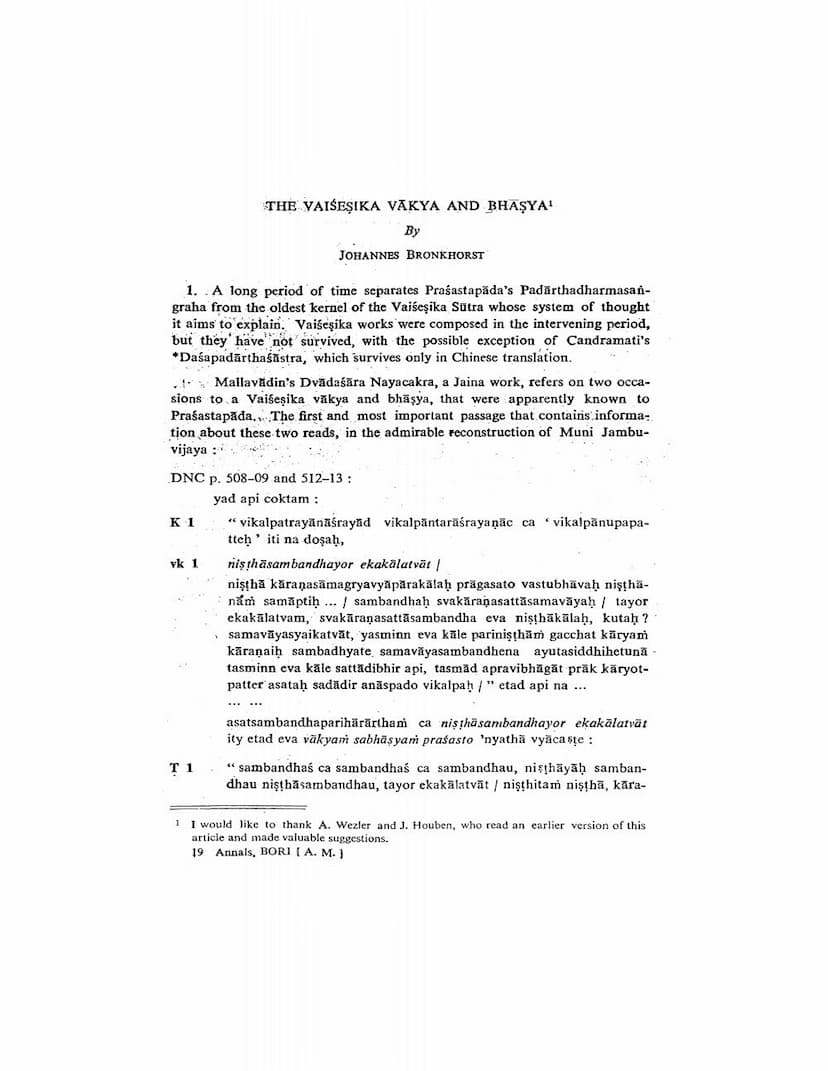
The article investigates the existence and nature of early Vaišeșika philosophical texts, particularly a Vākya (short aphorism) and its accompanying Bhāṣya (commentary) that were known to Mallavadin and Prasastapāda, the author of the Padārthadharmasangraha.
Key Discoveries and Arguments:
-
Mallavadin's Testimony: The primary evidence for the Vākya and Bhāṣya comes from Mallavadin's Jaina work, the Dvādaśāra Nayacakra. Mallavadin refers to these texts on at least two occasions, providing quotes and discussions of their content.
-
Prasastapāda's Role: The author argues that Prasastapāda (also referred to as Prasastamati) is the commentator on this Vākya-cum-Bhāṣya. Prasastapāda apparently reinterpreted the original Vākya and Bhāṣya, aiming to show the compatibility of his interpretations with the earlier material.
-
Nature of the Vākya and Bhāṣya:
- The Vākya itself is described as a short, nominal sentence.
- The Bhāṣya provided an explanation of these Vākyas in standard Sanskrit.
- This style, where short aphorisms (Vākyas) are explained, is compared to the "Vārtika-style," which was prevalent around the middle of the first millennium CE and influenced by Patañjali's Mahābhāṣya.
-
Identification of the "Kaṭandi": A significant portion of the article is dedicated to identifying the Vākya-cum-Bhāṣya. Bronkhorst proposes that this work is identical to the Kaṭandi. Evidence for this includes:
- Simhasūri, Mallavadin's commentator, mentions the Kaṭandi and a Ṭīkā (likely Prasastapāda's commentary) together, suggesting the Ṭīkā is a commentary on the Kaṭandi.
- The arguments and topics discussed in passages attributed to the Kaṭandi by Simhasūri directly correspond to the Vākya-cum-Bhāṣya discussed by Mallavadin.
- The Kaṭandi is described as being written in the Vārtika-style, consistent with the Vākya-cum-Bhāṣya.
-
Prasastapāda's Ṭīkā on the Kaṭandi: The author shows that Prasastapāda wrote a Ṭīkā (commentary) on the Kaṭandi. This commentary is now lost, but references to it are found in Mallavadin's work. These references reveal that Prasastapāda's Ṭīkā also contained Vākyas, though perhaps not in the consistent Vārtika-style.
-
Influence on the Padārthadharmasangraha: Bronkhorst argues that the Kaṭandi profoundly influenced Prasastapāda's surviving work, the Padārthadharmasangraha. This is supported by:
- The fact that Prasastapāda commented on the Kaṭandi.
- The presence of passages in the Padārthadharmasangraha that exhibit the Vārtika-style and appear to be direct quotations from the Kaṭandi.
- One instance where a Vākya from another text was quoted by Prasastapāda and placed in the Padārthadharmasangraha without its original context, suggesting borrowing from the Kaṭandi.
-
Dating the Kaṭandi and its Influences:
- The Kaṭandi's logical framework appears to be influenced by Buddhist logicians, likely Vasubandhu, but predates Dignāga's Pramāṇasamuccaya.
- The Kaṭandi likely borrowed logical concepts from Buddhist texts and integrated them into the Vaišeșika system, sometimes by reinterpreting or equating them with existing Vaišeșika terms.
-
Dignāga's Knowledge of the Kaṭandi: There is evidence suggesting that the Buddhist logician Dignāga knew and reacted to the Kaṭandi. This is seen in Dignāga's criticism of certain Vaišeșika logical positions that are also found in the Kaṭandi.
-
The Vaiśesika Sūtra and the Kaṭandi: The article also explores the possibility that the surviving versions of the Vaiśesika Sūtra itself might have been "extracted" from the Kaṭandi. The division of the Sūtra into āhnikas (sections, similar to the Mahābhāṣya) and the presence of a longer "sūtra" (VS 1.1.4) not found in all versions are presented as potential evidence for this.
-
The Identity of Rāvaṇa: The author touches upon the possibility that Rāvaṇa, a figure sometimes credited with a Vaišeșika Bhāṣya, might be the author of the Kaṭandi.
In summary, Bronkhorst's article reconstructs the history of early Vaišeșika texts, establishing the existence of a significant Vākya-cum-Bhāṣya, likely known as the Kaṭandi. This work, written in the Vārtika-style, served as a crucial source for Prasastapāda's Padārthadharmasangraha and also influenced later Buddhist thinkers like Dignāga. The research highlights the interconnectedness of philosophical traditions and the complex process of textual transmission and influence in ancient India.