
Uber Den Sakramentalen Charakter Des Dharma Nachinnend
Added to library: September 2, 2025
Summary
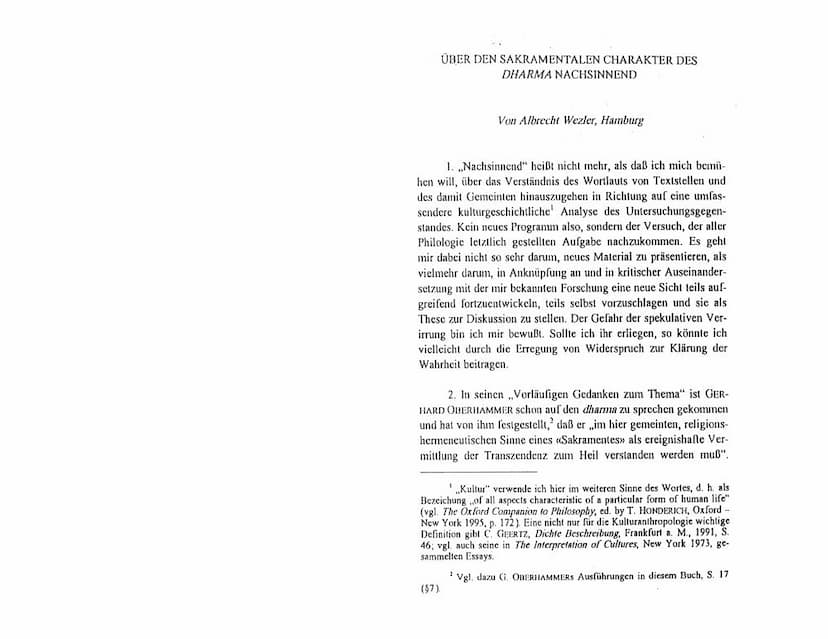
Here's a comprehensive summary of Albrecht Wetzler's text "Über den Sakramentalen Charakter Des Dharma Nachinnend" (On the Sacramental Character of Dharma, Reflectively), based on the provided pages:
The article, authored by Albrecht Wetzler, delves into the multifaceted concept of dharma within Hinduism, aiming for a broader cultural-historical analysis beyond mere textual interpretation. Wetzler sets out to critically engage with existing scholarship and propose new perspectives on the nature of dharma, acknowledging the potential for speculative interpretations.
Core Argument and Distinction of Dharmas:
Wetzler's central thesis revolves around a crucial distinction he makes between two primary understandings of dharma in ancient Indian texts:
- Vedische Dharma: This refers to the dharma as understood in the Vedic tradition, primarily associated with the performance of ritualistic prescriptions found in the Vedas, especially the elaborate Srauta sacrifices.
- Dharmaśāstra Dharma (also referred to as Varnaśrama-dharma): This is the dharma as articulated in the Dharmaśāstras, encompassing moral, social, legal, and customary norms that govern the conduct of individuals based on their caste (varṇa) and stage of life (āśrama).
Wetzler questions whether these are merely different aspects of a single, unified concept of dharma or if they represent distinct historical strands of ancient Indian culture that were later conflated. He argues that the emphasis on ritual in the Vedic tradition, and the emphasis on custom and social norms in the Dharmaśāstras, are fundamentally different. While Vedic texts mention social customs, their primary focus is ritual, whereas Dharmaśāstras contain few direct instructions for Srauta rituals, instead focusing on domestic rituals (Gṛhya) and other societal regulations.
Critique of Existing Scholarship (Hacker):
Wetzler engages with the work of P. Hacker, particularly his influential essay "Dharma im Hinduismus." While acknowledging Hacker's focus on the Vedic tradition's relationship to dharma and the "transcendental salvation" derived from it, Wetzler points out that Hacker's definition of dharma as "execution of the ritual prescriptions revealed in the Veda" seems to focus solely on the Mīmāṃsā interpretation and the concept of codanalakṣaṇo 'rthaḥ (something useful characterized by Vedic injunctions).
Wetzler finds Hacker's characterization of Hindu dharma as "radically empirical" problematic because it overlooks the transcendental dimension of the Veda for its adherents and fails to adequately differentiate between explicit textual injunctions and the adoption of exemplary behavior. He argues that Hacker's reliance on the "consensus of the good" as a source of dharma requires further nuance.
The Role of Custom (Ācāra) and Tradition (Smṛti):
A significant portion of the article explores the concept of ācāra (customary practice, conduct) and smṛti (tradition, memory) as sources of dharma. Wetzler highlights that the Dharmaśāstras themselves recognize custom as a primary source, leading to a potential "paradigm shift" in Indology. He cites scholars like R. Lariviere, J. Duncan M. Derrett, and P. V. Kane, who emphasize the role of custom and social norms in shaping the Dharmaśāstra literature.
Wetzler discusses the linguistic nuances of terms like smṛti, suggesting it originally referred to specific familial or clan-related memories and traditions, distinct from śruti (what is heard, revelation). He argues that ācāra is not just "good conduct" but also "traditional usage," and that the Dharmaśāstras codify these existing customs. He challenges the idea that these texts are merely creating new laws, suggesting they are primarily recording and systematizing pre-existing practices.
"Vedization" and "Brahmanization" of Dharma:
Wetzler posits that a key process in the development of the Dharmaśāstra dharma was "Vedization," which he defines as the development of the idea of vedamūlatva (the Veda as the root of dharma). He argues that the Dharmaśāstras' claim of the Veda as the source of dharma is not an explanation of historical origin but a legitimization of their teachings. He observes that this concept is sometimes presented as a metaphor for "cause" or "source of knowledge."
Furthermore, he introduces the concept of "Brahmanization," which involves the Brahmanical elite restricting the sources of dharma to those who know the Veda, thereby emphasizing their own exclusive role. Wetzler contends that the emphasis on ācāra in the Dharmaśāstras, particularly in contrast to the Vedic ritual, signifies a shift in how salvation (mokṣa) could be attained. This shift democratized access to spiritual merit by making it attainable through everyday conduct rather than exclusive ritual performances, which were often expensive and accessible only to the wealthy.
Sacramentalization of Dharma:
Wetzler connects this shift to the "sacramentalization" of dharma. He argues that the idea of dharma within the Dharmaśāstras, like the Vedic sacrifices, came to be understood as having the power to bring about salvation. The performance of dharma according to these texts is presented as a way to achieve spiritual advancement and heavenly bliss, irrespective of visible motives. This "dharma-piety" or "dharmism" represents a reorientation of religious practice.
Motivations and Conclusion:
Wetzler suggests that the Brahmanical elite's motivations for this "Vedization" and "sacramentalization" included securing their own social and economic position, especially in the face of the decline of Vedic sacrificial practices and the rise of alternative religious movements like Buddhism. He posits that the Brahmanas sought to integrate customs into the Vedic worldview to maintain their authority and influence.
Ultimately, Wetzler concludes that the dharma discussed in the Dharmaśāstras is fundamentally different from the dharma of the Vedas. While the latter focuses on ritual, the former emphasizes custom, morality, and social conduct. The Dharmaśāstras are seen as a codification of existing traditions and practices, a process driven by Brahmanical interests and a desire to legitimize their own authority. The concept of dharma within the Dharmaśāstras, when viewed through this lens, gains a "sacramental" character, promising salvation through adherence to established norms of conduct.