
UBC Indic
Added to library: September 2, 2025
Summary
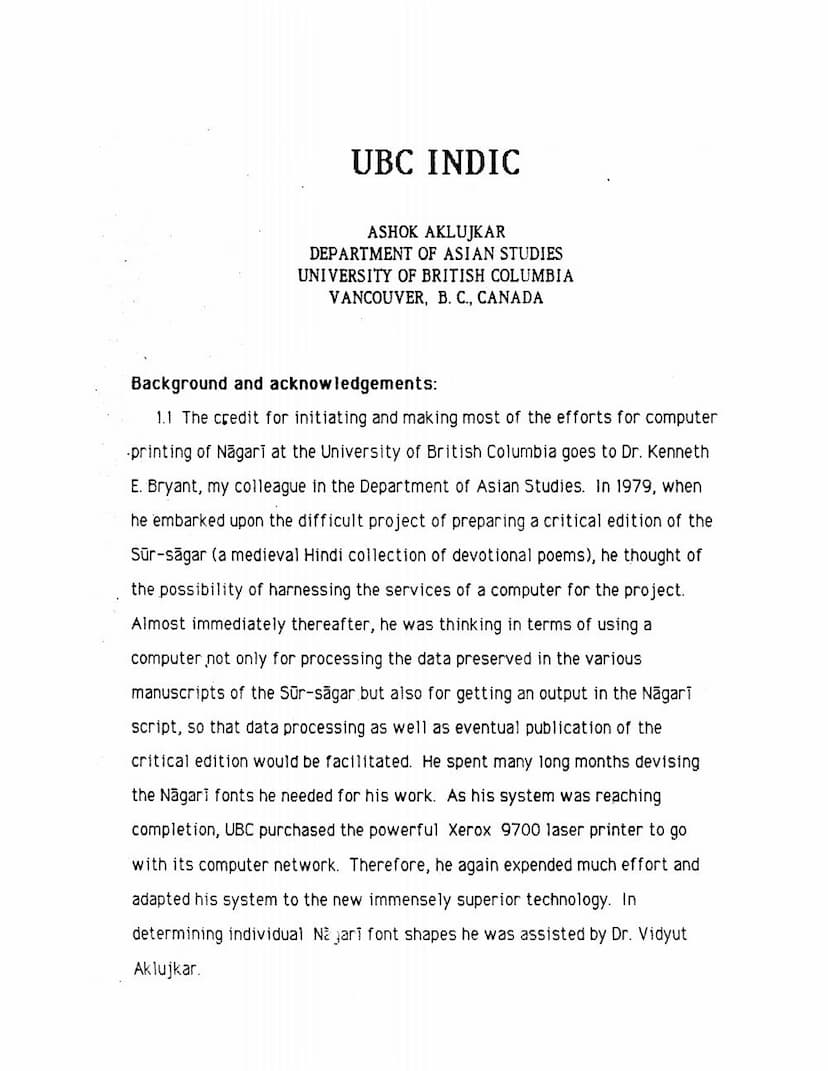
Here's a comprehensive summary of the provided Jain text, "UBC INDIC" by Ashok Aklujkar, focusing on its content and purpose:
UBC INDIC: A System for Indic Language Printing on Macintosh Computers
This document describes the development and features of "UBC Indic," a software system designed to enable the printing of Nāgari script and transliterated Indic languages on Macintosh personal computers. Developed by Ashok Aklujkar at the University of British Columbia (UBC), the project was largely inspired and technically guided by Dr. Kenneth E. Bryant.
Background and Genesis:
- Dr. Bryant's Initiative: The effort began with Dr. Kenneth E. Bryant's need for computer-assisted preparation of a critical edition of the Sūr-sāgar, which required output in the Nāgari script. He was instrumental in developing Nāgari fonts for the Xerox 9700 laser printer.
- Transition to Macintosh: As Macintosh computers became prevalent, the focus shifted to using them for Nāgari printing. Dr. Bryant's expertise facilitated the acquisition of Macintoshes by scholars and an Apple Laser Writer for the Department of Asian Studies.
- Aklujkar's Contribution: Ashok Aklujkar took on the task of adapting existing Nāgari fonts (initially "Kanchi" by Dr. R. Padmanabhan) and developing a "start-up disk" tailored for specialists in Indic languages. His own knowledge of computers was limited, and he received significant assistance from Dr. Bryant, Dr. George L. Hart, and Mr. Hardeep Khabra.
- Integration and Improvement: A key challenge was integrating existing Nāgari fonts (like "Kanchi") with a more intuitive keyboard layout (based on Dr. Bryant's "easy-to-remember" distribution). Aklujkar, with the help of Hardeep Khabra, refined the font shapes and arrangements through numerous revisions, aiming for good Nāgari print quality and addressing specific research needs.
Key Features of UBC Indic:
- Target Audience: Primarily for scholars working with Indian languages (Indologists), but also useful for those who occasionally use Indian words.
- Script Support:
- Nāgari: The primary Indic script supported, designed for Sanskrit, Hindi, and Marathi. The system is adaptable for other Brahmic scripts like Bengali, Gujarati, and Gurmukhi.
- Roman Script: Includes Roman characters with necessary diacritical marks for standard Indic transliterations, as well as accented characters for European languages.
- Urdu/Perso-Arabic: Provisions for transliteration of Urdu words and printing of the "nukta" character.
- Roman Font Adaptations:
- Modified versions of Geneva and New York fonts (sizes 12 and 24) to match the height of Nāgari letters for seamless mixing of scripts.
- Includes essential system fonts like Chicago 12 and Monaco 9.
- Nāgari Font Design Principles:
- Logical Arrangement: Aims for a correlation between Nāgari letters and their standard Roman transliteration equivalents.
- Keyboard Layout:
- Consonants with the inherent "a" are on the first two keyboards.
- Aspiration and long vowels are indicated by capitalization (shift key).
- Half-forms of consonants are placed on the third and fourth keyboards, corresponding to their full forms.
- Vowel signs (non-initial forms) are placed on the first two keyboards based on phonetic lightness/length.
- Conjuncts (consonant clusters) are primarily on the third and fourth keyboards.
- Special characters and diacritical marks are arranged logically on the third and fourth keyboards for ease of access.
- Efficiency and Clarity: Prioritizes preserving essential distinctions and improving typing efficiency. Unnecessary variations in Nāgari printing are streamlined to fit the computer's limitations and modern printing needs.
- Critical Editing Tools: Includes features useful for critical editing, such as various parentheses, raised numbers for footnotes, and specific punctuation marks.
- Numbering Options: Offers flexibility with Nāgari and Arabic numbers, including raised versions for notes, leading to two main versions: "UBC Indic" (Nāgari numbers) and "UBC Indic International" (Arabic numbers).
- Improvements in 1986 Version: The 1986 version of UBC Indic is significantly enhanced over the 1985 version, with improved Roman fonts, additional Nāgari characters (Vedic accent marks, root indicators, etc.), and refined keyboard assignments.
Tips for Better Results:
The document provides specific advice on how to achieve optimal printing results, particularly concerning the placement of top marks, handling of vowel signs, use of accent marks (svarita, anudātta), underlining, and combining characters.
Distribution:
Copies of UBC Indic and UBC Indic International are available for purchase from the author at the University of British Columbia. All proceeds are dedicated to the Community Endowment for South Asian Studies.
In essence, UBC Indic represents a significant effort to bridge the gap between traditional Indic scripts and modern digital publishing, offering a user-friendly and comprehensive solution for scholars and anyone needing to work with these languages on Macintosh computers.