
Two Literary Conventions Of Classical India
Added to library: September 2, 2025
Summary
Here's a comprehensive summary of Johannes Bronkhorst's "Two Literary Conventions of Classical India," based on the provided text:
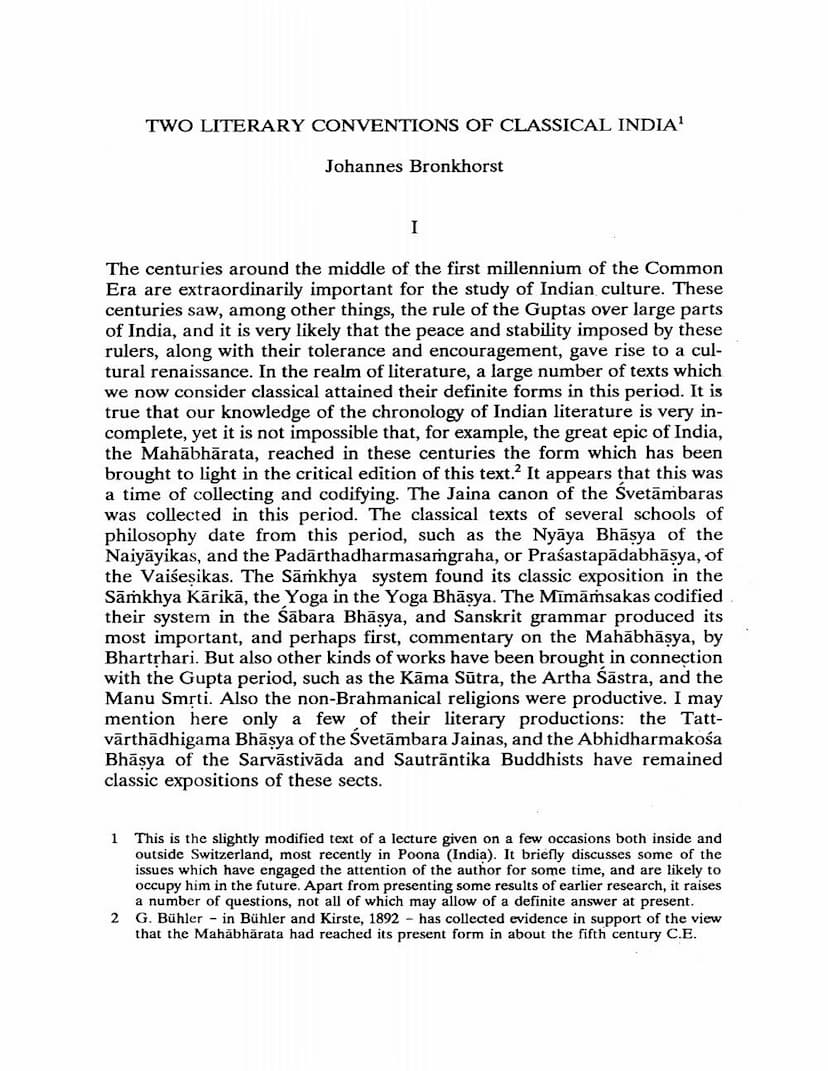
The book explores two significant literary conventions that characterized classical Indian literature, particularly during the centuries around the middle of the first millennium CE, a period of cultural renaissance following the Gupta Empire's stability.
The first convention is the "Bhāṣya style," characterized by the tendency of commentaries (often called bhāṣyas) to absorb the shorter texts (sūtras or verses) they comment upon, creating the impression of a single, unified work.
-
Key Features of the Bhāṣya Style:
- Assimilation: Commentaries aim to integrate the primary text so completely that their original separation and authorship become obscured.
- Single Author Impression: Authors sometimes actively create the impression that the commentary and the text it explains were written by the same person.
- Lack of Variant Readings: Commentaries often do not acknowledge or discuss different versions of the original text.
- First-Person References: In some cases, the commentary uses the first person when referring to the sūtras or verses, implying shared authorship.
- Misinterpretation: The style can lead to misinterpretations of the original text if the commentator was not its author, as evidenced by the Yoga Bhāṣya's treatment of Yoga Sūtra 1.25.
-
Examples Illustrating the Bhāṣya Style:
- Yoga Bhāṣya and Yoga Sūtras: While traditionally attributed to Vyāsa and Patañjali respectively, earlier traditions suggest a single author, Patañjali, for the entire Yogaśāstra. The Bhāṣya's internal references often imply this.
- Tattvārthādhigama Bhāṣya and Tattvārtha Sūtras: The Svetāmbara Jains believe Umāsvāti authored both, though the Digambaras contest this. Similar to the Yoga Bhāṣya, the Tattvārthādhigama Bhāṣya obscures the distinction between the sūtras and the commentary.
- Madhyāntavibhāga Śāstra: In contrast, this Buddhist text refers to its verses (kārikās) in the third person, making the separate authorship clearer. However, it also exhibits syntactic integration of verses into the commentary, blurring boundaries.
- Artha Śāstra: Attributed to Kautilya, this work shows evidence of multiple authors, with earlier verse portions and later prose sections. The concluding lines suggest Visnugupta composed both "Sūtra and Bhāṣya," potentially referring to the compilation of earlier material into a unified śāstra.
The author notes that this "Bhāṣya style" is not necessarily present in all bhāṣyas but is a notable tendency in the period.
The second convention is the "Vārttika style," which emerged from the practice of commenting on grammatical texts, specifically the Pāṇinian tradition.
-
Origin in Grammar: This style originates from the Mahābhāṣya of Patañjali, which itself contains vārttikas (brief nominal phrases) attributed to Kātyāyana.
-
Blurring of Vārttika Authorship: Bronkhorst argues that during the middle of the first millennium CE, the distinction between the vārttikas and Patañjali's bhāṣya became less clear. The term vārttika began to refer to larger portions of the Mahābhāṣya, sometimes even parts without distinct nominal phrases.
-
Imitation of the Mahābhāṣya: This convention led to the imitation of the Mahābhāṣya's structure, where ordinary prose is interspersed with short, explanatory nominal phrases (vākyas).
-
"Vārttika Style" Definition: This is characterized by the alternation of prose passages with short nominal phrases, which are then explained.
-
Examples of the Vārttika Style:
- Commentary on the Mahābhāṣya by Bhartṛhari: Bhartṛhari's commentary on the Mahābhāṣya exhibits this style.
- Yuktidīpikā: A commentary on the Sāṁkhya Kārikā, this work is also identified as having a vārttika component.
- Akalanka's Tattvārtha Vārttika and Rāja Vārttika: These works explicitly adopt the vārttika appellation.
- Nyāya Bhāṣya: This commentary on the Nyāya Sūtras is cited as an example where the vārttika style was already noted.
- Vākyapadīya and its Vrtti: The author argues against the traditional attribution of both to Bhartṛhari, presenting evidence that the Vrtti is a separate commentary, likely exhibiting the bhāṣya style (specifically, not recording variant readings and forming a single unit with the verses).
- Prasastapāda's Padārthadharmasaṁgraha: This text shows passages in vārttika style that appear to be borrowed from an earlier work, possibly a commentary on the Vaiśesika Sūtra in the vārttika style.
- Vasu's commentary on Aryadeva's Śataka: This commentary is also seen as exemplifying the vārttika style, with potential implications for the dating of the Nyāya Sūtras.
- Abhidharmakośa and Abhidharmakośa Bhāṣya: The commentary presents differing doctrinal views and sometimes corrects or supplements the verse text, suggesting separate authorship, despite tradition. The Bhāṣya also uses third-person references (e.g., "he will explain") for the verses, a feature that, as seen with Mandana Miśra, can be used by an author to refer to their own verses but also potentially to those of others.
In conclusion, Bronkhorst identifies these two literary conventions – the "Bhāṣya style" of textual assimilation and the "Vārttika style" of prose-phrase alternation – as crucial for understanding the literary landscape of classical India. He suggests that recognizing these conventions helps in analyzing authorship, textual relationships, and the evolution of scholarly practices. The book aims to raise questions and stimulate further research into these important aspects of ancient Indian literature.