
Tu Rangai Jane Rangma 05
Added to library: September 2, 2025
Summary
Here's a comprehensive summary of the Jain text "Tu Rangai Jane Rangma 05":
Book Title: Tu Rangai Jane Rangma 05 (Become Colored in the Color) Author(s): Purnanand Prakashan Publisher: Purnanand Prakashan Catalog Link: https://jainqq.org/explore/032094/1
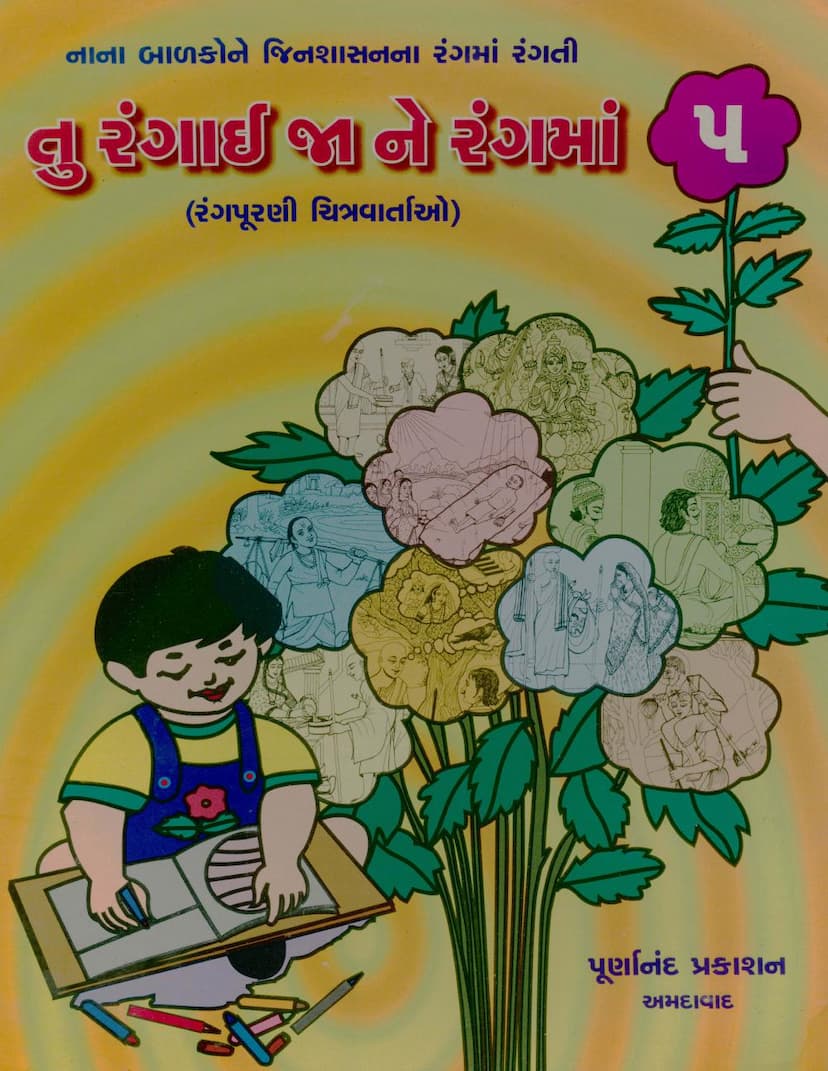
This publication is the first issue of the second year of the "Tu Rangai Jane Rangma" series, aimed at coloring young children with the essence of Jainism. The series is designed as coloring storybooks that introduce children to the shining stars of the Jain faith. It aims to awaken a child's artistic inclination and immerse them in the colors of Dharma by filling in the favorite colors of great personalities from Jain history. This practice is intended to enhance their artistic skills and understanding.
Key Content and Stories:
The book is structured around several short stories and concepts, each with a moral or lesson for children. The stories often highlight the virtues and practices of Jainism through narratives of historical figures and allegorical tales.
-
The Influence of Rules (નિયમનો પ્રભાવ): This story features Vankchul, a prince who was exiled due to his misbehavior. He joins a group of thieves and becomes their leader. During Chaturmas, a monk stays with the thieves under the condition of not preaching. After the Chaturmas period, the monk advises Vankchul on the importance of rules, comparing a life without rules to that of an animal. Vankchul takes four vows: not to eat unknown fruits, not to eat crow meat, to strike with a sword from a distance, and not to mistreat his queen. These rules save his life from poisonous fruits and a contagious disease affecting crows, and also protect his sister and wife from harm. His adherence to the fourth rule leads to him being appointed as a minister. The story emphasizes that even small rules, when followed with conviction, bring significant benefits and protection.
-
To Whom Did the King Bow? (રાજા કોને નમ્યો ?): King Vikramaditya of Ujjain encounters four goddesses (Lakshmi, Saraswati, Kirti, and Hope/Asha). Each goddess claims that the king bowed to her. Vikramaditya explains to Lakshmi that she is often associated with sin and is fickle. He tells Saraswati that she only stays where she is well-cared for and can even deceive scholars. He informs Kirti that she is dependent on Lakshmi and Saraswati. Finally, he bows to the goddess of Hope (Asha) because without hope, people cannot strive for wealth, knowledge, or fame. The story teaches children not to get discouraged, to maintain high hopes, and to strive for success.
-
Shrvan, the Devoted Son to Parents (માતૃ-પિતૃ ભક્ત શ્રવણ): This story recounts the tale of Shravan, a devoted son whose parents were blind and elderly. Despite their poverty, Shravan cared for them meticulously. When his parents expressed a lifelong desire to visit 68 holy places, Shravan, unable to afford the journey, decided to carry them on a makeshift palanquin (kawad). He did this without feeling burdened, ashamed, or tired, driven by his love and devotion. The story highlights the immense virtue of parental devotion and encourages children to be a support for their aging parents and to fulfill their wishes without shame.
-
Why Was the Child Crying? (બાળક કેમ રડતો હતો ?): This story is about Vajkumar (initially unnamed), born to Sunanda and Dhanagiri. His father had recently taken Jain initiation (diksha). Sunanda was sad that she couldn't celebrate her son's birth as a major festival. Upon hearing the word "diksha," the baby began to cry incessantly. This crying was driven by a past-life memory of being a Jain monk and a strong desire for diksha. After six months of continuous crying, his father, Dhanagiri Muni, who was on his spiritual journey, came to their house for alms. Sunanda, overwhelmed, asked him to take the child. Dhanagiri Muni, remembering his Guru's instruction to accept whatever is offered (be it animate or inanimate), accepted the baby. The moment the baby was placed in his lap, he stopped crying. The Guru named him Vajkumar due to his unusual weight. Vajkumar took diksha at the age of four and later became the influential Acharya Vajswami. The story emphasizes that devotion and desire for spiritual life often stem from past lives and that dedication to the spiritual path leads to great spiritual attainment.
-
The Marvelous Power of Devotion (પ્રભુભક્તિની ગજબ છે શક્તિ): This story features Pethadshah, the chief minister of Mandavgarh, who was deeply devoted to Jainism. He clearly told the king that his priority was "Deva-Guru-Dharma, then the kingdom's affairs." His devotion was so profound that he would have guards outside the temple to ensure no one disturbed his prayer. When a major invasion threatened the kingdom, the king summoned Pethadshah, but he was in prayer. The king himself went to the temple and was impressed by Pethadshah's deep devotion. The king joined Pethadshah in offering flowers. When the king expressed concern about the invasion, Pethadshah assured him that good things would happen, attributing it to the king's prayer. Soon after, news arrived that the invading army had retreated without any apparent reason. The king was astonished and deeply respected the power of Jain devotion. The story teaches children to be proud of their Jain identity, to forget everything else when in the temple, and that deep devotion can bring inner peace and positive outcomes.
-
From Bridegroom to Kevali (મુરતિયો બન્યો કેવલી): A young man, dressed as a bridegroom, and his friends were going to a garden. In the garden, they met an Acharya (Chanda Rudracharya) who was known for his anger but was trying to control it by staying in solitude. The friends teased the bridegroom and presented him to the Acharya as a new disciple. The Acharya, already agitated, lost his temper and forcefully pulled the young man's hair, thus changing his appearance from a bridegroom to a monk. After the outburst, the Acharya calmed down. The young man, now a monk named Nutan Muni, felt immense gratitude towards the Acharya for this unexpected spiritual initiation. He realized his good fortune and decided to remain a monk. Fearing his family would come to take him back, he helped his Acharya, who was old and frail, to move from the garden. During the night journey, the Acharya, still prone to anger, hit Nutan Muni with a stick for not walking carefully, causing him to bleed. Despite the pain and injury, Nutan Muni reflected on the Acharya's kindness in giving him diksha and his own perceived shortcomings, all the while developing immense equanimity. Eventually, Nutan Muni attained Keval Gnan (omniscience). Upon realizing this, the Acharya, filled with remorse for his behavior towards a Kevali, also attained Keval Gnan. The story emphasizes the importance of controlling anger, not mocking others, cultivating patience, and seeking forgiveness and repentance.
-
Anupama's Devotion to Guru (અનુપમા ની - ગુરુભક્તિ): This story is about Anupamadevi, the wife of Tejpal (and sister-in-law to Vastupal), who were renowned patrons of Jainism, famous for the Dilwara Temples. Anupamadevi was exceptionally intelligent and deeply devoted to the Jain faith and its spiritual leaders. She believed that by serving monks and nuns, she would eventually attain diksha at a young age in a future life. She devotedly offered alms (gochari) to 500 monks and nuns daily, considering the opportunity to serve them a great blessing. She even used her expensive sarees to clean the utensils used by monks. She also supported the religious activities of other community members. Anupamadevi's profound devotion and numerous good deeds, including temple construction and charity, led her to be reborn in Mahavideh Kshetra, where she took diksha at the age of eight from Lord Simandhar Swami and attained Keval Gnan in her ninth year. She is now a Kevali, preaching and benefiting many beings. The story highlights the great merit of serving monks and nuns and encourages children to follow such devotional practices.
-
Dhanna and Shalibhadra's Renunciation (ધન્ના-શાલિભદ્રનું અણસણ): This story narrates the lives of Shalibhadra and Dhannaji, wealthy merchants and brothers-in-law in Rajagrihi. Shalibhadra was incredibly wealthy, living a life of extreme luxury. Dhannaji was also prosperous and known for his generosity, even to his envious brothers, whom he supported multiple times when they lost their fortunes. Both Shalibhadra and Dhannaji lived lives of detachment despite their immense wealth, showing humility and wisdom. When Shalibhadra heard Lord Mahavir's sermon, he felt detachment and decided to take diksha after leaving his 32 wives one by one over 32 days. Dhannaji, upon hearing this, immediately decided to join him, urging Shalibhadra to renounce everything at once. They both went to Lord Mahavir and took diksha. They practiced severe penance, and their bodies withered. During their penance, when Lord Mahavir mentioned that Shalibhadra's mother would perform his first meal after a month's fast, they went to his mother's home. However, no one recognized them, and the meal was not offered. Later, a shepherd offered curd to Shalibhadra for his parana (breaking the fast). Lord Mahavir explained that the shepherd was his mother from a past life. Both Dhanna and Shalibhadra then proceeded to Vaibhavgiri mountain for the final fast unto death (anashan). Their families witnessed their extreme renunciation and admired their tapasya. Dhannaji attained Moksha (liberation), while Shalibhadra, due to a brief moment of attachment to his earthly mother, was reborn in the Sarvarthasiddhi heaven and will attain Moksha in a future human birth. The story teaches the value of wealth earned through merit, the importance of detachment, generosity, and realizing that the body is temporary and should be used for spiritual Sadhana.
Contest Information:
The publication also includes a contest for children. It presents eight questions based on the content of the booklet. Participants are instructed to answer the questions on a postcard, using only one word per answer. They must include their name, full address, and membership number. Five lucky winners will be selected and their names published in the next issue, receiving prizes. The deadline for submitting answers is also provided.
Previous Issue Results:
The publication also lists the correct answers and lucky winners from the previous year's annual examination (for issues 1-4 of the first year). It also mentions the names of students who received prizes for their performance in that examination.
In essence, "Tu Rangai Jane Rangma 05" is an educational and inspirational publication designed to instill Jain values and principles in young children through engaging stories, encouraging them to learn, reflect, and participate actively.