
Tibetan Citations Of Bhartrharis Verses And Problem Of His Date
Added to library: September 2, 2025
Summary
This article, "Tibetan Citations Of Bhartrharis Verses And Problem Of His Date" by Hajime Nakamura, explores the presence of Bhartṛhari's verses in Tibetan Buddhist literature and uses these citations to shed light on the dating of the philosopher Bhartṛhari.
Here's a comprehensive summary of the article's key points:
1. Discovery of Tibetan Citations:
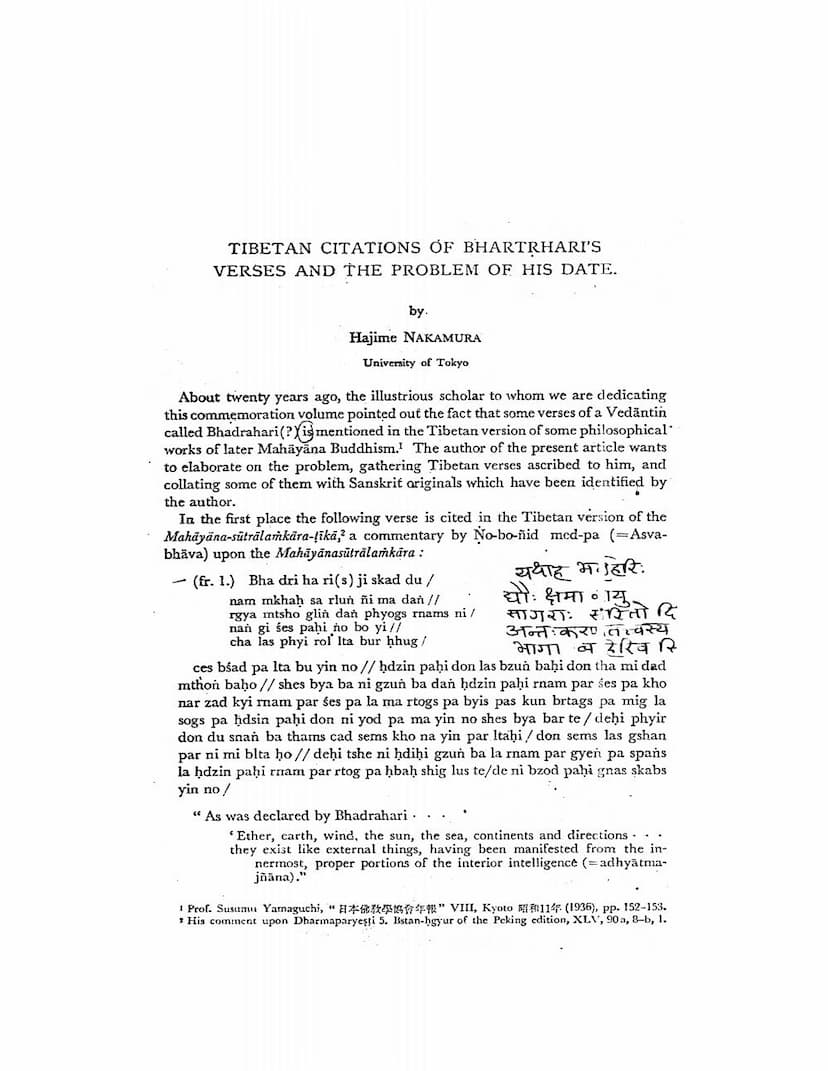
- The author begins by referencing a previous observation by another scholar that verses attributed to a Vedāntin named Bhadrahari (likely a transliteration of Bhartṛhari) appear in Tibetan versions of later Mahāyāna Buddhist philosophical works.
- Nakamura's aim is to expand on this, collecting more Tibetan citations attributed to Bhartṛhari and comparing them with their Sanskrit originals, which he has identified.
2. Examples of Tibetan Citations and Sanskrit Originals:
The article presents several Tibetan citations attributed to Bhartṛhari (often rendered as Bha dri ha ri, Bhata ha ri, etc.) and provides their likely Sanskrit originals, many of which are found in Bhartṛhari's own Vākyapadīya:
- Fragment 1 & 12: These verses, nearly identical, discuss how external phenomena (ether, earth, sun, etc.) are manifestations of the "innermost, proper portions of the interior intelligence" (adhyātmajñāna). This is seen as aligning with Buddhist Idealism (vijñaptimātrata). The Sanskrit original is identified as Vākyapadīya III, 7, 41.
- Fragment 2: This verse defines "action" (kriyā) as that which is declared to be established or not established, and whose essence is the order to be resorted to. The Sanskrit original is found in Vākyapadīya III, 8, concerning the definition of action.
- Fragment 3-10 & 13-16: These fragments touch upon various philosophical concepts attributed to Bhartṛhari, including:
- The eternal, beginningless Brahman as the ultimate reality from which things evolve (Vākyapadīya I, 1).
- The illusory nature of imaginary assumptions derived from reasoning and scripture (Vākyapadīya II, v, 143; III, 4, 1-2).
- The manifestation of phenomena from the Ātman (Self).
- The cause of existence and the concept of deliverance.
- The subjective nature of sensation and perception.
- The idea that all things appear from the Ātman, the Truth.
- The concept of the supreme Brahman being attained through grammar.
- The nature of spoken words, their classification, and how the mind categorizes them (Vākyapadīya III, 6).
- The idea that meaning is not separate from words.
3. Attribution and Identification of Bhartṛhari:
Nakamura provides several reasons why these Tibetan citations are likely to be attributed to Bhartṛhari:
- Name Variations: The Tibetan transliterations (Bhadrahari, Bhadrihari, Bhatahari, etc.) suggest a common original Sanskrit name that was difficult to transcribe consistently.
- Presence in Vākyapadīya: The Sanskrit originals of many cited verses are found in Bhartṛhari's Vākyapadīya. For others, verses with similar purport are present.
- External Attribution: Bhatta-Nārāyanakantha, a commentator on the Mrgendrāgama (a Śaiva scripture), explicitly attributes one of these verses (Fragment 11) to Bhartṛhari, characterizing him as a vivartavādin (proponent of manifestation theory).
4. The Problem of Bhartṛhari's Date:
The core of the article lies in using these Tibetan citations to address the complex issue of Bhartṛhari's precise historical placement.
- Challenging I-Tsing's Account: The author critically examines the commonly accepted date of Bhartṛhari based on the account of the Chinese traveler I-Tsing. I-Tsing stated Bhartṛhari died 40 years before his sojourn (c. 651-652 AD), placing Bhartṛhari around 600 AD. However, I-Tsing also mentions Bhartṛhari being a contemporary of Dharmapāla and Dharmapāla commenting on Bhartṛhari's work. Since Dharmapāla lived c. 530-561 AD, these statements are contradictory if Bhartṛhari died c. 600 AD. Nakamura suggests I-Tsing's information about the 40-year gap is likely incorrect.
- Evidence from Vasubandhu and Dignāga:
- Vasubandhu: Evidence suggests Bhartṛhari lived after Vasubandhu. Punyarāja, a commentator on the Vākyapadīya, mentions Vasurāta as Bhartṛhari's teacher, and Vasurāta is associated with Vasubandhu's circle. Jain writer Simhasūrigani (early 6th century AD) also mentions Vasurāta as Bhartṛhari's upādhyāya (teacher). Paramārtha places Vasurāta as a contemporary of Vasubandhu.
- Dignāga: Crucially, Nakamura cites H. R. Rangaswamy Iyengar's work, which points out that Dignāga (a prominent Buddhist philosopher) cites verses in his Pramāna-samuccaya that are found in Bhartṛhari's Vākyapadīya. Jinendrabuddhi, a commentator on Dignāga, confirms that Dignāga is referring to Bhartṛhari's views. This strongly suggests Bhartṛhari lived before or was contemporary with Dignāga.
- Dating of Contemporaries: The article reviews the estimated dates of Dignāga, Asvabhāva, Bhavya, and Dharmapāla, all of whom are considered contemporaries or predecessors of Bhartṛhari. These estimates generally place them in the 4th and 5th centuries AD.
- Dignāga: c. 350-500 AD, often placed around 500 AD.
- Asvabhāva: Earlier than Dharmapāla, later than Dignāga (c. 450-530 AD).
- Bhavya: Contemporary of Buddhapālita (c. 400-450 AD), active in the early 5th century AD.
- Dharmapāla: Precisely dated as 530-561 AD.
5. Conclusion on Bhartṛhari's Date:
Based on the convergence of evidence from the Tibetan citations and the relationships with Vasubandhu and Dignāga, Nakamura concludes that Bhartṛhari must have lived prior to, or at the latest contemporary with, Dignāga, Asvabhāva, Bhavya, and Dharmapāla.
The article suggests a date of approximately 450-500 AD for Bhartṛhari, the author of the Vākyapadīya. This revised dating challenges the older tradition based on I-Tsing's testimony.
6. Philosophical Overlap and Bhartṛhari's Stance:
- The article notes that some verses attributed to Bhartṛhari, particularly those discussing phenomena as mind-dependent or manifestations of the Absolute, show philosophical similarities to Buddhist Idealism (vijñaptimātrata). This is evident in Asvabhāva's commentary on Fragment 1.
- Nakamura also highlights Bhartṛhari's critique of reasoning in Fragment 19, where he emphasizes the reliance on scripture and denounces the validity of inference alone. This aligns with Bhartṛhari's broader philosophical position as presented in the Vākyapadīya.
7. Acknowledgements:
The author concludes by expressing gratitude to various scholars who assisted in his research, including those who helped identify citations in Asvabhāva's and Bhavya's works.
In essence, Nakamura's article demonstrates the value of Tibetan Buddhist literature for historical and textual research, using specific citations to challenge established scholarly views on the dating of the influential Indian philosopher Bhartṛhari.