
Three Sanskrit Fragments Of Vinaya Of Sarvastivadins
Added to library: September 2, 2025
Summary
Here's a comprehensive summary of J.W. De Jong's "Three Sanskrit Fragments Of Vinaya Of Sarvastivadins," focusing on the content of the fragments and their significance:
Overview:
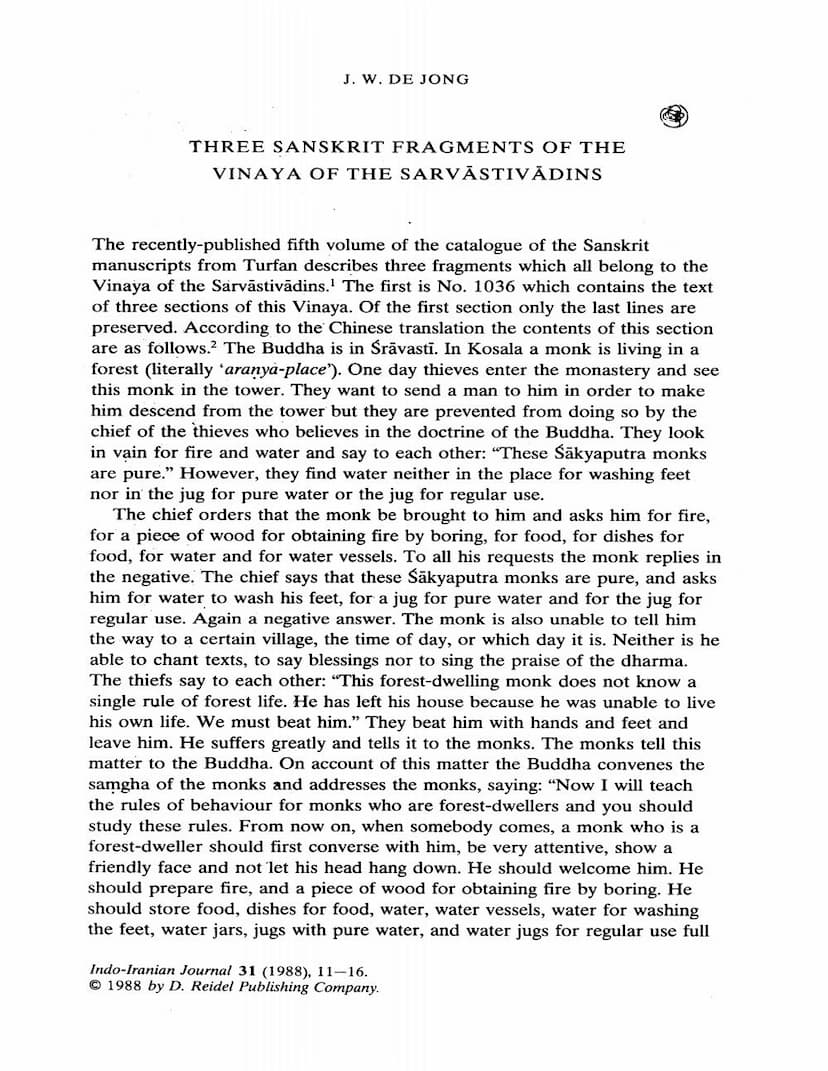
This scholarly article by J.W. De Jong examines three Sanskrit manuscript fragments (T 1036, T 1047, and T 1093) that belong to the Vinaya (monastic discipline) of the Sarvāstivāda school of Buddhism. The author uses Chinese translations from the Taisho Tripitaka to clarify and interpret the Sanskrit texts, highlighting similarities and differences with Pali Vinaya texts and other Buddhist traditions. The fragments offer valuable insights into the specific rules and practices of Sarvāstivāda monastic life, particularly concerning forest-dwelling monks, lay interactions, and various minor regulations.
Fragment T 1036:
This fragment contains three distinct sections of the Sarvāstivāda Vinaya.
-
First Section: This section details rules for forest-dwelling monks. The narrative describes a scenario where thieves encounter a monk in a forest tower. The monk is unable to provide basic necessities (fire, food, water, utensils) or knowledge of the Dharma (texts, blessings) to the chief of the thieves. The thieves, initially surprised by the monk's purity, eventually beat him for his apparent incompetence. The Buddha, upon hearing this, establishes specific rules for forest-dwelling monks. These rules emphasize hospitality, preparedness (having fire-making materials, storing food, water, etc.), knowledge of time and cosmology (naksatras), study and recitation of scriptures (sūtras, vinaya, abhidharma), and understanding of spiritual attainments. A key rule mentioned is that forest dwellers should not collect "sun-stones and moon-stones," a prohibition seemingly unique to the Sarvāstivādins. The fragment also discusses the term "yasti" and its potential connection to "meditation sticks" or a "stick for beating the dew," noting its presence in other Vinayas. The Gonisādasūtra is referenced in relation to forest-dwelling rules, and its connection to the Pali Gulissānisutta is established.
-
Second Section: This section recounts an interaction between the Buddha and a Brahman named Agnidatta. Agnidatta offers a sakuli cake to the Buddha, who then distributes it to the monks. During the distribution, some monks eat noisily while the Buddha preaches. Agnidatta questions if all disciples can receive the Buddha's teaching, implying some are more interested in worldly sustenance ("eating") than the Dharma. The Buddha confirms that some can, and some cannot. The Buddha then preaches to Agnidatta, who leaves after showing respect. Afterward, the Buddha establishes a rule that eating should not occur during Dharma preaching, blessings, or praise of the Dharma, and that anyone who does so commits a sin. The fragment discusses the meaning of the Sanskrit term "ārāgayamti" and its interpretation as "assimilate the teaching" or "please."
-
Third Section: This section describes a young monk entering Bārāṇasī for alms. The monk sees the Buddha from afar and feels ashamed, lowering his head. Upon returning, the Buddha asks the congregation who the monk is. The ashamed monk confesses. The Buddha commends his shame and self-control, stating that such controlled reactions when encountering monks, nuns, lay followers, or heretics bring long-lasting joy. The Sanskrit text mentions the monk averting his eyes from the arriving Buddha, and a reference to a "vivācikā," the exact meaning of which remains unclear due to textual fragmentation and translation differences.
Fragment T 1047:
This fragment presents a story involving monks and nuns.
- Monastery near Sāketa: Monks establish a monastery near Sāketa, but the proximity of houses and human activity disrupts their practice. They request a wealthy householder, Amjana, to build a new monastery, which he does in the "Amjana hain." The monks relocate.
- Nuns' Stay and Dispute: Nuns traveling to Śrāvasti arrive at the old monastery near Sāketa and find provisions. They receive permission from the monks to stay. After the monastery's owner dies, his son inherits it and demands the nuns leave, as it is his share of the property. The nuns, having received permission from the monks, refuse to leave unless the monks compel them.
- Sumukhā and the Householder's Son: A nun named Sumukhā, of Brahman origin and described as strong, uses harsh words and quarrels with the householder's son. Enraged, the son strikes the nun. Sumukhā reports this to officials.
- Legal Consequence: The officials examine the law, which states that if someone strikes a pravrajita (ordained person), the limb used for striking will be severed. The householder's right hand is consequently cut off. The Sanskrit text has a slight variation, suggesting Sumukhā struck the householder's son, but further fragments are needed for confirmation.
Fragment T 1093:
This fragment details a series of minor rules for monks.
- Vyajana and Vidhūpana: The rules concern the use of fans or whisks. The Chinese translation uses "fei" (door/door-leaf) for vyajana and "fu" (to brush) for vidhūpana. The distinction between these terms, both potentially translated as "fan," is noted as difficult to ascertain.
- Mirrors: Monks are prohibited from looking at their faces in mirrors, bowls, or water, unless there is a facial wound.
- Eye Healing: Five substances for eye healing are listed: black substance, bluish-gray powder, grass powder, flower powder, and fruit juice. The Buddha advises against using them for adornment. The fragment lists four specific ointments: kādājanam, cūrṇāmjanam, (sa) tysām janam, and puṣpāmjanam, noting a discrepancy with the Mahāvagga's list of five ointments.
- Ointment Sticks: The Buddha permits ointment sticks made of various materials, including iron, brass, shell, ivory, horn, wood, and pottery, as listed in the Chinese text. The Mahāvagga lists a broader range of materials.
- Amjanahastodaka: The meaning of this term is unclear, but the Chinese translation suggests it relates to the rule concerning the container for an eye ointment stick, emphasizing its careful guarding to prevent loss and disruption of walking.
- Flowers, Perfumes, and Necklaces: Monks are not to wear or let others wear these items. If received without request, they can be offered to stupas.
- Dance, Song, and Music: Monks are forbidden from being spectators of or allowing others to be spectators of dance, song, and music.
- Beds and Chairs (Sayyāsana): The rule for sleeping states that a healthy monk should not lie down during the day or at night when a lamp is lit. If they snore, they should get up and walk or retreat to a private area to avoid disturbing others.
Overall Significance:
The article by J.W. De Jong provides a valuable contribution to the study of Buddhist Vinaya. By analyzing these Sanskrit fragments alongside their Chinese translations, it reconstructs and clarifies aspects of the Sarvāstivāda monastic code. The fragments highlight the school's distinctive rules, such as those for forest dwellers and the prohibition of collecting certain stones, and offer a glimpse into the practical regulations governing monastic life, from hospitality to personal adornment and artistic engagement. The comparison with Pali texts and other Buddhist schools underscores the diversity within early Buddhism.