
Teen Din Mein
Added to library: September 2, 2025
Summary
Here is a comprehensive summary of the Jain text "Teen Din Mein" by Dharmchand Shastri, based on the provided pages:
Book Title: Teen Din Mein (In Three Days) Author: Dharmchand Shastri (Editor) Publisher: Acharya Dharmshrut Granthmala, Jaipur Source Material: Sanskrit Sukumal Charitra
Overview:
"Teen Din Mein" is a Jain picture storybook presented by Acharya Dharmshrut Granthmala. Its aim is to introduce children to Jain culture through a story based on the life of Sukumal, a significant figure in Jain narratives. The book emphasizes the symbolic nature of this story, highlighting the importance of understanding and practicing essential teachings from developed religions in one's own life. It's intended to inspire the younger generation with ideals and guide them toward a righteous path, presenting religious teachings as relatable life lessons.
Synopsis of the Story:
The story begins by introducing the principle, "When you awaken, it is morning" (Jab Jago Tabhi Sabera), setting the tone for the transformative journey of Sukumal.
-
The Blessing and the Warning: In the city of Ujjain, a wealthy and pious couple, Surendradatta and Yashobhadra, lived in great prosperity but longed for a child. King Vrishabhank announced a royal decree for citizens to visit the Digambar Jain Muni Vardan. Yashobhadra heard this announcement and, distressed by their childlessness, sought the Muni's blessings. The Muni blessed her with a son, predicting he would be fortunate, handsome, virtuous, and respected. However, he also warned that upon seeing the child, Surendradatta would renounce worldly life and become a monk. Furthermore, he foretold that the son, Sukumal, would also renounce his household life after encountering a Muni and hearing their teachings.
-
The Secret Birth and the Father's Renunciation: Yashobhadra became pregnant but kept it a secret, even giving birth in an underground chamber to prevent her husband from knowing. When a servant girl was found washing the child's clothes, she informed the Sethani of the boy's birth. Overjoyed, Surendradatta prepared to congratulate his wife and offer rewards. Upon learning of the birth, Surendradatta, deeply moved by the world's suffering and seeking true happiness, immediately renounced his worldly possessions and became a naked Digambar monk.
-
Yashobhadra's Protective Measures: While Yashobhadra rejoiced at the birth of her son, Sukumal, she remained determined to prevent him from encountering any Muni or hearing their teachings, fearing he too would renounce his life. To achieve this, she had a magnificent "Sarvatobhadra" palace constructed, surrounded by 32 other palaces and guarded by gatekeepers, to isolate Sukumal from any spiritual influence.
-
Sukumal's Sheltered Upbringing: Sukumal grew up in immense luxury and comfort within these palaces, unaware of the passage of day and night, or the extremes of heat and cold. All his needs and desires for physical comfort were met. He was accustomed to extreme gentleness, sleeping and sitting on the softest surfaces.
-
The Jewel-Embroidered Shawl and the Slipper: As Sukumal grew into a young man, his mother was thrilled that her plan had succeeded. A merchant brought a beautiful jewel-embroidered shawl (ratnakambal) to sell. While Sukumal admired its beauty, he found it too coarse and uncomfortable. His mother, wanting to please him, purchased it. Sukumal, unable to wear it, decided to have 32 pairs of slippers made for his 32 wives from the shawl. One day, one of his wives wore a slipper made from the shawl, and it was accidentally carried away by a kite, which dropped it on the roof of the king's palace, mistaking it for meat.
-
The King's Inquiry and Sukumal's Identity Revealed: The king, finding the exquisite slipper, was intrigued and ordered his minister to discover its owner. The minister eventually learned that the slipper belonged to the wife of Sukumal, son of the city's Seth Surendradatta. Impressed by Sukumal's apparent good fortune and wealth, the king expressed a desire to meet him.
-
The King's Visit and Observations: The king, Vrishabhank, visited Sukumal's home. Yashobhadra warmly welcomed him. During the meal, the king observed Sukumal's unusual behavior: he couldn't sit still, and his eyes watered. Yashobhadra explained that Sukumal's extreme delicacy meant he was accustomed to soft seating, and the mustard seeds that had fallen on his seat from the king's auspicious blessing were causing him discomfort. Regarding his watering eyes, she explained he lived in the light of jewels and couldn't tolerate the light of a ghee lamp used in the king's Aarti. When the king questioned why Sukumal was meticulously picking out individual grains of rice to eat, Yashobhadra clarified that special, pre-softened rice infused with lotus fragrance was prepared for him, and he was distinguishing it from ordinary rice mixed in due to the king's visit. The king was astonished by Sukumal's extraordinary delicacy.
-
The Uncle's Arrival and the Prophecy of Limited Lifespan: The story then jumps to the day of Chaturmas (a four-month period of religious observance). Sukumal's maternal uncle, Yashobhadra, who had become a Muni, arrived at a Jain temple located in Sukumal's palace gardens. Through his spiritual insight, he learned that Sukumal's lifespan was very short, and he needed to be guided towards spiritual salvation. He informed Yashobhadra of his arrival.
-
Yashobhadra's Plea and the Muni's Resolve: Yashobhadra, upon hearing of the Muni's presence, rushed to him, pleading that if Sukumal heard his words or saw him, he would renounce his life, leaving her alone. She begged the Muni to leave. The Muni, however, stated that he had already taken his Chaturmas vow there and could not relocate.
-
Sukumal's Awakening: As the Chaturmas period concluded, Muni Yashobhadra began reciting scriptures loudly. He spoke of the suffering in all realms of existence – the hells, animal, and human lives, and even the heavens, illustrating with the example of Padmanabh Dev in the Achyuta heaven, who, despite his immense splendor, remained unsatisfied. Sukumal, hearing these words, had a recollective experience (Jati Smaran). He realized the ephemeral and repulsive nature of his body (filled with impurities) and the futility of pursuing sensual pleasures. He understood that all worldly pleasures are transient, unsatisfactory, and dependent on others. He decided it was foolish to continue in this state and resolved to seek his own welfare.
-
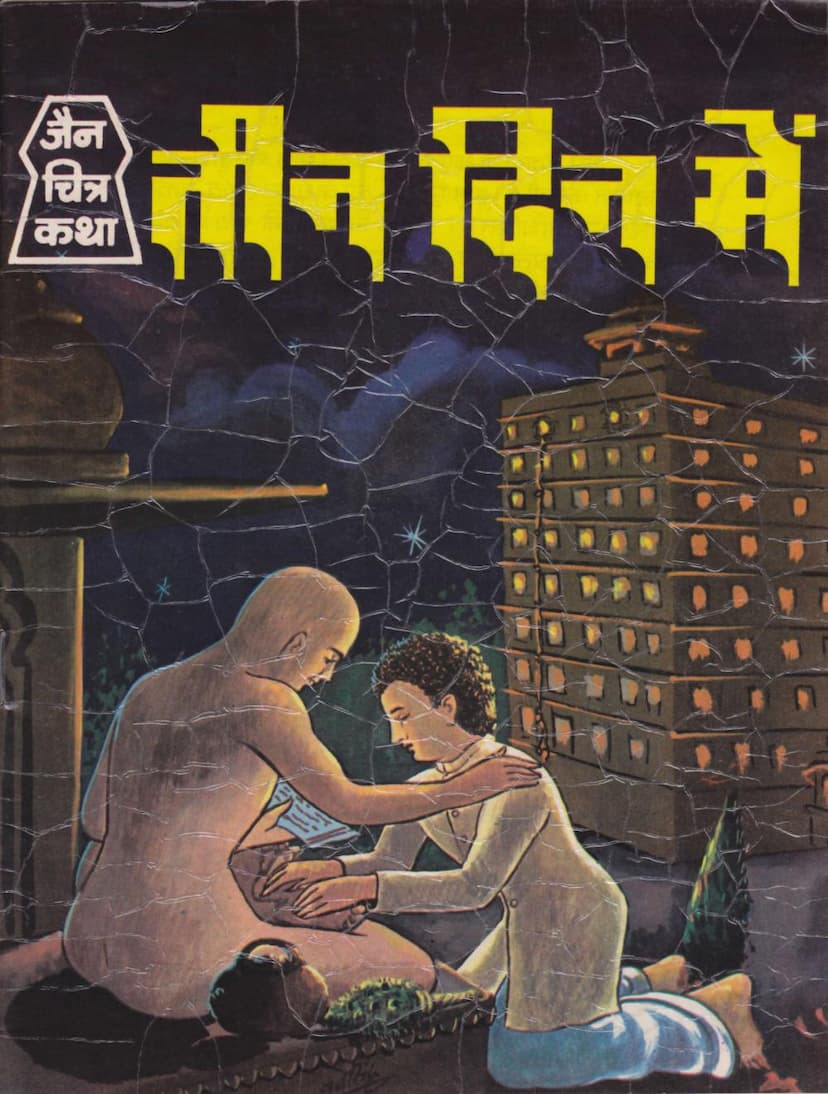
Sukumal's Escape and Renunciation: Sukumal realized he was trapped within the palace, with all doors guarded. He devised a plan: he would tie together the saris of his wives to create a rope and escape through the window. He successfully executed this plan and reached Muni Yashobhadra's feet.
-
Accepting Diksha and the Time Limit: Sukumal bowed to the Muni and confessed he had been lost in worldly pleasures but had now awakened to his true self. He renounced the world, his body, and all possessions, becoming a naked Digambar monk. Muni Yashobhadra then informed him that his lifespan was now only three days.
-
The Search and Sukumal's Devotion: Meanwhile, Sukumal's wives and mother discovered his absence. They searched for him frantically. Yashobhadra, suspecting he had gone to Muni Yashobhadra, went to the temple. Upon finding the sari-rope, she understood how Sukumal had escaped. She searched for him and the Muni but found neither.
-
Extreme Austerity and Divine Intervention: Sukumal, now a monk, began intense penance in the forest. A lioness (Syalani) and her cub began to devour his body. Sukumal, however, remained absorbed in meditation, realizing his true self was distinct from his physical body, which was perishable. He understood his soul was eternal and unchanging. Despite the excruciating pain, he did not falter in his meditation. He recalled a past life where he was his current tormentor's brother-in-law and had wronged her. He recognized that the pain inflicted was a result of past karma.
-
Attaining Sarvarthasiddhi: Through his steadfast meditation and contemplation of the twelve bhavanas (reflections), Sukumal endured the immense hardship. He achieved the state of Sarvarthasiddhi, a celestial realm, with an lifespan of 33 sagars. He realized this achievement was due to his past austerities and that from this existence, he would attain the human rebirth that would lead him to Moksha (liberation).
Core Message:
The book emphasizes that true happiness lies in spiritual liberation, not in worldly pleasures. It highlights the importance of self-realization, detachment from the material world, and the power of understanding spiritual teachings, even when faced with extreme adversity. The story of Sukumal, who achieved ultimate salvation in just three days after his awakening, serves as an inspiration for readers to pursue their spiritual path diligently. The narrative also underscores the concept of karma and its influence on one's life.