
Tarkarahasya And Vadarahasya
Added to library: September 2, 2025
Summary
Here's a comprehensive summary of the provided text from Gudrun Bühnemann's work on "Tarkarahasya and Vādarahasya":
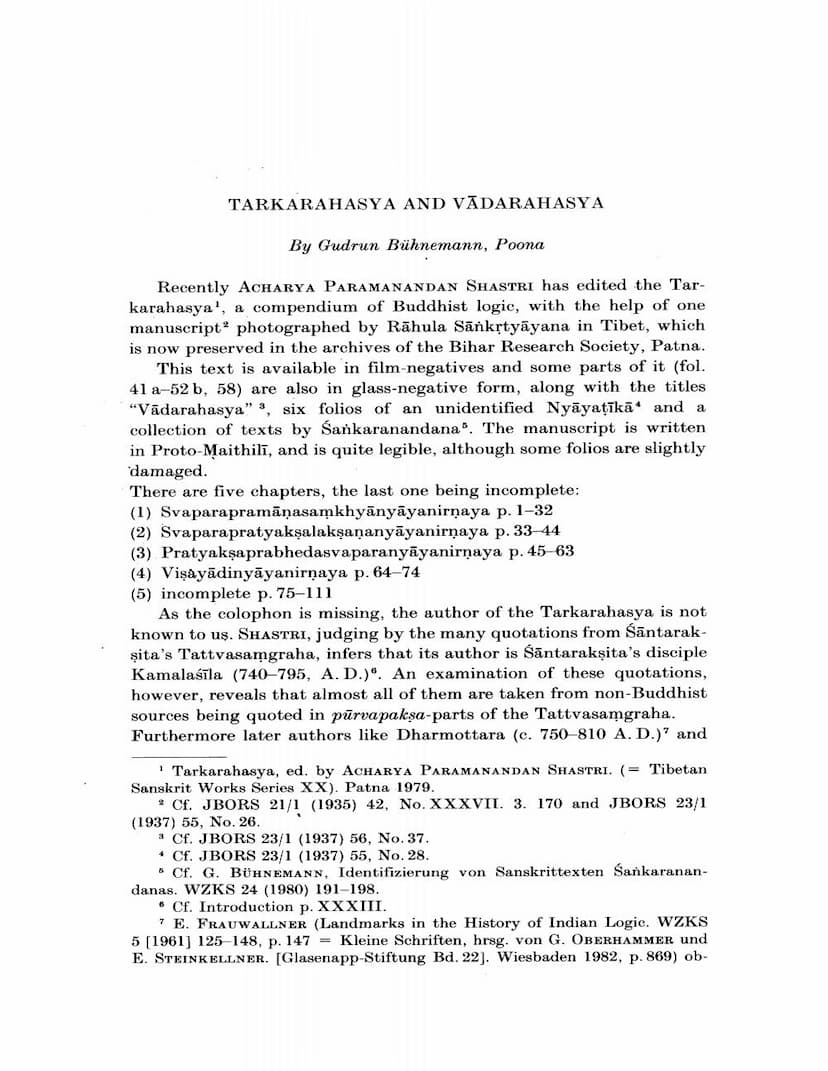
This article discusses two important, though partially unedited, Sanskrit Buddhist logic texts: Tarkarahasya and Vādarahasya. Both texts were discovered in Tibet and are significant for understanding the later stages of Indian Buddhist logic.
Tarkarahasya:
- Discovery and Manuscript: Edited by Acharya Paramanandan Shastri, this text is a compendium of Buddhist logic. It survives in a manuscript photographed by Rahula Sankṛtyāyana in Tibet, now housed at the Bihar Research Society, Patna. Parts of it are also preserved as glass negatives. The manuscript is written in Proto-Maithili and is mostly legible, though some folios are damaged.
- Structure: The text is divided into five chapters, with the last one being incomplete. The chapter titles suggest a focus on epistemology (pramāṇa) and dialectics.
- Authorship Debate: The author of Tarkarahasya is unknown due to the missing colophon. Shastri tentatively attributed it to Kamalashila (a disciple of Shantarakshita) based on extensive quotations from Shantarakshita's Tattvasamgraha. However, Bühnemann argues against this, noting that the quotations often come from non-Buddhist sources cited within the Tattvasamgraha's purvapaksha (opponent's view) sections. Furthermore, Tarkarahasya quotes later authors like Dharmottara and Prajñākaragupta, and importantly, Jñānaśrīmitra (early 11th century). This direct quotation of Jñānaśrīmitra makes Kamalashila's authorship unlikely, as Dharmottara is considered later than Kamalashila, and Jñānaśrīmitra is later still.
- Editorial Issues: Bühnemann points out that Shastri's edition did not consistently use the original folio numbers, leading to potential confusion. She highlights two instances where folios are missing, creating lacunae in the text and making continuous reading impossible. An appendix is provided in the original article to correlate Shastri's numbering with the manuscript's folio numbers.
- Refinements in the Edition: Bühnemann also suggests refinements to Shastri's critical apparatus, using the example of "sarvasarvajña" versus "sarvajña." She notes that Shastri incorrectly emended the text to "sarvajña" in a discussion of yogic perception and proofs of an omniscient being, missing the technical distinction used by later Buddhist logicians like Jñānaśrīmitra and Ratnakīrti.
Vādarahasya:
- Discovery and Manuscript: This text is an unedited manuscript from the same collection as Tarkarahasya, comprising 42 folios written in a Proto-Bengali style. It is available on film negatives, with folios 23-42 also on glass negatives.
- Condition and Decipherment: The Vādarahasya is more difficult to decipher than Tarkarahasya due to out-of-focus photographs in many sections. The manuscripts were found in different monasteries in Tibet (Tarkarahasya at Zhalu, Vādarahasya at Nor).
- Structure: It consists of three chapters, with the third being incomplete.
- Content and Authorship: The beginning of the text mentions the Nyāya philosopher Udayana and the Buddhist logician Jñānaśrīmitra. The text is in prose and deals with topics like jāti (fallacious objections) and nigrahasthāna (points of defeat in debate). Notably, it refutes Udayana's arguments, particularly those found in his Nyāyapariśiṣṭa. Bühnemann suggests that Vādarahasya might be the only extant Buddhist reply to Udayana's criticisms. Like Tarkarahasya, the author and exact number of chapters are not clearly stated.
- Relationship to Tarkarahasya: Both texts share similarities in their titles and chapter divisions ("nyāyanirnaya"). Bühnemann speculates that a closer study might reveal if they have the same author or if one is an imitation of the other.
- Dating: Both texts are considered to be from the final stages of Indian Buddhism. Tarkarahasya quotes Jñānaśrīmitra, who was criticized by Udayana and may have been his elder contemporary, but doesn't seem to quote Udayana. Vādarahasya criticizes Udayana, suggesting it was likely written later than Tarkarahasya.
Conclusion:
The article highlights the academic importance of these two texts for understanding the evolution of Indian Buddhist logic, particularly in its engagement with the Nyāya school. Bühnemann's analysis provides critical insights into the existing editions, potential authorship, and the scholarly challenges presented by these damaged and partially unedited manuscripts. The discovery of more complete manuscripts is hoped for to allow for more thorough critical editions.