
Syntactic Gleanings From Bhartharis Trikandi
Added to library: September 2, 2025
Summary
Here's a comprehensive summary of the provided text from "Syntactic Gleanings From Bhartharis Trikandi" by Ashok Aklujkar, focusing on the syntactic aspects discussed:
Introduction and Approach:
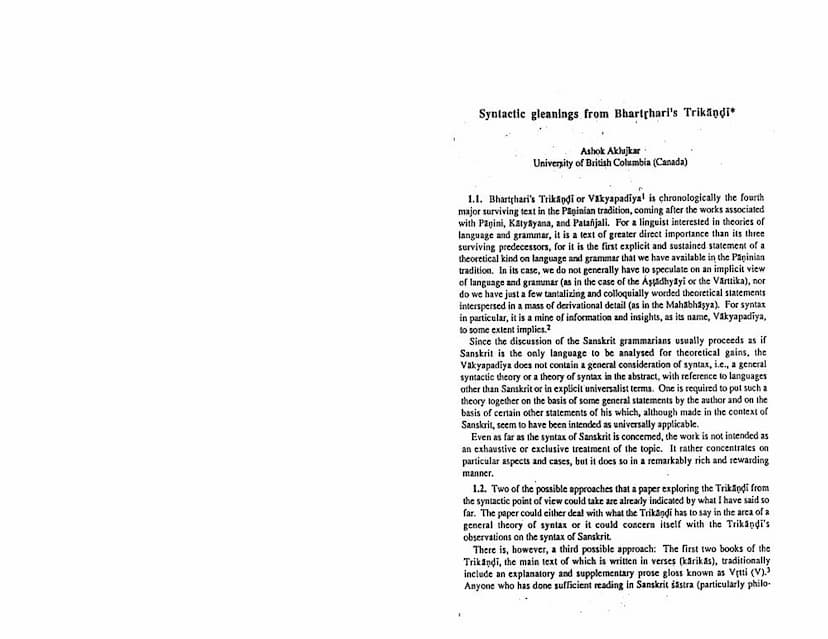
The author, Ashok Aklujkar, introduces Bharthari's Trikandi (also known as Vakyapadiya) as a pivotal text in the Papinian grammatical tradition, chronologically following Panini, Katyayana, and Patanjali. He emphasizes its direct importance for linguists due to its explicit and sustained theoretical treatment of language and grammar, unlike its predecessors where theories were often implicit or interspersed. The Vakyapadiya is considered a "mine of information and insights" for syntax.
Aklujkar acknowledges that the Vakyapadiya does not present a general syntactic theory in abstract or across languages beyond Sanskrit. Instead, it focuses on Sanskrit syntax, but often with statements intended to be universally applicable. The work is not exhaustive but concentrates on specific aspects and cases with remarkable richness.
The paper proposes three approaches to studying the Trikandi from a syntactic perspective:
- General Theory of Syntax: What the Trikandi says about universal principles of syntax.
- Syntax of Sanskrit: Observations on the specific syntax of Sanskrit as presented in the text.
- Syntax of the Vṛtti: The author's chosen approach, focusing on the syntactic characteristics of the explanatory prose gloss (Vṛtti) that accompanies the verse (kārikā) text of the first two books. This choice is motivated by the Vṛtti's distinctive style, diction, embellishments, and syntactic devices.
Focus on Word Order and Syntactic Peculiarities in the Vṛtti:
The author then delves into specific syntactic features observed in the Vakyapadiya Vṛtti, primarily concentrating on word order, while setting aside commonly known features of Classical Sanskrit syntax.
Key Syntactic Observations:
-
Placement of Connectives (ca, va):
- General Rule: Connectives like ca ('and') and va ('or') typically appear at the end of the set of items they connect, rarely after each single item.
- Specification: If the second member of a pair joined by ca or va has a qualifier (like an adjective), the connective is placed after the qualifier, not at the end of the entire second member. This positions the qualifier similarly to a word introducing a clause. Examples are provided where ca or va follows an adjective modifying the second element in a pair.
-
Displacement of Connectives by Emphasis Particles:
- Words adding emphasis, such as api ('even', 'also') and eva ('indeed', 'only'), can push ca and va from their usual second position in a clause to the third position.
- The particle hi ('indeed', 'for') also exhibits similar displacement, often appearing after the first major word of a clause or even in the third position due to strong association with the subject word. Examples illustrate this phenomenon.
-
Connotation of 'X ca Y ca' vs. 'X Y ca':
- Aklujkar speculates on a possible difference in connotation between the repetitive "X ca Y ca" and the simpler "X Y ca."
- Passages in the Vṛtti suggest that the "X ca Y ca" construction was favored when connecting two items perceived as belonging to distinct groups, especially logically opposed ones. This might reflect an awareness of contrasting categories. Examples are given where ca is used with each item in a contrasting pair.
-
The "Dehali-dipa" Placement of Genitive Modifiers:
- While genitive modifiers usually precede the noun (like attributive adjectives), the Vṛtti sometimes places them after the noun.
- This "dehali-dipa" (threshold lamp) strategy, where a genitive sandwiched between two nouns illuminates both, creates a play on meaning. It links simultaneously to the preceding and following noun, often with different shades of genitival meaning.
- This stylistic choice overrides natural Sanskrit syntax for specific gains, reflecting the culture's sensitivity to multiple meanings and language play. Examples illustrate this post-nominal genitive placement.
-
Rhetorical Principles Guiding Word Order:
- The author suggests that a rhetorical principle aiming for conviction and understanding guides word order in the Vṛtti.
- The author acts like a good teacher, moving from general to specific, gross to subtle, or the least arguable to specific characterizations.
- This principle is crucial for explaining word order even when words have the same syntactic role, as it indicates a specific movement conducive to effective communication.
- Progressive Qualification: In some instances, a sequence of adjectives builds upon each other, leading the reader towards a final assertion or assuming potential reader questions. Each subsequent adjective makes the statement more plausible or elaborates on the preceding one. Examples demonstrate this cumulative effect of adjectives.
-
Parenthetical Clauses:
- The Vṛtti is noted for its use of truly parenthetical clauses, which interrupt the normal word order.
- Aklujkar considers these genuinely parenthetical clauses rare in Classical Sanskrit expository prose, although particles and short phrases for emotional effect exist in poetry.
- The Vṛtti, along with Mandana Misra's Brahmasiddhi, is presented as a significant exception to this practice, employing such clauses for detailed explanation within a larger sentence structure without apparent syntactic dependence on the surrounding sentence. An extensive example illustrates a parenthetical clause embedded within a relative clause.
Conclusion:
Aklujkar concludes by stating that these observed peculiarities in word order might be specific to the Vṛtti and its historical context, reflecting inherited traditions and the author's objectives. He plans to offer theoretical observations on Sanskrit word order in a subsequent article.
In essence, the paper meticulously dissects the syntactic artistry of the Vakyapadiya Vṛtti, highlighting subtle but significant deviations from standard Sanskrit syntax, particularly in word order, which serve rhetorical, semantic, and communicative purposes.