
Swetambar Pratishtha Vidhi Gujrati Phoenix
Added to library: September 2, 2025
Summary
Here's a comprehensive summary in English of the provided Jain text, "Swetambar Pratishtha Vidhi Gujrati Phoenix":
This document outlines the key rituals and their significance within a Swetambar Jain Pratishtha (consecration) ceremony. The text, from the Jain Center Phoenix, details various symbolic installations and pujas (worship) performed to ensure auspiciousness, spiritual development, and well-being.
Key Rituals and Their Significance:
-
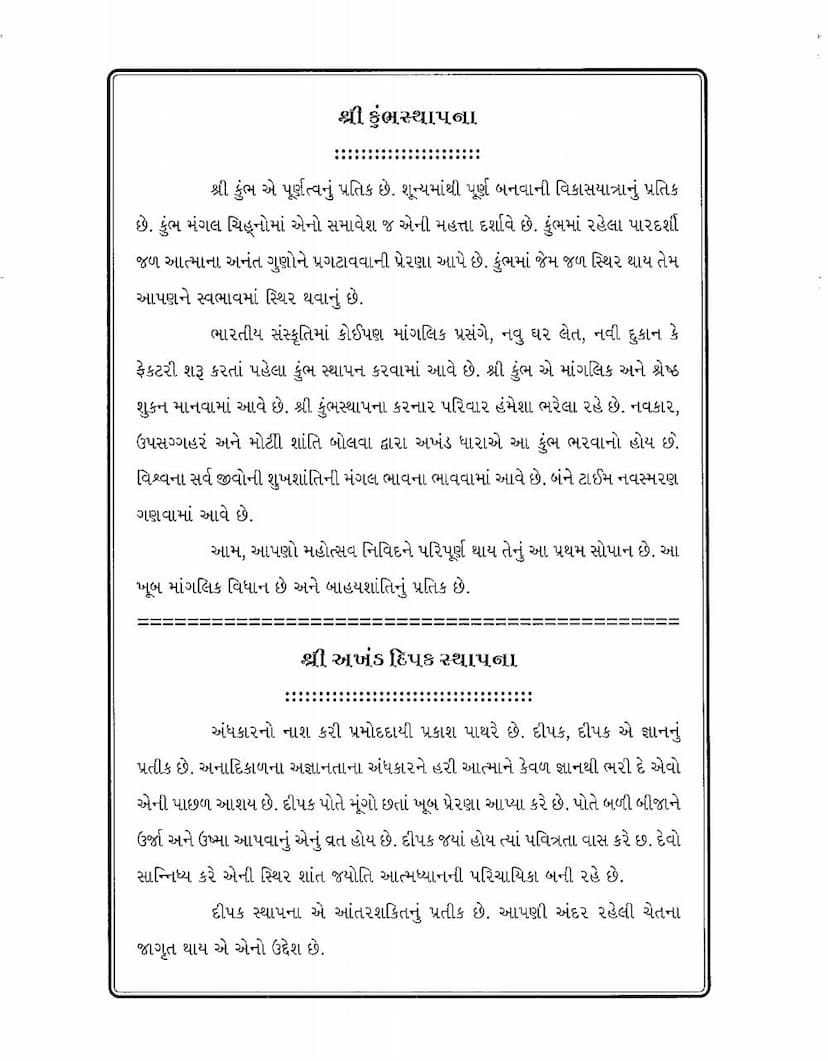
Shri Kumbh Sthapana (Installation of the Pot):
- The Kumbh (pot) symbolizes perfection and the journey from zero to completeness. Its inclusion among auspicious symbols highlights its importance.
- The clear water within the pot inspires the revelation of the soul's infinite qualities. Just as water becomes still in the pot, the devotee should strive for stillness in their true nature.
- In Indian culture, Kumbh Sthapana is performed at auspicious occasions, before moving into a new home, or starting a new business. It's considered an auspicious omen, ensuring a family remains "full" or prosperous.
- The pot is filled with an unbroken stream of devotional recitations like the Navkar Mantra, Upsargahar Stotra, and 'Moti Shanti' (Great Peace). This ritual fosters a benevolent sentiment for the peace and happiness of all beings worldwide.
- This is the first step towards the successful completion of the festival and represents external peace.
-
Shri Akhand Deepak Sthapana (Installation of the Eternal Lamp):
- The lamp dispels darkness and spreads joyous light. It symbolizes knowledge, aiming to eradicate the darkness of primordial ignorance and fill the soul with omniscience.
- Despite being silent, the lamp offers profound inspiration. Its vow is to burn itself to provide energy and warmth to others.
- Purity resides where a lamp is present. Its steady, calm flame, attracting divine presence, serves as a guide for self-meditation.
- Deepak Sthapana symbolizes inner strength, aiming to awaken the dormant consciousness within.
-
Shri Javāraropaṇ (Sowing of Barley):
- This ritual symbolizes cultivating the pure soul-land with the sharp plough of Guru's guidance. Barley seeds of Jinasa (desire for liberation) are sown, and a protective fence is made with practices like vows, great vows, sentiments, and control over senses and actions.
- By irrigating with the water of qualities like pacification and illuminating with the light of self-study, penance, and meditation, sprouts of spiritual maturity (Bhavasthiti) emerge.
- Branches and leaves of good destiny and virtues are formed, flowers of equanimity blossom, and ultimately, the fruit of liberation (Shivagati) is attained.
- This sacred rite is performed by unmarried girls while reciting the Navkar Mantra, with the underlying intention of promoting peace in the world.
-
Shri Thāvagrah Pāṭlā Pūjā (Worship of the Grahas):
- The nine Grahas (planets) are also considered supreme devotees of the Paramatma (Supreme Soul), constantly engaged in His service. They are very powerful.
- In the Pratishtha festival, they are invited with their families, vehicles, and weapons. They are offered an Ashtaprakari Puja (worship with eight types of offerings).
- Each Graha is propitiated with a garland of its respective color, with the aspiration that the Pratishtha festival and its objectives be fulfilled.
-
Shri Darshādēpāl Pāṭlāpūjan (Worship of the Directional Guardians):
- These ten Dikpals (guardians of the ten directions) are invoked with honor and invited.
- They are offered Ashtaprakari Puja, and propitiated with garlands of their respective colors.
- Their blessings are sought for the prosperity, growth, contentment, nourishment, and peace of the entire community (Sakal Sangh).
-
Shri Ashtamangal Pāṭlāpūjan (Worship of the Eight Auspicious Symbols):
- The sight of the Ashtamangala (eight auspicious symbols) is meritorious and auspicious.
- These eight symbols, which indicate good fortune and destroy evil, are worshipped with Ashtaprakari Puja.
- It is mentioned that Indra Maharaj himself inscribes the eight auspicious symbols on Mount Meru at the time of the Prabhu's birth.
-
Shri Nandāvartpūjan (Worship of Nandavarta):
- The word "Nandavarta" is formed from "Nandi" (knowledge) and "Avarta" (flow or cycle). The word "Nandi" is used in the sense of knowledge.
- This puja relates to the Paramatma's state after attaining Kevalgyan (omniscience), specifically the uninterrupted flow of knowledge. The word "Jnana" (knowledge) is an unbroken form.
- This puja is connected to the excellence of the Prabhu's knowledge. It involves the worship of 291 Devotional (Samyakdrashti) deities, who are invited to the Pratishtha ceremony.
-
Shri Adhār Abhisheka (Eighteen Types of Auspicious Baths):
- The text explains that the Prabhu, upon birth, is born with a pure and fragrant body, free from any impurity. After attaining Kevalgyan and Kevaldarshan, the Prabhu is also free from the eighteen types of flaws like ignorance.
- Therefore, the eighteen Abhishekas are not performed on the Prabhu himself. However, since the idol of Jin (Jinvimb) is made of gross matter, it might accumulate impurities due to our inadvertence, ignorance, or lack of attention.
- The eighteen Abhishekas are performed to purify such impurities and cleanse the idol.
- By engaging in the eighteen types of sinful activities, our soul becomes laden with karmas and perpetuates its cycle of rebirth. This ritual is a pure and meritorious act to purify and cleanse the soul from these sinful activities.
Impact of the Pratishtha:
The text concludes by emphasizing the profound impact of the Pratishtha ceremony and the chanting of its mantras:
-
Influence on the Atmosphere: The mantras influence the entire atmosphere.
-
Divine Presence: They attract the presence of deities.
-
Spreading Merit: They propagate virtuous particles.
-
Continuous Auspiciousness: They create an unbroken tradition of auspiciousness and well-being.
-
Spiritual Growth: They open pathways for spiritual development.
-
Alleviation of Suffering: They alleviate the worldly afflictions, diseases, and troubles of the universe.
-
Material and Spiritual Fulfillment: Devotees who perform selfless devotion to Jin are granted the highest material pleasures, while also maintaining detachment towards these pleasures.
-
Inner Peace: They create a continuous flow of virtues and an ocean of peace in life.
-
Equanimity: They prevent one from being distressed by mountains of sorrow that fall upon life due to karma, and also prevent one from becoming overjoyed by overflowing happiness like an ocean. They bestow equanimity in all circumstances, including happiness and sorrow, friends and foes, prosperity and adversity, and favorable and unfavorable conditions.
-
Liberation: Ultimately, they end the ageless wandering and grant liberation from infinite suffering, leading to the attainment of eternal, unfading, and everlasting happiness – the supreme state of Moksha (liberation).
-
Shāntirāgnātra Pūjan (Worship for Peace):
- This puja is performed during the sacred Pratishtha occasion for the upliftment, prosperity, happiness, and peace of the entire community.
- It is a highly auspicious ritual for world peace.
- This pure ritual is performed to pacify factors that create disharmony in the adoration of the path to liberation within the entire Jain community, ensuring its continuous practice.
- 27 or 108 families can participate in this puja.
- Each recitation involves the remembrance and veneration of Lord Shantinath, Lord Parshvanath, 170 Tirthankaras, and the Chatur Nikaya Devas (four classes of deities), with an Abhisheka and Ashtaprakari Puja performed each time.