
Study Of Mahabharata
Added to library: September 2, 2025
Summary
Here's a comprehensive summary of the provided Jain text, "The Study of the Mahabharata" by J. W. de Jong, Part I:
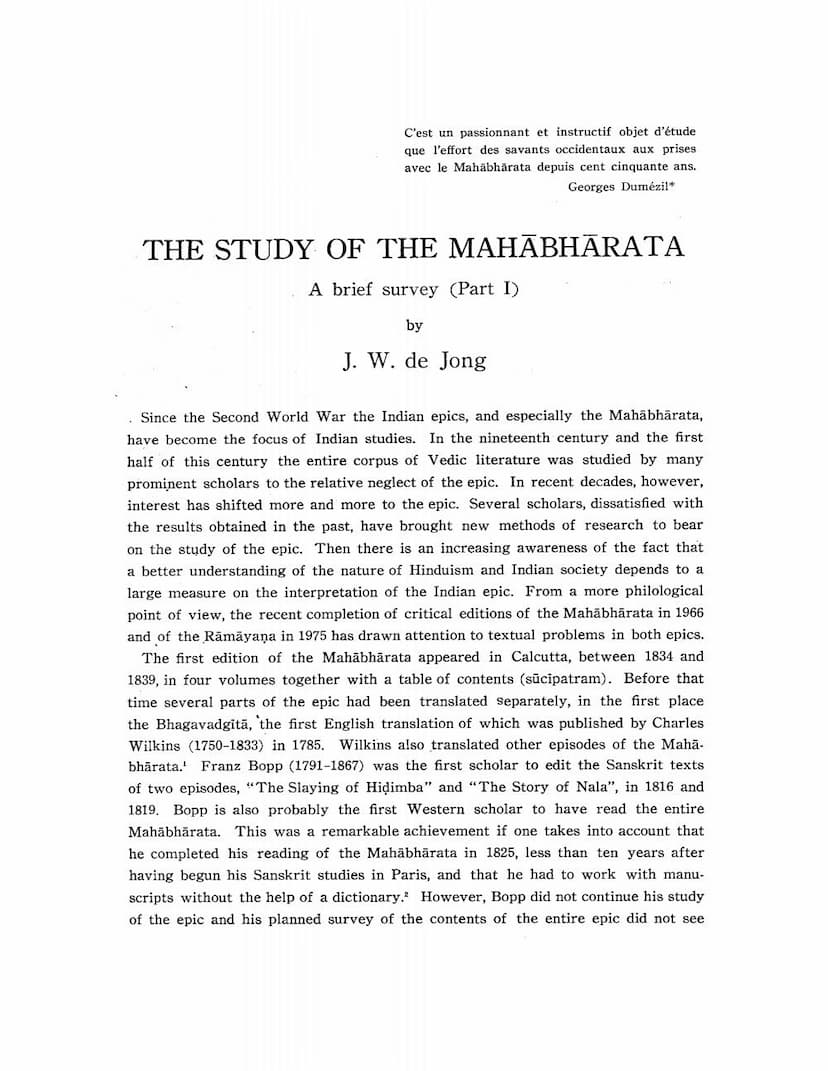
This excerpt, the first part of J. W. de Jong's "The Study of the Mahabharata," provides a historical overview of Western scholarly engagement with the epic, highlighting the evolution of research methods and approaches from the 19th century to the mid-20th century.
Key Themes and Developments:
- Shifting Focus to Epics: The text notes a significant shift in Indian studies after World War II, moving from a primary focus on Vedic literature to a greater emphasis on the Indian epics, particularly the Mahabharata. This shift is attributed to a dissatisfaction with previous results, the introduction of new research methodologies, and a growing recognition of the epics' importance for understanding Hinduism and Indian society.
- Early Western Scholarship and Textual Issues: The early part of the summary details the initial efforts of Western scholars to engage with the Mahabharata.
- Early Editions and Translations: The first edition of the Mahabharata in Calcutta (1834-1839) is mentioned, along with early translations of sections like the Bhagavad Gita by Charles Wilkins. Franz Bopp is credited as the first to edit Sanskrit texts of Mahabharata episodes and likely the first Westerner to read the entire epic, a remarkable feat considering the lack of dictionaries and reliance on manuscripts.
- Christian Lassen's Contributions: Christian Lassen is presented as the first scholar to undertake a systematic study of the Mahabharata, viewing it primarily as a source for pre-Buddhist Indian history. He analyzed the epic for evidence of different recensions and historical timelines, dating the second recension to around 400-460 BCE and the third to shortly after Ashoka. Lassen's work, while influential, was later criticized by scholars like Auguste Barth and V. S. Sukthankar for being arbitrary.
- The "Analytic Theory" and its Proponents: A significant portion of the text is dedicated to the "analytic theory," which aims to dissect the epic into its constituent parts and trace its historical development.
- Søren Sørensen: Sørensen is highlighted as a key proponent of this theory, believing it possible to separate the "Mahabharata saga," "Mahabharata poem," and "Mahabharata compilation." He developed rigorous criteria for identifying later additions and aimed to isolate the core "original poem."
- E. Washburn Hopkins: Hopkins is described as another major advocate of the analytic theory, influencing subsequent scholarship. He proposed a multi-stage development of the epic, from an early "Bhārata (Kuru) lay" to later compilations with expanded didactic material and the eventual elevation of Krishna. Hopkins also viewed the epic as reflecting real historical contests, though disentangling fact from fiction was challenging.
- Moriz Winternitz: Winternitz, a prominent Mahabharata scholar, also adopted an analytical approach, distinguishing layers of the epic: an original heroic poem based on a family feud, accretion of diverse poetry and legends, Brahmanical interpolations of myths and philosophical sections, and later additions by priests and ascetics.
- J. A. B. van Buitenen: More recent scholarship, represented by van Buitenen, continues the analytical tradition. He outlines a "central story" with "later" accretions and a "third perimeter" of Brahmanization. Van Buitenen posits a development from an 8th or 9th-century BCE original poem to a text largely completed by 200 AD, with didactic portions added later.
- The "Inversion-Theory": Adolf Holtzmann and his nephew are discussed for the "inversion-theory," which proposed that the original poem favored the Kauravas and was later revised to favor the Pandavas. This theory, though influential, faced significant criticism.
- The "Mythological Theory": Alfred Ludwig's mythological theory, which viewed the epic as a transformation of a seasonal myth, is briefly mentioned as a contrast to historical approaches.
- Joseph Dahlmann's "Holistic" Approach: Joseph Dahlmann is presented as an outlier who strongly advocated for the unity and homogeneity of the epic, viewing it as a singular creation centered on dharma and the battle between dharma and adharma. His work, while influential in reviving interest, was criticized for exaggerating the text's unity and for his early dating.
- G. J. Held's Ethnological Perspective: A significant portion of the text is dedicated to the work of G. J. Held, who offered a new, ethnographic perspective. Held opposed the analytical method, arguing that the epic should be understood within its cultural context. He proposed that the epic reflects a social organization based on moieties or phratries, with the Kauravas and Pandavas representing these divisions. He saw the epic as a myth connected to ritual, highlighting the complementary and rivalrous relationship between these groups, a structure also observed in celestial beings like devas and asuras. Held emphasized the importance of understanding the epic's cultural function and interrelationship between myth, ritual, and society.
- The Role of Krishna: The text touches on the evolving portrayal of Krishna, from a heroic figure to a divine one, and how scholars like Held interpret his dual nature (benefactor and trickster) as integral to the phratry structure.
In essence, Part I of "The Study of the Mahabharata" chronicles the intellectual journey of Western scholars in understanding this complex epic, showcasing the debates and evolving methodologies that have shaped its interpretation, from early philological and historical analyses to more structural and ethnographic approaches.