
Study Of Mahabharata
Added to library: September 2, 2025
Summary
This document is a detailed survey of scholarly approaches to understanding the Mahabharata, focusing on mythological interpretations. Here's a comprehensive summary:
Part II: Mythological Interpretations of the Mahabharata
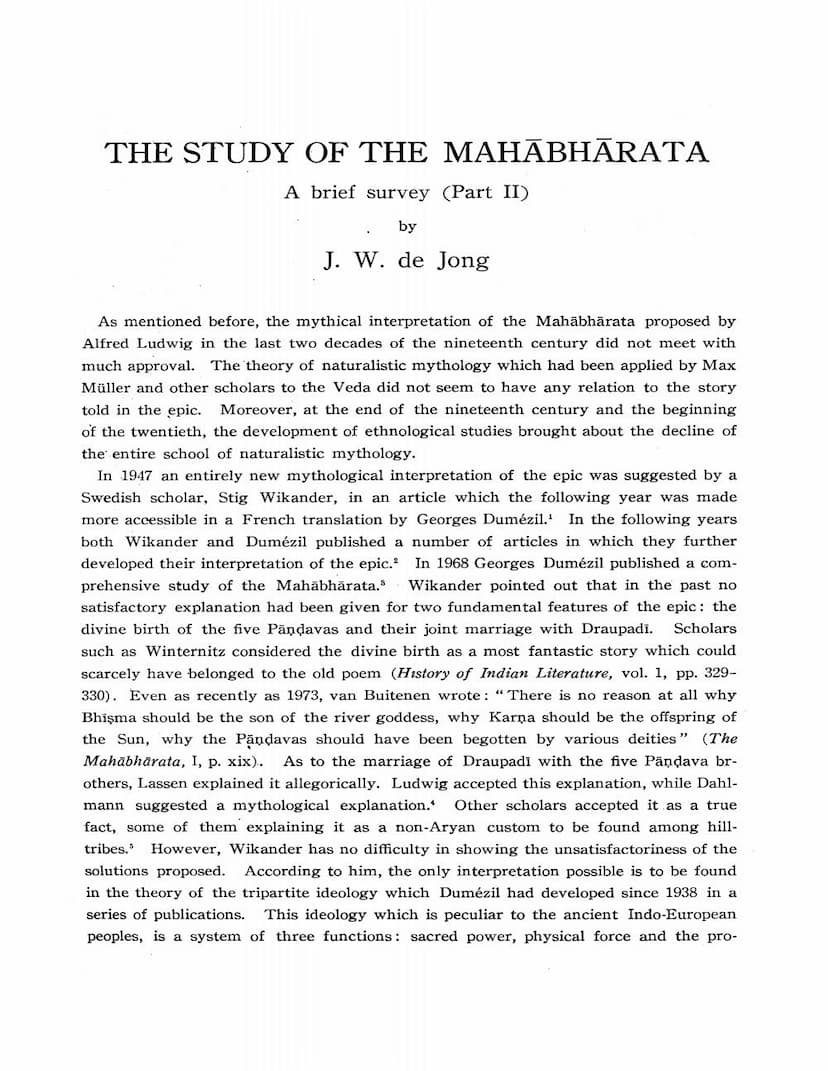
The author, J.W. de Jong, begins by noting the decline of early 19th-century naturalistic mythological interpretations of the Mahabharata, pioneered by scholars like Alfred Ludwig. These theories, which saw Vedic myths in epic stories, failed to gain traction, partly due to the rise of ethnological studies.
The Wikander-Dumézil Interpretation:
A significant shift occurred in 1947 with Swedish scholar Stig Wikander's new mythological interpretation, further developed by Georges Dumézil. This approach centers on the tripartite ideology prevalent in ancient Indo-European societies, which posits a division of society and deities into three functions:
- Sacred Power: Represented by priests and spiritual authority.
- Physical Force: Embodied by warriors and rulers.
- Productivity/Material Prosperity: Associated with farmers, merchants, and artisans.
In India, these functions are traditionally linked to the three varnas: Brahman, Kshatriya, and Vaishya. Dumézil emphasizes that this tripartite structure might be an ideal or an analytical tool, not necessarily a literal societal division.
Wikander and Dumézil argue that the Mahabharata's key elements, often considered problematic by earlier scholars, are explained by this tripartite ideology:
-
Divine Birth of the Pandavas: The Pandavas' divine parentage is interpreted as a representation of the three functions. Yudhisthira (son of Dharma) embodies sacred power. Bhima and Arjuna (sons of Vayu and Indra, respectively) represent physical force. Nakula and Sahadeva (sons of the Asvins) represent the productive class. The divine fathers themselves are seen as embodiments of these three functions. Wikander's assertion that Bhima's father, Vayu, is Indo-Iranian rather than Vedic, suggests the myth's ancient origins, predating the specific Vedic pantheon. Dharma's incarnation as a Brahman during Yudhisthira's exile is seen as representing the passive aspect of sacred kingship.
-
Joint Marriage with Draupadi: This polyandrous marriage is linked to the Indo-Iranian tradition of associating a female deity of fertility with the male gods of the three functions. Draupadi, viewed as an incarnation of the goddess Shri, embodies this synthesis. The complexity of this association, with Shri having affinities for the second function, remains a point of discussion for Dumézil.
-
Karna's Origins: Karna's divine parentage (son of Surya) and his birth with armor and earrings are compared to Indo-European sun myths, particularly those found in the Ossetian epic, suggesting a retention of ancient solar mythology.
-
Pāṇḍu, Dhṛtarāṣṭra, and Vidura: Dumézil attempts to link these characters to Vedic deities. Pāṇḍu is hypothetically linked to Varuna, Dhṛtarāṣṭra to Bhaga, and Vidura (son of Vyasa and a Shudra woman, also an incarnation of Dharma) to Aryaman. The absence of direct links in Vedic texts and the fact that Aryaman and Bhaga are minor deities in the Mahabharata pantheon present challenges to this theory. Dumézil suggests that Dharma replaced Mitra for Yudhisthira as the term "dharma" evolved to encompass Mitra's essence.
-
Bhishma: Bhishma's incarnation as the sky god Dyu is compared to the Scandinavian god Heimdallr, indicating a loss of important archaic mythological elements in the Vedic texts that were preserved elsewhere in Indo-European traditions.
-
Aśvatthāmā's Massacre and Eschatology: The massacre of the Pandava warriors by Aśvatthāmā (incarnation of Śiva-Rudra) is seen as an epic transposition of an eschatological crisis, a confrontation between Rudra and Vishnu (in the form of Krishna). Dumézil draws parallels with Scandinavian eschatology, suggesting a common Indo-European origin for such beliefs.
Wikander and Dumézil's continued work refined these ideas. They highlight the distinction between the Pandava brothers (Yudhisthira, Bhima, Arjuna) and the twins (Nakula, Sahadeva), suggesting that the former, born to Kunti, represent the first two functions, while the latter, born to Madri, represent the third. The difference in their divine fathers and the "asuric" nature of Pāṇḍu's marriage to Madri are noted. Dumézil posits that certain ancient theological doctrines not found in Vedic hymns must have been orally transmitted, and compares the specialized twins in the Mahabharata to similar figures in other Indo-European mythologies.
Madeleine Biardeau's Approach:
Madeleine Biardeau offers a contrasting yet complementary perspective, focusing on classical Hinduism as found in epics, Puranas, and contemporary religious practices. While Dumézil looks to Indo-European origins, Biardeau emphasizes the Mahabharata as an integral part of a continuing Hindu tradition.
-
Cosmic Crisis and Pralaya: Biardeau connects the Mahabharata's plot to the Puranic concept of pralaya (cosmic dissolution and recreation). The epic's events, occurring at the junction of two yugas (ages), reflect the symbolism of pralaya, including cosmic fire, flood, and the subsequent recreation by Vishnu-Narayana. The Pandavas' exile is interpreted as an attenuated form of pralaya.
-
Sacrifice and the Battle: The epic battle is seen as a cosmic ritual, comparable to the pralaya, carried out as a sacrifice. The war signifies the degradation of dharma leading to catastrophe, but also its resurgence through the actions of the dharmic princes.
-
Avatar Doctrine: Biardeau analyzes the concept of the avatar, particularly Krishna. The avatar is a supreme being who descends to restore dharma, embodying both destroyer and creator roles, and uniting opposing forces like Rudra-Śiva and Viṣṇu-Nārāyaṇa. The avatar can also be both a Brahman and a warrior, exemplified by Parashurama.
-
Bhakti and Salvation: Biardeau highlights the universalizing nature of bhakti (devotion), which offers salvation to all, irrespective of caste or merit. This universality stems from the divine yogin's impartiality. The relationship between the king and the avatar is crucial, justifying the king's duties, including warfare for dharma. The salvation of the king's martial activity through bhakti is a key theme, exemplified in Arjuna's role and the Bhagavad Gita. The Gita teaches acting without attachment to results, integrating renunciation and duty.
P.A. Grintser's Oral-Formulaic Approach:
P.A. Grintser, in contrast to mythological interpretations, examines the Mahabharata through the lens of oral literature and its typological similarities with other epics.
-
Oral Tradition and Formulas: Grintser applies the methods of Milman Parry and A.B. Lord, focusing on the use of fixed formulas in oral poetry. He identifies various categories of formulas (attributive, narrative, auxiliary, direct speech, maxims, similes) that are characteristic of oral composition. While acknowledging the limited applicability of Parry's strict formulaic principles due to Sanskrit's metrical variety and synonymy, Grintser finds a significant presence of formulas and formulaic expressions in the Mahabharata.
-
Oral Techniques: Grintser analyzes other hallmarks of oral literature found in the epic, including themes (repeated narrative or descriptive elements), repetitions (literal or varied), inserted episodes (to fill temporal gaps or convey meaning), and catalogues. He explains repetitions not as signs of inauthenticity but as functional elements of oral performance.
-
Genesis and Typology: Grintser discusses the epic's genesis, suggesting it evolved from a shorter narrative expanded by Bhargava Brahmans and that didactic elements were later reinforced. He believes the Mahabharata has a historical basis, possibly around 1000 BC, and an "Indian heroic age" from the 14th to 10th centuries BC. He compares the Mahabharata to other epics, classifying it as an "epic of heroic war," and notes shared motifs like the abduction of a wife, arguing for a common compositional scheme underlying fairy tales and epics.
-
Myth and Folk-tale: Grintser distinguishes between myth and folk-tale based on their semantics and historical context. Myth deals with cosmic or ritual gains in ahistoric time, while folk-tale involves individual treasures in historic time. Both, however, share a common compositional structure. He notes that the epic, while using mythical motifs, presents them in a historical context and with active, self-reliant heroes, differing from the passive figures in folk-tales.
Key Differences and Overlap:
The text highlights the distinct approaches of Dumézil (Indo-European functional mythology) and Biardeau (classical Hindu religion and Puranic traditions). While Dumézil traces the epic's roots to ancient European mythologies, Biardeau interprets it as a living document of Hindu thought. Grintser, on the other hand, focuses on the structural and compositional aspects derived from oral tradition. Despite their differences, these scholars acknowledge that their approaches are not mutually exclusive, and that understanding the Mahabharata requires considering various perspectives.
The document concludes by noting that despite extensive scholarly work, several problems within the Mahabharata, such as the unexplained names of heroes and the absence of certain Vedic deities, remain subjects of ongoing research.