
Studies On Bhartrhari 3
Added to library: September 2, 2025
Summary
Here's a comprehensive summary of the provided text, "Studies on Bhartrhari 3" by Johannes Bronkhorst, focusing on Bhartrhari's concepts of sphota and universals:
Introduction: The Mystery of Sphota and the Quest for Understanding
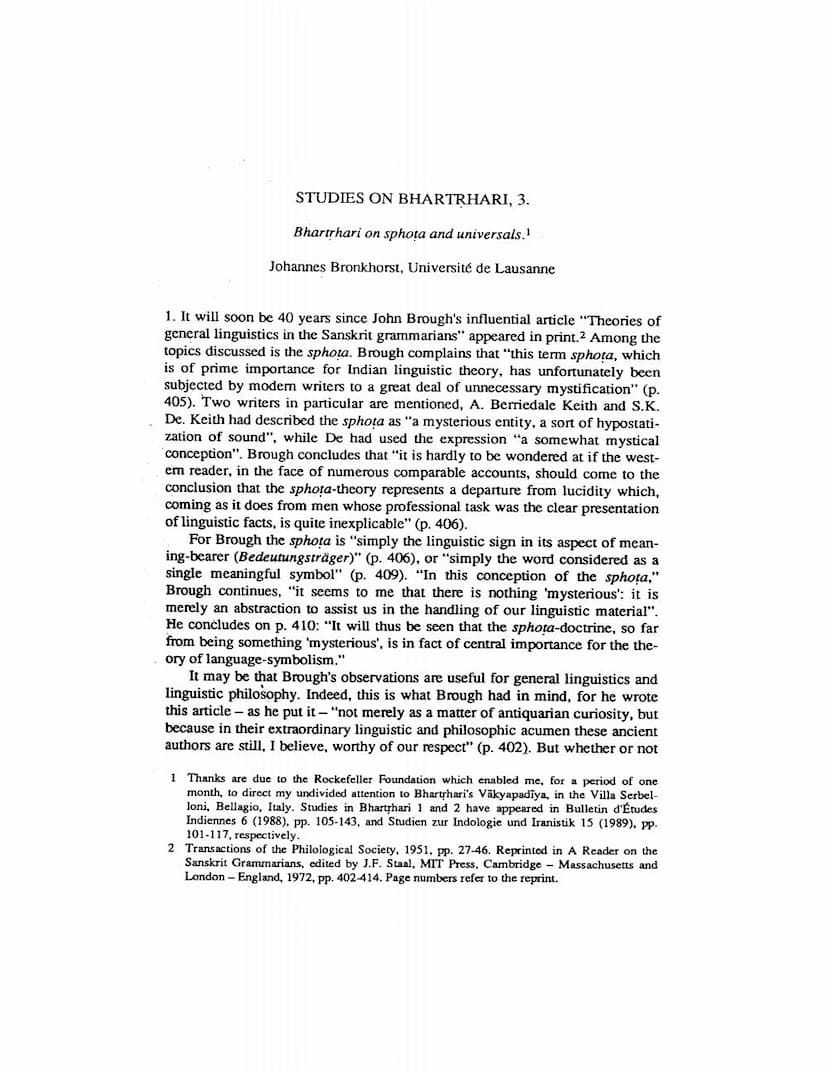
Bronkhorst begins by referencing John Brough's influential 1951 article on Sanskrit grammarians, particularly its discussion of sphota. Brough aimed to demystify sphota, defining it as "simply the linguistic sign in its aspect of meaning-bearer" or "the word considered as a single meaningful symbol." Brough saw sphota as an abstraction essential for understanding language symbolism and criticized earlier interpretations by Keith and De for imbuing it with unnecessary mystique.
However, Bronkhorst argues that Brough's "familiarity" with sphota through comparison with modern linguistics does not equate to true understanding, especially within the context of Bhartrhari's broader philosophical system. Brough acknowledges that Indians attributed an "ontological status" to sphota and built a "metaphysical superstructure" upon it, even quoting a verse (VP 1.96) stating that sphota is considered a jati (universal) by some. Brough dismisses this view, preferring to see sphota as an individual. Bronkhorst questions whether we truly understand Bhartrhari if we don't grasp how sphota fits into this metaphysical framework, citing examples like Bhartrhari's views on the indivisibility of sentences, pots, and the Rigveda as areas Brough's analysis doesn't fully illuminate.
Critique of Radhika Herzberger's Interpretation
Bronkhorst then turns to Radhika Herzberger's "Bhartrhari and the Buddhists," criticizing her attempt to integrate Bhartrhari's grammatical and metaphysical ideas. Herzberger's core question is about the basis of naming. She attributes a theory of two types of universals to Bhartrhari: arthajāti (thing-universals) and śabdajāti (word-universals), with the latter being more significant. She describes word-universals as having phonological, syntactic, and semantic strands, enabling direct access to a word's meaning.
Herzberger posits a hierarchical structure for word-universals, culminating in a "Great Being" or "Supreme Universal." Bronkhorst systematically challenges this interpretation based on the Vākyapadiya (VP):
- Two Kinds of Universals: Bronkhorst agrees this point is established by VP 3.6, which states words first express their own universal.
- Semantic Aspect of Word-Universals: Bronkhorst finds this problematic, arguing that the stanza cited by Herzberger (VP 3.3) doesn't support this. He suggests Herzberger misunderstands the preceding stanza (VP 3.2) which discusses universals and individuals as objects of words, not as divisions of words themselves. Bronkhorst reinterprets upalakṣaṇa (indicated by) in VP 3.3 as "coimplies," suggesting it refers to the functional capacity of a material like khadira.
- Hierarchical Structure: Bronkhorst scrutinizes Herzberger's use of VP 3.7-8 to support this. He argues that Herzberger's interpretation of "the effect of universals" (jātikārya) as proof of hierarchy is unwarranted. He analyzes VP 3.9-10, suggesting Herzberger's reliance on a less reliable textual reading leads her to an artificial interpretation. Bronkhorst's reading of VP 3.9-10 explains the formation of plurals like jātayaḥ (universals) and śabdajātayaḥ (word-universals) through the concept of ekaśeṣa (singular remainder), where a word-universal can substitute for a non-existent thing-universal, rather than proving a hierarchy.
- Supreme Universal: Bronkhorst disputes Herzberger's claim that VP 3.33 supports a "Supreme Universal" at the top of this hierarchy. He points out that the word "Supreme" is an addition by the translator, not present in the original Sanskrit.
Bronkhorst concludes that Herzberger's interpretation of Bhartrhari's ideas on universals is not supported by the text and her understanding of Dignāga is also influenced by her flawed reading of Bhartrhari.
Bronkhorst's "Top-Down" Approach: Brahman and Universals
Bronkhorst proposes a "top-down" approach, starting with the metaphysical foundation of Bhartrhari's thought, which he believes came first in Bhartrhari's own vision. He analyzes stanzas VP 3.32-39, identifying Bhartrhari's absolute as Brahman, which he intends to argue is conceived as the totality of existence.
These stanzas describe Being (Brahman) as the fundamental reality. Each thing has a real and an unreal part; the real part is the universal. Brahman itself, when differentiated into "cows etc.," becomes the universal. This differentiation happens through "powers" of Brahman, introducing sequential and temporal divisions that create the "unreal phenomenal world." Universals, therefore, are not abstract entities separate from things but are, in their real aspect, identical with Brahman. Bronkhorst compares Bhartrhari's universals to Plato's Ideas: real and unchanging, while phenomenal appearances are their unreal reflections.
Sphota as Universal: Reconciling with VP 1.96
Applying this framework to sphota, Bronkhorst concludes that the real word, the sphota, is a universal. This aligns with the view attributed to "some" in VP 1.96. He reiterates that sphota and sound are not different in their essence, just as a pot and its "potness" (as a universal) are not different in their true reality, although sound, unlike sphota, has spatial and temporal dimensions (as seen in VP 1.99). This is further illustrated by the doctrine that sense organs are of the same nature as their objects (VP 1.100-101).
Bronkhorst addresses why the view of sphota as a universal is attributed to "some." He notes Bhartrhari acknowledges two views on what words denote: universals or substances (dravya). The Vākyapadiya's third kāṇḍa presents both perspectives. Bronkhorst argues that whether the ultimate referent is a universal or a substance, all words ultimately denote Brahman.
Sphota as Substance: The Alternative View
Bronkhorst then explores the alternative view where sphota is understood as a substance. This is presented in VP 1.105 onwards. Here, sphota is described as an utterance produced by the organs of speech, and subsequent sounds are born from it. The "substantial" nature is emphasized in stanzas 110 and 120, where sphota is identified with wind, atoms, or knowledge. These views present sphota as a superfine substance, not directly perceived but manifested by specific causes. This offers a way to maintain the timelessness of sphota even when physical sounds are temporary. Bronkhorst notes that the inclusion of "knowledge" reflects an idealist perspective where reality is derived from knowledge, ultimately identical with Brahman.
Bhartrhari, as is his practice, does not definitively choose between the universal or substance view of sphota. The crucial point is that the duration of the sphota is independent of the duration of perceived sound.
Appendix: Authorship of the Vrtti
Bronkhorst adds an appendix questioning the authorship of the Vrtti (commentary) on the Vākyapadiya. He argues that the Vrtti's interpretation of stanzas like VP 1.99 is more forced and artificial than his own. Specifically, he points out that the Vrtti's interpretation of "no difference between sound and word" as denial of "difference of location" is less plausible than his interpretation of it as a denial of fundamental difference between sound and sphota. He also finds the Vrtti's explanation of the stanzas as responses to absurd objections unconvincing.
Conclusion
In essence, Bronkhorst argues that to truly understand Bhartrhari's concepts of sphota and universals, one must engage with his overarching metaphysical framework, which begins with Brahman as the ultimate reality. He critiques attempts to demystify sphota through modern linguistic parallels or by focusing solely on grammatical aspects without considering the philosophical underpinnings. Bronkhorst presents Bhartrhari's sphota as either a universal intrinsically linked to Brahman or as a subtle substance, both views ultimately reinforcing the idea that language, in its deepest sense, is a manifestation of this ultimate reality.