
Studies On Bhartrhari
Added to library: September 2, 2025
Summary
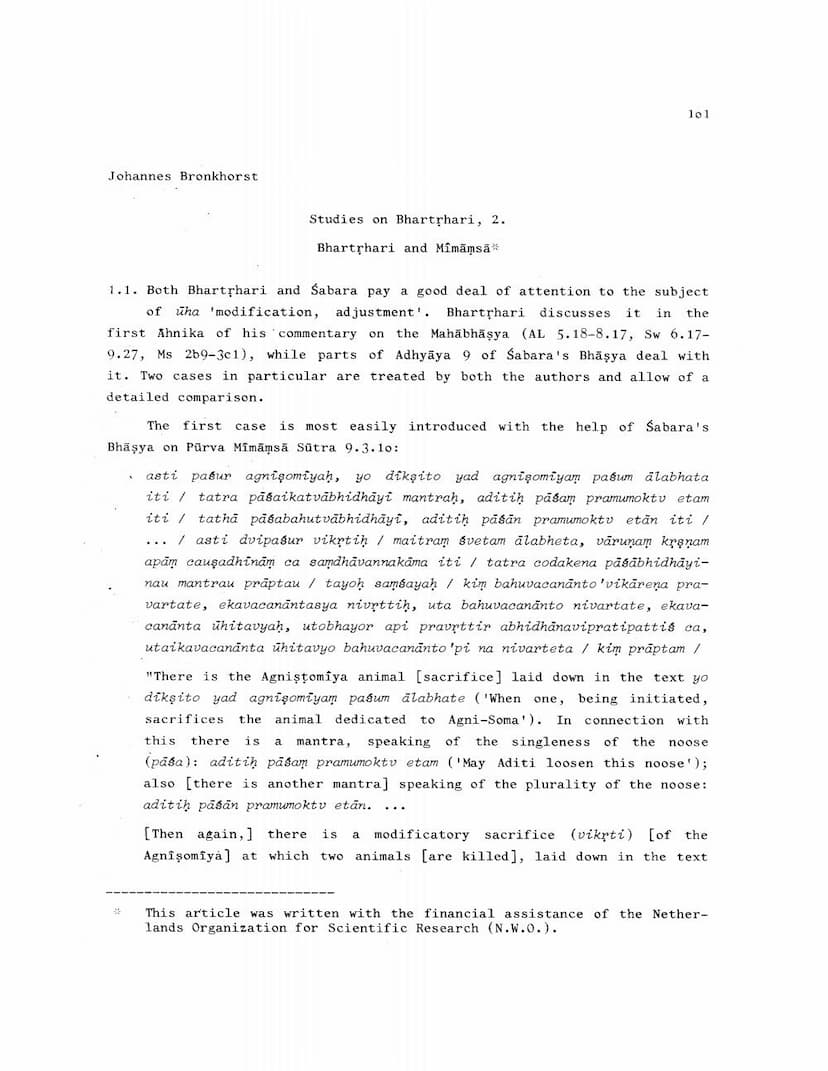
This document, "Studies on Bhartṛhari, 2. Bhartṛhari and Mīmāṁsā" by Johannes Bronkhorst, explores the relationship between the grammarian Bhartṛhari and the Mīmāṁsā school of Indian philosophy, particularly focusing on how Bhartṛhari's work intersects with Mīmāṁsā discussions on ritual and grammatical interpretation.
The core argument is that Bhartṛhari was knowledgeable about Mīmāṁsā but did not directly engage with or rely on the Mīmāṁsā tradition, especially Śabara's Bhāṣya, when dealing with ritualistic details. Instead, Bronkhorst posits that Bhartṛhari drew heavily from the ritualistic traditions of his own Vedic school, likely the Maitrāyaṇīyas.
Here's a breakdown of the key points:
1. Bhartṛhari and Mīmāṁsā on Uha (Modification/Adjustment):
- Shared Interest: Both Bhartṛhari and Śabara discuss the concept of uha, which involves modifying liturgical texts (mantras) to fit different ritual contexts.
- Case Study 1: Aditiḥ pāśān pramumoktu:
- Śabara discusses the modification of a mantra involving plural "nooses" (pāśān) when applied to a sacrifice with two animals. He ultimately argues for modifying the singular form to a dual.
- Bhartṛhari, however, discusses a similar mantra. For his specific Vedic school (likely Maitrāyaṇīya), a rule existed that the plural form pāśān was used without modification even when only one noose was present in the original ritual. For the Vājasaneyins, the singular pāśam was used, requiring modification.
- Bronkhorst's conclusion: Bhartṛhari's description of uha in this case reflects the practice of the Maitrāyaṇīya school, not the general Mīmāṁsā position presented by Śabara. The similarity between Bhartṛhari's view and an unaccepted position in Śabara's discussion suggests that Mīmāṁsakas might have been aware of different Vedic school traditions.
- Case Study 2: Adhrigu Mantra:
- Bhartṛhari discusses the adhrigu mantra, specifically the phrase "it has twenty-six ribs" (ṣaḍviṁśatir asya vaṁkrayas). He interprets a rule that this phrase is repeated when there is more than one animal.
- Śabara argues against repeating the numeral and suggests mentioning the total number of ribs.
- Bronkhorst's conclusion: Bhartṛhari's discussion here shows clear influence from the Mānava Śrauta Sūtra (MSS) and a specific stanza attributed to the ritualistic tradition of a Vedic school, likely Maitrāyaṇīya. This further supports the idea that Bhartṛhari's sources were ritualistic texts rather than Mīmāṁsā treatises.
2. Bhartṛhari's Independent Ritual Knowledge:
- Bhartṛhari's discussions on ritualistic matters, like the Sunaskarṇastoma sacrifice and the use of vibhaktis (case endings) in prayers, demonstrate reliance on specific ritual manuals, particularly the Mānava Śrauta Sūtra.
- He introduces a stanza on uha that governs his discussion on the adhrigu mantra, which is not found in earlier Mīmāṁsā works, reinforcing his reliance on non-Mīmāṁsā ritual traditions.
- His understanding of the Sunaskarṇastoma sacrifice, particularly the interpretation of "desiring one's own death" (maraṇakāmo), is cited as authority by later Mīmāṁsakas, indicating Bhartṛhari's distinct interpretation derived from his own sources.
3. Bhartṛhari's Knowledge of Mīmāṁsā:
- Despite his independent approach to ritual, Bhartṛhari was clearly acquainted with Mīmāṁsā. He uses the term "Mīmāṁsaka" in his commentary and quotes Mīmāṁsā positions.
- However, his engagement with Mīmāṁsā appears to be with an earlier, possibly verse-containing, Mīmāṁsā work, rather than Śabara's Bhāṣya. This unknown work might be Bhavadāsa's Vṛtti.
- Bhartṛhari's discussion on the eternality of words and the Mīmāṁsā view on dharma indicates an awareness of Mīmāṁsā debates. His contrasting statement about dharma being manifested by sacrifices, rather than produced, suggests he was engaging with views that predated or differed from Śabara's.
4. Conclusion:
- Bhartṛhari was not a Mīmāṁsaka.
- He possessed deep knowledge of ritualistic practices, drawing primarily from the tradition of his Vedic school (most likely Maitrāyaṇīya), evidenced by his use of Srauta Sūtras like the Mānava Śrauta Sūtra.
- His engagement with Mīmāṁsā was indirect, likely through an earlier Mīmāṁsā text (possibly Bhavadāsa's Vṛtti) rather than Śabara's Bhāṣya.
- The study highlights that Bhartṛhari's expertise lay in grammar and its application to Vedic ritual, but his primary sources for ritualistic details were distinct from the formal Mīmāṁsā tradition as represented by Śabara.
In essence, Bronkhorst's article argues for a nuanced understanding of Bhartṛhari's relationship with Mīmāṁsā, positioning him as an informed observer of Mīmāṁsā who nevertheless operated within and drew upon his own distinct Vedic school tradition for his analyses of ritual and language.