
Studies On Bhartahari And Prakrta Dhvani And Samkhya Tanmatras
Added to library: September 2, 2025
Summary
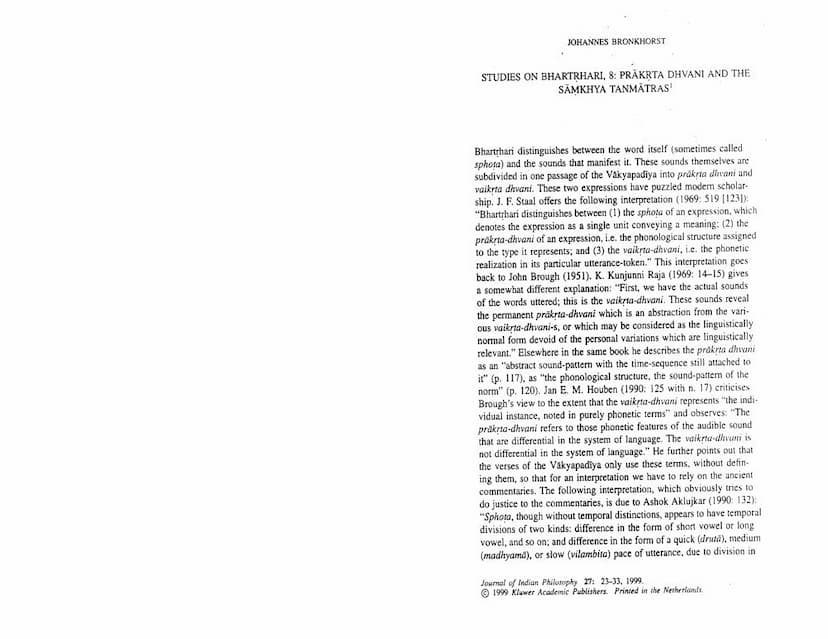
This document, "Studies on Bhartṛhari, Prakṛta Dhvani and the Samkhya Tanmātras" by Johannes Bronkhorst, explores the meaning of the terms prakṛta dhvani and vaikṛta dhvani in the philosophical tradition, particularly in relation to the work of Bhartṛhari, a renowned grammarian and philosopher.
The central thesis is that these terms, often difficult to interpret, likely have their origins in the Samkhya philosophy. Bronkhorst begins by examining various modern scholarly interpretations of Bhartṛhari's distinction between prakṛta dhvani and vaikṛta dhvani. These interpretations generally suggest a division within sound itself:
- Sphota: The ultimate, meaning-bearing unit of language, considered timeless.
- Prakṛta dhvani: A phonological structure or abstract sound-pattern, considered the "primary manifesting sound" or the "linguistically normal form."
- Vaikṛta dhvani: The actual phonetic realization in a particular utterance, or "secondary manifesting sounds" that reveal tempo and other variations.
Bronkhorst critiques these interpretations, suggesting they might impose modern linguistic notions onto ancient texts. He then proposes an alternative approach: to investigate the origins of the terms prakṛta and vaikṛta themselves, linking them to the Samkhya concept of prakṛti (original nature) and vikṛti (modification/product).
The paper delves into the Samkhya cosmological system, specifically its twenty-five principles (tattvas). Key to this is the concept of tanmātras, described as subtle, unmanifested essences of sensory qualities, which are themselves derived from ahaṁkāra (ego). The five tanmātras are:
- Śabda-tanmātra (sound)
- Sparśa-tanmātra (touch)
- Rūpa-tanmātra (color)
- Rasa-tanmātra (taste)
- Gandha-tanmātra (smell)
The text highlights a significant aspect of Samkhya doctrine: the tanmātras are described as "without specific features" (aviśeṣa). For instance, the śabda-tanmātra is sound "and nothing but that," devoid of specific features like accents (udātta, anudātta, svarita) or nasalization. This aligns with Bhartṛhari's prakṛta dhvani, which is presented as a more fundamental, less differentiated aspect of sound.
Bronkhorst hypothesizes that an earlier form of Samkhya, known to Bhartṛhari, may have considered qualities (guṇas) as the final evolutes (vikṛtis) derived from the tanmātras. In this model:
- The śabda-tanmātra would be the prakṛta sabda (original sound).
- The quality of sound itself, along with any "adventitious features" (like those distinguishing short, long, or protracted vowels, or tempo), would constitute the vaikṛta sabda (modified sound).
This hypothesis suggests that prakṛta sabda (sound as a subtle essence) gave rise to vaikṛta sabda (the perceivable qualities of sound). Bronkhorst acknowledges that Samkhya texts don't explicitly use the terms prakṛta sabda or vaikṛta sabda, but argues that the conceptual framework supports this interpretation, particularly in understanding Bhartṛhari's usage.
The paper then analyzes specific verses from Bhartṛhari's Vākyapadīya and its commentaries. These verses describe prakṛta dhvani as being "without difference of duration" and the cause of grasping the sphota. Vaikṛta dhvani, in contrast, is associated with differences in condition, such as the speed of utterance (druta, madhyama, vilambita). The commentaries suggest that vaikṛta dhvani can follow prakṛta dhvani, extending the perception of sound.
Bronkhorst concludes that Bhartṛhari's distinction between prakṛta dhvani and vaikṛta dhvani is likely a philosophical adaptation of an older Samkhya doctrine. The revision of Samkhya that replaced qualities with the five elements led to the disappearance of this distinction within Samkhya itself, and consequently, later commentators like Vṛṣabhadeva did not understand Bhartṛhari's usage in this context. The core idea is that prakṛta dhvani represents a purer, more fundamental aspect of sound, while vaikṛta dhvani encompasses the variations and concrete manifestations of sound in actual speech.