
Studien Zum Dvadasaranayacakra Des Svetambra Mallavadin
Added to library: September 2, 2025
Summary
Here's a comprehensive summary of the provided Jain text, focusing on the key arguments and discoveries presented by A. Wezler regarding Mallavadin's Dvadasaranayacakra (NC):
The Core Subject: Mallavadin's Dvadasaranayacakra and the Sarvasarvatmakatvavada
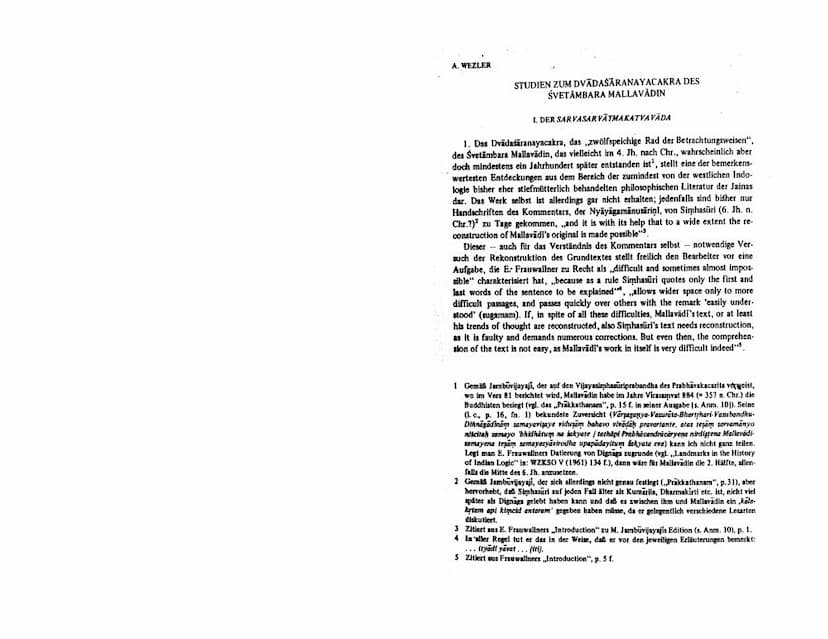
The article, "Studien Zum Dvadasaranayacakra Des Svetambra Mallavadin," by A. Wezler, introduces and analyzes a significant Jain philosophical work, the Dvadasaranayacakra (NC) by Mallavadin, believed to have originated around the 4th century CE or later. The original text of the NC is lost; our understanding relies heavily on the commentary Nyayagamanusarini by Simhasuri (6th century CE). Wezler acknowledges the immense difficulty of reconstructing Mallavadin's original text due to Simhasuri's quoting practices and the inherent complexity of Mallavadin's thought.
The Significance of the Dvadasaranayacakra
Wezler highlights the NC's importance not only for Jain philosophy but also for the study of other Indian philosophical systems. Its unique structure, based on "twelve modes of consideration" (dvadasaranayacakra), provides valuable insights into older and contemporary non-Jain thinking, particularly for periods with scarce surviving literature from those traditions. The NC sheds light on "important and creative periods of Indian Philosophy."
Reconstructing the Text and Editorial Efforts
The article details the evolution of scholarly editions of the NC, noting the efforts of Muni Caturvijayaji, Lalcandra B. Gandhi, and notably, Muni Jambūvijayaji. Jambūvijayaji's edition is praised for its scholarly rigor, meticulous reconstruction of Mallavadin's original text, and extensive use of manuscript material, including a particularly valuable manuscript (bha). This edition is considered a significant advancement for future research.
The Central Philosophical Debate in Chapter III: Samkhya, Isvaravada, and Sarvasarvatmakatvavada
The main focus of the article is an analysis of a crucial dialectical debate presented in the third chapter of the NC, vidhyubhayara. Wezler identifies a discrepancy between the interpretations of this chapter by Erich Frauwallner and Muni Jambūvijayaji.
- Frauwallner's Interpretation: Frauwallner believed that in this chapter, the Isvaravadin (a proponent of theism) refutes the central tenets of the Samkhya system, and in turn, allows the Samkhya to be refuted by the Isvaravadin.
- Jambūvijayaji's Interpretation: Jambūvijayaji, however, argues that it is a sarvasarvatmakatvavadin (a proponent of the doctrine that "everything is everything" or "everything is of all things") who refutes Samkhya metaphysics, and this sarvasarvatmakatvavadin is then subsequently criticized by the Isvaravadin.
Identifying the Sarvasarvatmakatvavada and its Samkhya Roots
Wezler's detailed textual analysis strongly supports Jambūvijayaji's interpretation. Through extensive citation and translation of passages from the NC and its commentary, Wezler establishes that the sarvasarvatmakatvavada is a fundamental and integral element of Samkhya ontology. The core of this doctrine is the idea that every individual phenomenon contains within itself, in an unmanifested state, representatives of all other phenomena. This is exemplified through the "alimentary chain" – the observation that animals consume plants and other animals, leading to the philosophical conclusion that the consumed matter remains in the consumer.
Crucially, Wezler demonstrates that this vada is not merely a Samkhya doctrine but also appears in other philosophical traditions, notably in later discussions on theories of error by thinkers like Prajñākaragupta and Ramanuja. This leads to a complex discussion about the historical relationship between Samkhya and these other schools, with Wezler proposing that the sarvasarvatmakatvavada may have originated in a shared pre-Samkhya tradition.
Critique of Frauwallner's Historical Reconstruction
A significant portion of the article involves a critical re-evaluation of Erich Frauwallner's historical analyses of Samkhya. Wezler argues that Frauwallner's dating and understanding of the development of Samkhya doctrines, particularly the causal theory (satkaryavada) and the concept of being, may be flawed. He suggests that the sarvasarvatmakatvavada and the Samkhya concept of being are more deeply rooted in earlier traditions, possibly even influencing later theistic schools, rather than being solely later developments within Samkhya designed to prove the existence of prakrti (primordial matter).
The Role of the Isvaravadin
The article clarifies that the Isvaravadin in chapter III is not refuting Samkhya itself, but rather the sarvasarvatmakatvavada as presented by a non-Samkhya proponent, who, according to the evidence, belongs to a specific theistic school. This highlights Mallavadin's method of using different philosophical schools to critique each other within his own dialectical framework.
The Significance of Jatyānucchedena
Wezler also analyzes the clarifying phrase jātyanucchedena ("without the annihilation of the species"), which accompanies the sarvasarvatmakatvavada. He argues that this phrase is intended to prevent the misunderstanding that if everything is "everything," then individual identity and distinct species are lost. Instead, it emphasizes that while all matter is interconnected, individual phenomena retain their unique identity and species-specific characteristics.
The Problem of Sarvasarvatmakatvavada and Moksha
The article touches upon the potential difficulty of reconciling the sarvasarvatmakatvavada with the Samkhya doctrine of liberation (moksha). If liberation involves the dissolution of the material aggregate, it raises questions about how this aligns with the idea that everything is contained within everything.
Conclusion and Future Research
Wezler concludes that the sarvasarvatmakatvavada is a crucial, yet often overlooked, element of Samkhya philosophy, providing significant insights into its ontology and causal theories. He emphasizes that the re-evaluation of Mallavadin's Dvadasaranayacakra offers a more nuanced understanding of the historical development of Indian philosophy. The article sets the stage for further detailed analysis of the NC and its contributions to the understanding of various Indian philosophical schools.