
Story Of Rama In Tibet
Added to library: September 2, 2025
Summary
Here's a comprehensive summary of the provided Jain text, "The Story of Rama in Tibet," by J. W. De Jong, focusing on its content and significance:
Overview:
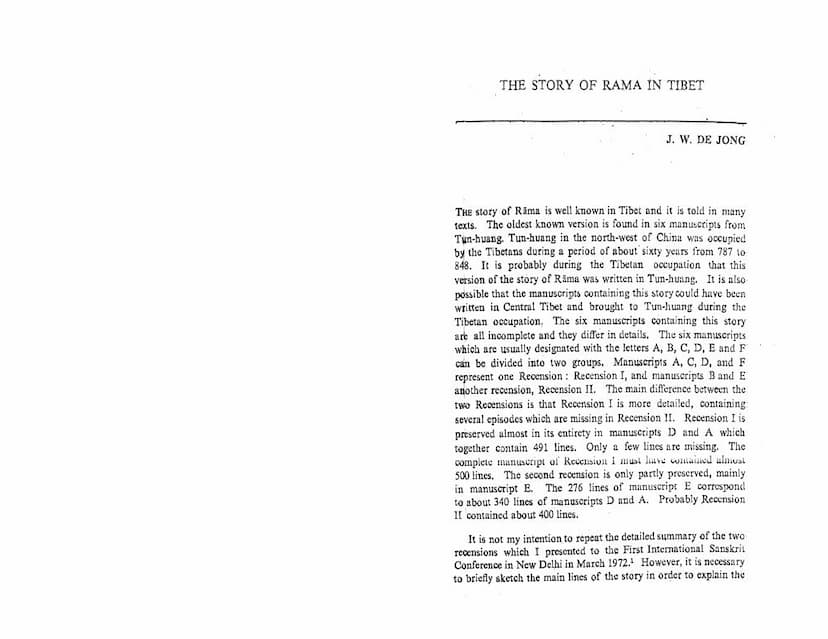
The article by J. W. De Jong explores the presence and evolution of the Rama story in Tibet, highlighting its adaptation and transmission through various texts. The study begins with the earliest known Tibetan versions found in Tun-huang manuscripts and traces the narrative's development through later Tibetan and Mongolian commentaries on Sanskrit works.
Early Tibetan Versions (Tun-huang Manuscripts):
- Discovery: The oldest known Tibetan versions of the Rama story are preserved in six manuscripts discovered in Tun-huang, a region occupied by Tibetans from 787 to 848 AD.
- Recensions: These manuscripts are divided into two recensions:
- Recension I: More detailed, containing episodes missing in Recension II. It's preserved mostly intact in manuscripts D and A.
- Recension II: Less detailed, primarily preserved in manuscript E.
- Narrative Beginning: Both recensions start with the kingdom of Lankapura, ruled by the demon king Yagsakori, who is invincible. The gods request a son from rşi Viśravas and Sridevi, who then have a son named Vaisravana. Vaisravana defeats Yagsakori but spares his son, Malhyapanta.
- Rise of the Demon Sons: Malhyapanta seeks revenge and, through his union with a divine rşi's daughter, Mekesena, fathers three sons: Daśagrīva, Udpakana (Ampakarna), and Cirisana (Birinaśa). They gain power over the gods from Mahadeva and return to Lankapura to avenge their grandfather, Yagsakori.
- Detailed Boons (Recension I): Recension I provides more detail on how these sons obtain boons. After Brahma refuses their requests, they appeal to Mahadeva. Daśagrīva sacrifices one of his heads. Mahadeva's wife, Upade, offers her power, but predicts their destruction by a woman. Mahadeva's minister, Prahasti, offers his power, predicting their destruction by a monkey. Ultimately, they receive three boons from Mahadeva: power over gods, the death of anyone struck by their first arrow, and immortality unless Daśagrīva's horse-head is severed.
- Ramana's Incarnation: The gods appeal to Vishnu for help against Daśagrīva. Vishnu incarnates as Ramana, son of Dasaratha, with Lagsena as his own son.
- Sita's Origin and Marriage: Daśagrīva's daughter, predicted to cause his ruin, is placed in a copper box and cast into the waters. She is found by peasants and named Rol-rñed-ma ("Found in the furrow"). Dasaratha is wounded, leading Ramana to renounce the throne for his brother Lagsena. Rol-rñed-ma is given to Ramana, who renames her Queen Sita, and he then becomes king.
- Abduction of Sita: Marutse, a minister of Yagsakori, prevents Brahmins from achieving a siddhi. Ramana injures Marutse, and the Brahmins bless Ramana, ensuring rebirth as gods for those killed by his arrows. Daśagrīva's sister, Purpala, desires Ramana, but he rejects her. Purpala advises Daśagrīva to abduct Sita. Marutse, disguised as a deer, lures Ramana away. Lagsena, fearing for Ramana, leaves Sita, and Daśagrīva abducts Sita along with a plot of land.
- Search for Sita and Alliance with Sugriva: Ramana and Lagsena search for Sita. They encounter the monkey-king Sugriva, who is fighting his brother Balin. Ramana makes a pact with Sugriva, promising to help him regain his kingdom in exchange for aid in finding Sita. Ramana struggles to distinguish between Sugriva and Balin until Sugriva wears a mirror. Balin is killed by Ramana.
- Hanumanta's Role: After a three-year wait for Sugriva's fulfillment of his promise, Ramana sends a message. Sugriva arrives with his monkey army. Monkeys Pifu, Sindu, and Hanumanta are dispatched to search for Sita. They meet Pada', who informs them of Sita's abduction by Daśagrīva. Hanumanta travels to Lankapura, finds Sita, delivers Ramana's letter and ring, and causes havoc by uprooting trees and killing demons. He is captured, his tail is set on fire, and he burns the demon city before returning to Sita for a message to Ramana.
- War and Sita's Return: The monkeys and men build a bridge to Lanka. Daśagrīva's brother, Ampakarna, joins Ramana. The demon Kumbhakarna is awakened and swallowed by some, but Ramana and Hanumanta escape. Hanumanta retrieves a herb from Mount Kailasa, reviving the fallen. Lagsena is killed, but Ramana cuts off Daśagrīva's horse-head, killing him and most demons. Ramana liberates Sita and revives Lagsena. Sugriva and Ramana return to their homes, with Hanumanta becoming Sugriva's minister and later king.
- Later Events: The story continues with Ramana suppressing a revolt and leaving Sita and their son Lava in the care of rṣis. When Lava is lost, another son is created from Kusa grass. Ramana, upon returning, overhears an accusation of Sita's adultery and rejects her. Hanumanta intervenes, confirming Sita's innocence, and Ramana reunites with Sita and their sons, living happily in "Old Earth."
Later Tibetan and Mongolian Versions:
- Mahāvyutpatti: The Sanskrit-Tibetan terminological dictionary, Mahāvyutpatti (9th century), includes an entry for "sitāharaṇam," suggesting knowledge of the Sita abduction story.
- Biography of Atisa: The biography of Atisa (11th century) mentions a work about "the ravishment of Sitä and of the killing of the yakṣa A-sa-pa," though its date and connection to the Tun-huang version are uncertain.
- Sa-skya Pandita's Subhāṣitaratnanidhi (13th century): This collection of aphorisms includes a stanza (321) referring to Ravana's death in Lanka. Both Tibetan and Mongolian translations of this work confirm the reference to Ravana's demise.
- Dmar-ston Chos-rgyal's Commentary: A commentary on the Subhāṣitaratnanidhi by Dmar-ston Chos-rgyal (likely 13th century), based on earlier commentaries, recounts the Rama story. This version shares many similarities with the Tun-huang recensions but also includes unique details like Hanumanta's visit to Vayu and the Naga story. Crucially, it omits the later events of Sita's rejection by Ramana.
- Dandin's Kāvyādarśa (13th century onwards): This influential Indian work on poetics was translated into Tibetan in the 13th century. Tibetan scholars wrote many commentaries on it, and the Rama story is found in commentaries on the "udattalamkāra."
- Sanghasri's Version (c. 1429): A commentary by Sanghasri contains a Rama story that is described as aberrant by later scholars, with significant differences from other versions, such as the story of Dasaratha's broken chariot axle.
- Rin-spuns-pa's Version (1586): This version is considered more orthodox, drawing from Dmar-ston's work and the Kāvyādarśa. It includes details like Mahadeva's son having a monkey face and the story of the broken chariot axle as a motivation for Sita's exile.
- Mongolian Versions: Mongolian translations and adaptations of Dmar-ston's commentary exist, some containing details not found in the original Tibetan text, suggesting access to other Rama story sources.
- Common Themes and Variations: Across these Tibetan and Mongolian versions, the core narrative elements of Ravana's boons, Sita's origin and abduction, Hanuman's exploits, and the final battle are present. However, variations exist in specific details, the emphasis on certain episodes, and the inclusion or exclusion of parts of the story (like Sita's eventual rejection and return).
Significance:
The article demonstrates the significant and enduring popularity of the Rama story in Tibet, dating back to at least the 8th century. It highlights how the story was transmitted, adapted, and integrated into Tibetan culture and literature, often through commentaries on Indian texts. The study emphasizes the rich variations in these Tibetan retellings, offering valuable insights into the cross-cultural transmission of epic narratives and the ways in which they are reinterpreted in different cultural contexts. The author expresses hope for further research by Tibetan scholars to bring more versions to light and provide a more comprehensive understanding of this literary phenomenon.