
Spitzer Manuscript Report On Work In Progress
Added to library: September 2, 2025
Summary
Here's a comprehensive summary of the Spitzer Manuscript Report on Work in Progress by Eli Franco, focusing on the key information presented:
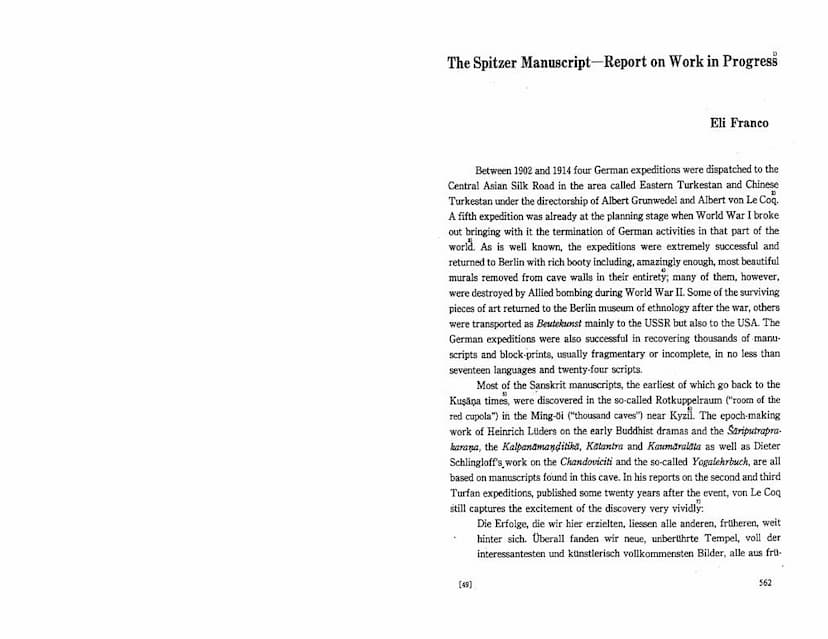
This report details the ongoing research and significance of the "Spitzer manuscript," a pivotal find from the German expeditions to Eastern Turkestan (modern Xinjiang) between 1902 and 1914. These expeditions, led by Albert Grünwedel and Albert von Le Coq, were highly successful in unearthing a vast collection of manuscripts and artifacts from Buddhist sites along the Silk Road.
Discovery and Early Research:
- The Spitzer manuscript, officially cataloged as SHT-810, was discovered in the "Rotkuppelraum" (Room of the Red Cupola) within the Ming-öi ("Thousand Caves") complex near Kyzil.
- It is a palm-leaf manuscript written in Kuṣāṇa-Brahmi script and is dated to around 200 CE, making it one of the earliest philosophical Sanskrit manuscripts discovered.
- The manuscript was named after Moritz Spitzer, a German-Jewish scholar who first worked on it in 1927-1928. He received modest financial support from the Prussian Academy of Sciences for this work.
- Spitzer was unable to complete his research and "disappeared from the Berlin field of vision." His transcripts, however, were preserved and later recovered.
- Early mentions of the manuscript appear in publications by Heinrich Lüders, who used some of its leaves to support his studies on Mathura inscriptions, and the Japanese scholar Shōko Watanabe, who created hand copies of larger fragments.
- Yasho Miyasaka later published transcriptions and suggested the manuscript belonged to the Sautrāntika school, a theory that the current author, Eli Franco, disputes.
Content and Significance:
- The Spitzer manuscript is identified as an Abhidharma work, possibly containing more than one such text. Based on the prevalent findings in the Turfan region, Franco's working hypothesis is that it belongs to the Sarvāstivāda school.
- A particularly remarkable feature of the manuscript is its frequent reference to non-Buddhist literature and topics. This includes mentions of Mantras, Brahmanas, Upanishads, Arthaśāstra, Kāmaśāstra, the Rāmāyaṇa, Mahābhārata, and various philosophical schools like Sāmkhya and Vaiśeṣika. This is noted as being typical for Jñānaprasthāna commentaries of the Kuṣāṇa period.
- The report highlights a section of the manuscript that enumerates sixty-four kalās (arts and sciences). This list is unique in its composition and order compared to other known kalā lists. The text details several of these kalās, such as painting (alekhya), gambling (dyūtakausalya), knowledge of calculation and writing (gaṇanālipijñānam), surgery (śalākāharaṇa), kāma, flower arrangement (mālyasamāyoga), and a problematic term, veṣṭima. The enumeration also mentions various crafts (śilpāni) like blacksmith, silversmith, carpenter, etc., as arts.
- The manuscript also discusses other branches of knowledge like lakṣaṇa (science of marks, possibly related to physiognomy or auspicious signs), jyotiṣa (astronomy/astrology), and utpatika (science of omens or calamities).
Current Research and Methodology:
- Eli Franco is undertaking a comprehensive edition of the manuscript, a project supported by the German Research Council.
- The research benefits from modern digitization techniques. High-resolution color slides of the fragments are scanned, digitized, and sometimes graphically enhanced to improve legibility.
- This digital approach allows for greater flexibility in analyzing and presenting the fragments, enabling closer juxtaposition of images and transcriptions, and facilitating the assembly of fragments without physical handling, thus preserving the fragile material.
- The report mentions the use of high-resolution scanning (2400 dpi) and JPG format for file compression, acknowledging the trade-offs between file size, information loss, and visual quality.
- Franco's work builds upon the efforts of Spitzer, Lüders, Watanabe, Miyasaka, and Dieter Schlingloff, whose research on other Turfan manuscripts, including the oldest surviving parvan-list of the Mahābhārata, is referenced.
- The report acknowledges that the study of the Spitzer manuscript is still in its early stages, with the hope that further fragment assembly will lead to a more complete understanding of its content and structure.
In essence, the report provides an update on the scholarly endeavor to decipher and publish a critically important ancient Sanskrit manuscript, emphasizing its historical, linguistic, and cultural significance within the context of Buddhist Silk Road studies.