
Spiritual Place Of Epistemological Tradition In Buddhism
Added to library: September 2, 2025
Summary
Here's a comprehensive summary of the provided text, focusing on the spiritual place of epistemological tradition in Buddhism, as presented by Ernst Steinkellner:
Introduction:
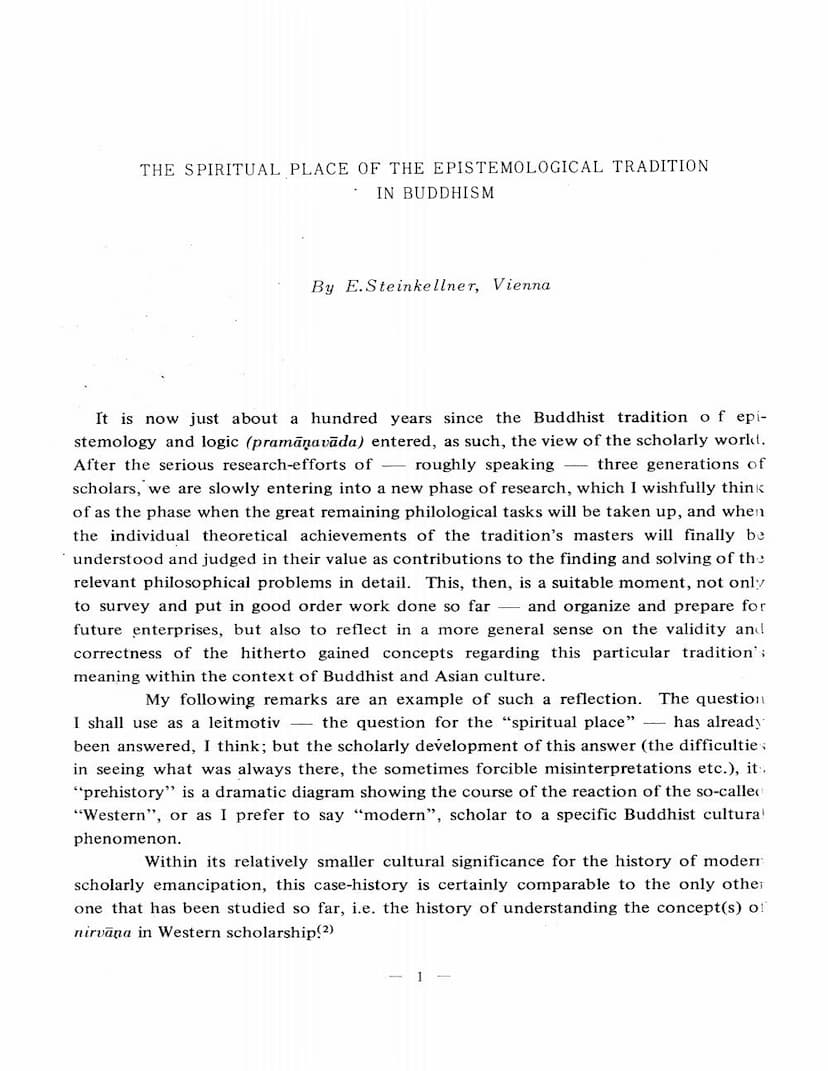
Ernst Steinkellner's lecture, delivered to a Japanese academic audience, addresses the "spiritual place" of the epistemological tradition (Pramāṇavāda) within Buddhism. He notes that after a century of scholarly work, the field is entering a new phase focused on detailed understanding and evaluation of individual masters' contributions. Steinkellner emphasizes that this lecture aims to reflect on the validity and correctness of current concepts regarding this tradition's meaning within Buddhist and Asian culture. He acknowledges the significant contributions of Japanese scholars to this field.
The Core Problem: The Seeming Incompatibility
A central difficulty in understanding Buddhist epistemology arises from the apparent contradiction between its analytical approach to cognition, truth, and logic, and Buddhism's overarching practical and religious goal of liberation. Scholars have struggled to reconcile Buddhist philosophers engaging in detailed investigations of seemingly "purely theoretical" problems like the nature of perception or the meaning of words with the religion's core aim of spiritual advancement through meditation and the cessation of suffering.
Misinterpretations and Biased Evaluations:
This perceived incompatibility has led to significant misinterpretations and "interpretational injustice" by scholars. Steinkellner identifies two main camps:
-
The Negative Approach (e.g., Edward Conze): Scholars who emphasize the practical, religious, and mystical aspects of Buddhism tend to view the epistemological tradition as a "deplorable distortion and corruption" of Buddhism's core ideas. They see the interest in logic and epistemology as a sign of "worldly" concerns gaining a foothold, potentially motivated by the need to "vanquish adversaries in controversy" and increase the order's resources. For them, this tradition is "un-Buddhistic" and heterodox.
-
The Positive Approach (e.g., Theodor Stcherbatsky, A.K. Warder, Sukumar Dutt): Conversely, some scholars, while still often viewing the tradition as "un-Buddhistic" in its analytical focus, celebrate it as a significant philosophical achievement of India.
- Stcherbatsky, for instance, interpreted Buddhist logic as a "liberal theory, emancipated from the religious background," aligning it with modern scientific worldviews. This was influenced by the Soviet intellectual climate that sought to position Buddhism favorably.
- Warder emphasizes the tradition's analytical rigor, sometimes at the expense of its religious context, leading to an unbalanced historical picture.
- Dutt, with a "nationalistic" motivation, views the development of monasteries into centers of general learning and scholarship (akin to universities) as a sign of Buddhism's "decline" from a purely monastic character. He interprets the epistemological tradition as a tool for intellectual disputation and secular utility, promoting a "secularization" within Buddhist culture.
Steinkellner argues that all these interpretations, both positive and negative, suffer from a common methodical fault: they fail to consider the tradition's self-understanding.
The Self-Understanding of the Epistemological Tradition:
The key to understanding the "spiritual place" of this tradition lies in its own self-formulated aims and motivations. Steinkellner points to the Mangala-verse of Dignāga's Pramāṇasamuccaya (composed around 530 AD) as the cornerstone that marks the beginning of this distinct epistemological period in Buddhism.
The verse salutes the Buddha as one who "has become a means of valid cognition" (pramāṇabhūta), who seeks the benefit of all beings, and is the teacher. Dignāga states his purpose is to "establish the means of valid cognition" and unify his scattered theories.
Steinkellner elaborates on Dignāga's explanation of the Buddha's attributes:
- The Buddha's status as a means of valid cognition is the result of the perfection of certain qualities.
- These qualities are divided into perfections in cause (hetu) and perfections in effect (phila), referring to the Bodhisattva's path.
- Perfections in intention (āśayasampad) and practice (prayogasampad) guarantee the Buddha does not teach falsehood.
- Perfect attainment of his own and others' objectives (svaparārthasampad) guarantees the value of his teachings for others.
Dharmakirti's Interpretation and the Proof of the Buddha's Authority:
The later tradition, heavily shaped by Dharmakirti, interprets this verse as a proof of the Buddha's authority as a means of valid cognition. This proof rests on two logical reasons:
- The Buddha's self-acquired knowledge of the ultimate goal and the path.
- The certainty, stemming from his perfect compassion, that he does not deceive others in mediating this knowledge.
This interpretation, particularly the pramāṇasiddhi (establishment of the means of valid cognition) chapter of Dharmakirti's Pramāṇavārttika, is crucial for understanding the tradition's self-conception.
The Reciprocal Relationship and Avoiding Misinterpretations:
Steinkellner addresses the interpretation by Prof. Nagatomi, who posits a reciprocal but ultimately faith-based relationship: the pramāṇa system tests the Buddha's words, but the pramāṇa's validity is derived from faith in the Buddha's words. Steinkellner finds this insufficient, arguing that it misinterprets the "critical test" of the Buddha's words.
He then presents Tilmann Vetter's explanation as a more accurate representation:
- Valid cognitions (pramāṇa) are essential for meaningful human action.
- The Buddhist's goal is emancipation, and the Buddha provides the goal and guidance that ordinary means of cognition (perception and inference) cannot.
- However, the Buddha's authority must be proven, not based on faith alone.
- His words are accepted as authoritative only when it's demonstrated he does not lie and has unique insights valuable to others.
- The Buddha is the authority for the ultimate goal of human action because it is not immediately present.
This creates a "historical-factual circle" that Dharmakirti embraced:
- The defining characteristic of pramāṇa is its success in meaningful practice (avisamvādana).
- This connects to the Buddha, on whose authority one knows what constitutes meaningful practice.
- The reciprocity arises from the need to prove the Buddha's authority. The Buddha himself accounts for the validity of his words, referencing the very means by which he became a pramāṇa (his perfections in cause and effect).
The Spiritual Place of Epistemology:
Steinkellner concludes that Dignāga's program, as expounded by Dharmakirti, offers the answer to the question of the spiritual place of epistemology in Buddhism. It represents:
- A philosophical foundation for Buddhism: Buddhism, through its epistemological tradition, participates in the broader philosophical development in India from the 3rd/4th centuries AD onwards, characterized by an increasing interest in dialectics, logic, and epistemology.
- Linkage to a value system: Buddhist epistemology is developed in conjunction with its philosophical system and is intrinsically linked to the order of values and goals governing human practice (namely, liberation). It cannot be separated from this context or treated as a detached "positive science" in the modern sense.
- A deserved position: The epistemological achievements of this tradition hold a rightful place not only in the history of Indian philosophy and the human mind but also in the history of Buddhism as a religion. It is not an "un-Buddhistic" intrusion but an integral part of its intellectual and spiritual framework, aiming to provide a rational basis for the Buddhist path.
In essence, the epistemological tradition in Buddhism is not merely a theoretical or secular pursuit but a crucial component that underpins the very validity and practice of the Buddhist path to liberation by establishing the authority of the Buddha and the means by which that authority can be rationally understood and verified.