
Soul Substance Jiva Dravya As Expounded In Dravya Sangraha
Added to library: September 2, 2025
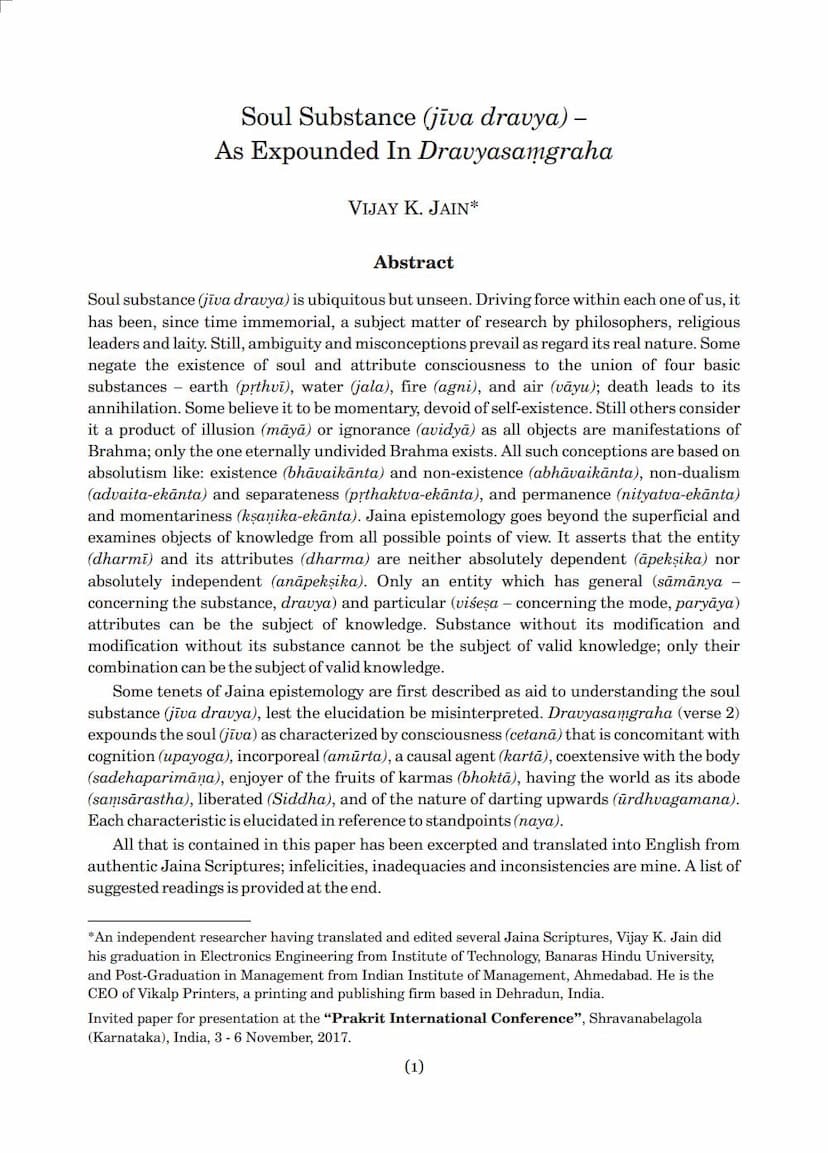
Summary
This document, "Soul Substance (jīva dravya) – As Expounded In Dravyasamgraha" by Vijay K. Jain, delves into the Jain understanding of the soul (jīva dravya), drawing heavily from the text Dravyasamgraha. The author begins by acknowledging the prevalent misconceptions about the soul's nature and highlights how Jain epistemology, through its doctrines of Syādvāda (conditional predication) and Naya (standpoints of interpretation), offers a nuanced and comprehensive understanding.
Key Jain Epistemological Tenets:
- Syādvāda (Doctrine of Conditional Predication): Reality is multifaceted and possesses infinite characters. Syādvāda, expressed through the "seven-nuance system" (saptabhangi), uses the qualifier "syāt" (in a way, from a particular standpoint) to acknowledge that statements about reality are conditional and depend on the viewpoint. This avoids absolutism and allows for seemingly contradictory statements to be true when viewed from different perspectives. It emphasizes the anekānta (many-sidedness) of reality.
- Naya (Standpoints of Interpretation): To understand an object with its innumerable attributes, different standpoints (naya) are employed. Pramāņa is comprehensive knowledge, while naya is partial and relative, focusing on a specific aspect. The text outlines a crucial classification of naya:
- Niscaya Naya (Transcendental Point of View): Represents the true, unconditioned, and complete nature of a substance, often equating the soul with its inherent qualities. It has two subcategories:
- Śuddha Niscaya Naya: Focuses on the pure, unadulterated state of the soul, free from karmic contamination (e.g., "Omniscience is the soul").
- Aśuddha Niscaya Naya: Views the soul as affected by material environment and karmas, though still as a whole (e.g., "Sensory knowledge is the soul").
- Vyavahāra Naya (Empirical Point of View): Deals with the conditioned, relative, and differentiated aspects of reality as perceived in the empirical world. It can be:
- Sadbhūta Vyavahāra Naya: Distinguishes between substance and its attributes, even though they are essentially inseparable.
- Anupacarita Sadbhūta Vyavahāra Naya: Distinguishes substance and attributes in a pure state (e.g., "Omniscience is an attribute of the soul").
- Upacarita Sadbhūta Vyavahāra Naya: Distinguishes substance and attributes in a state affected by karma (e.g., "Sensory knowledge is an attribute of the soul").
- Asadbhūta Vyavahāra Naya: Identifies essentially distinct substances due to convention or close association.
- Anupacarita Asadbhūta Vyavahāra Naya: Expresses oneness in closely related substances (e.g., "This body is mine," "Soul is the cause of material karmas").
- Upacarita Asadbhūta Vyavahāra Naya: Expresses oneness figuratively with less intimate relations (e.g., "My ornament," identifying the self with non-self objects).
- Sadbhūta Vyavahāra Naya: Distinguishes between substance and its attributes, even though they are essentially inseparable.
- Niscaya Naya (Transcendental Point of View): Represents the true, unconditioned, and complete nature of a substance, often equating the soul with its inherent qualities. It has two subcategories:
The text stresses that both niscaya and vyavahāra naya are essential for a complete understanding of reality, with vyavahāra serving as a practical starting point for beginners.
Dravya, Guna, Paryaya: The foundational Jain concepts are explained:
- Dravya (Substance): The substratum that possesses attributes and modes. It is characterized by origination (utpada), destruction (vyaya), and permanence (dhrauvya), which occur simultaneously and are interdependent.
- Guna (Attribute/Quality): Qualities are inseparable from the substance but are distinct from it. They can be general (sāmānya) or specific (viśeşa).
- Paryaya (Mode/Modification): These are the changing states or conditions of a substance, which occur through origination and destruction while the substance itself remains permanent.
The Soul (Jīva Dravya): The Dravyasamgraha defines the soul as having the following characteristics:
- Jivatva or Cetana (Consciousness): The soul is fundamentally consciousness, which is its inherent nature and not dependent on external factors. This consciousness manifests as knowledge-consciousness (jñāna-cetanā), karma-consciousness (karma-cetanā or bhāva-karma), and fruit-of-karma-consciousness (karma-phala-cetanā).
- Prāņa (Life-Essentials): From an empirical standpoint, the soul is identified with vital principles like strength, senses, lifespan, and respiration. However, these are considered karma-generated and not the soul's essential nature.
- Upayoga (Cognition): Consciousness manifests as cognition, which is the soul's unique characteristic. Upayoga is divided into knowledge-cognition (jñānopayoga) and perception-cognition (darśanopayoga). Jñānopayoga pertains to specific attributes and leads to various types of knowledge (sensory, scriptural, clairvoyant, telepathic, and omniscient), some pure and some erroneous. Darśanopayoga pertains to general attributes and leads to perception.
- Amūrta (Incorporeal/Non-material): The soul is fundamentally incorporeal, lacking physical qualities like color, taste, smell, or touch. While it appears to have a form in its embodied state due to karmic influence, its true nature is non-material.
- Kartā (Doer/Causal Agent): From an empirical perspective, the soul is considered a doer of karmas and psychic dispositions. However, from a transcendental viewpoint, the soul is the substantial cause (upādāna kārana) of its own psychic states, while subtle karmic matter is the substantial cause of material karmas. The soul acts as an instrumental cause (nimitta kāraņa) for karmic bondage due to its passionate states.
- Sadehaparimāņa (Coextensive with the Body): Empirically, the soul expands and contracts to fit the body it inhabits. Transcendentally, it has innumerable space-points. This coextensiveness is a result of karmic influence, not the soul's inherent nature. The soul is distinct from the physical body, which is perishable and karma-generated.
- Bhoktā (Enjoyer of the Fruits of Karma): Empirically, the soul experiences pleasure and pain from karmas. Transcendentally, it experiences only pure consciousness. Attachment and aversion to the fruits of karma lead to further bondage. The knowledgeable soul, however, remains unaffected by these experiences.
- Samsārī (Having the World as its Abode): Worldly souls are trapped in the cycle of transmigration, undergoing rebirths in various forms of life based on their karmic dispositions. The text details the classification of souls into 14 types based on their characteristics and stages of spiritual development.
- Siddha (The Liberated Soul): Upon annihilation of all karmas, the soul achieves liberation (nirvana). The Siddha soul is pure, possesses eight supreme qualities (infinite faith, knowledge, perception, power, fineness, inter-penetrability, neither heavy nor light, and undisturbed bliss), resides at the summit of the universe, and is eternal.
- Ūrdhvagamana (Upward Movement): The pure, liberated soul naturally moves upwards to the summit of the universe. This upward movement is attributed to previous impetus, freedom from ties, snapping of bondage, and its inherent upward-tending nature.
Conclusion: The ultimate aim of spiritual practice is self-realization, which is the destruction of ignorance and the attainment of pure, unadulterated knowledge – the soul's inherent nature. This self-knowledge leads to the discrimination between the self and non-self, paving the way for liberation from karmic bondage. The text emphasizes that self-knowledge is the foundation of all spiritual practices and the sole path to achieving supreme bliss.