
Soul Body And Person In Ancient India
Added to library: September 2, 2025
Summary
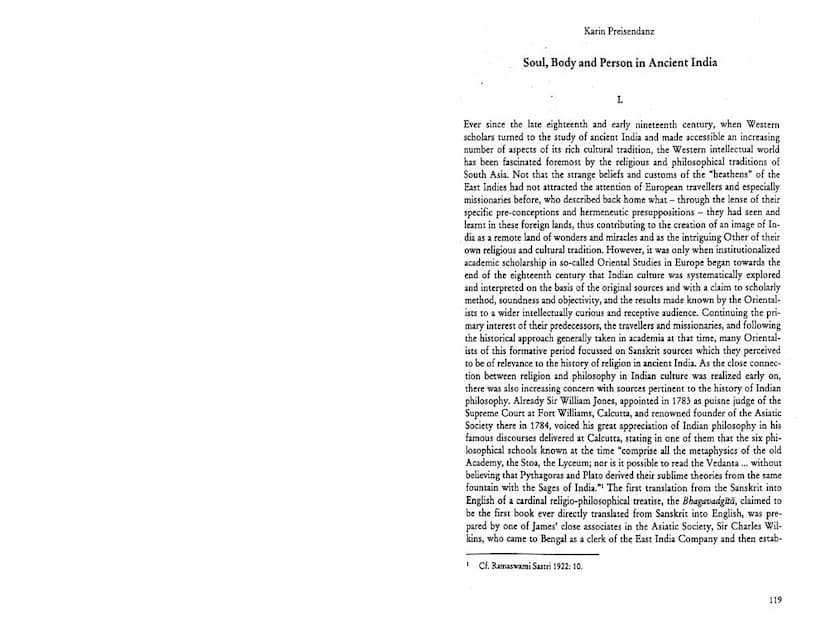
This document is an excerpt from Karin Preisendanz's book "Soul, Body and Person in Ancient India." It focuses on the reception of Indian philosophical and religious texts in the West and then delves into the complex and diverse notions of "soul" in ancient India, particularly within Vedic literature.
Here's a breakdown of the key points:
-
Western Fascination with Indian Thought: The introduction highlights how Western scholars, starting in the late 18th century, became increasingly interested in Indian religious and philosophical traditions. Early engagement was often filtered through missionary or traveler perspectives, but the establishment of Oriental Studies brought a more systematic approach based on original Sanskrit sources. Works like the Bhagavad Gita and the Upanishads were translated and significantly influenced European thinkers like Schopenhauer.
-
The Concept of "Soul" in Ancient India: The core of the excerpt is an exploration of the multifaceted concept of "soul" in ancient India. The author emphasizes that "soul" is a broad term and that ancient Indian thought conceived of multiple "souls" or "powers of life," each with different functions and manifestations.
-
Factors Contributing to Diversity: Several factors are identified as contributing to this diversity:
- Historical Depth and Volume of Literature: The long history of Vedic literature, from hymns to ritualistic treatises and early Upanishads, provided a rich basis for evolving concepts.
- Social Background: The influence of Brahmins as compilers and editors, alongside the potential integration of popular beliefs from various social strata and even non-Indo-Aryan groups, led to diverse notions.
- Geographical Expansion: The movement and diversification of the Vedic people across the subcontinent also contributed to variations in beliefs.
-
Key Terms and Their Meanings: The text then analyzes specific Sanskrit terms related to the soul:
- Asu: This term is extensively discussed, with different etymological theories and interpretations. It is explored as a "vital soul" or "body-soul" responsible for life functions like breathing. The author also considers the possibility of asu referring to a "free soul" or "individuating soul" that can leave the body. The text engages with scholarly debates (e.g., Arbman, Bodewitz, Schlerath, Eichner) on its precise meaning and function.
- Prāna: This term is identified with breath and also understood as a "vital soul" or "breathing-soul." Its role in cosmic correlations (e.g., with wind) and as one of several vital faculties or "body-souls" is examined. The text notes its development into a more generalized term for "vital forces" and its eventual inclusion in medical traditions.
- Ātman: This term, which becomes central in later Indian philosophy, is traced back to its early Vedic usage. Initially, it appears to refer to breath as a concrete, wind-like entity, or a "vital soul" responsible for basic life functions. The text discusses its connection to macrocosmic elements (like wind) and its eventual shift towards representing a more abstract "Self" or "essence," even extending to plants. The author notes the gradual "de-substantialization" of ātman and its increasing association with consciousness.
- Manas: This term is identified with the mind and the faculty of thinking, sometimes considered a "mental soul" or a "conscious free soul." Its relationship with ātman and asu is explored, particularly its potential to represent consciousness.
- Puruṣa: While not extensively detailed in this excerpt, it is mentioned as a "technical" term referring to a "free soul" and later evolving to represent a vital, conscious, and individuating "unitary" soul.
-
Analysis of Specific Passages: The author meticulously analyzes various Vedic hymns and Upanishadic passages to illustrate the different concepts of "soul" and the nuances of these terms. This includes detailed discussions of Atharvaveda hymns and Rgveda cremation hymns, examining how asu, prāna, and ātman are used in contexts of illness, death, and afterlife beliefs.
-
The "Free Soul" vs. "Vital Soul" Dichotomy: A recurring theme is the distinction between a "vital soul" (responsible for life processes) and a "free soul" or "excursion soul" (associated with personality and capable of leaving the body). The text explores how these concepts might have been distinct, merged, or evolved over time.
-
Later Developments and the Path to Unitary Soul: The excerpt concludes by touching upon the development of these concepts towards a more unitary notion of "soul" (ātman) in the Upanishads, where it becomes identified with consciousness and the ultimate principle (brahman). The role of puruṣa and jīva in this evolution is also briefly mentioned, along with the subsequent connection of the soul concept with karma and rebirth.
In essence, this excerpt from Preisendanz's work provides a scholarly examination of the intricate and evolving understanding of the soul in ancient Indian thought, tracing its origins in Vedic literature and highlighting the scholarly debates surrounding its interpretation. It emphasizes the richness and complexity of these concepts, moving beyond simplistic Western notions of a single, immortal soul.