
Soteriology In Early Jainism
Added to library: September 2, 2025
Summary
Here's a comprehensive summary of Klaus Bruhn's "Soteriology in Early Jainism," based on the provided text:
Overall Approach: "Sectional Studies" and Focus on the Kaṣāya Concept
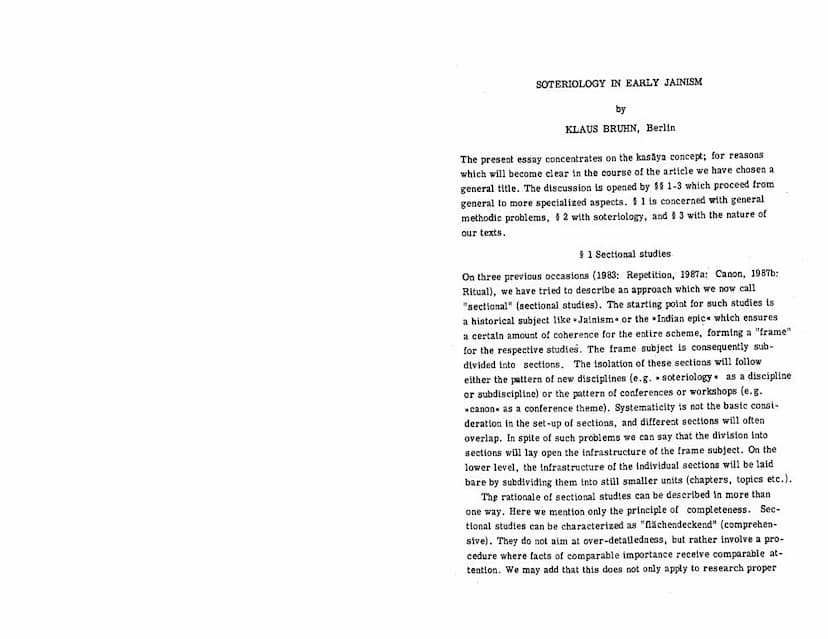
Klaus Bruhn introduces his methodology, termed "sectional studies," which involves framing a historical subject (like Jainism) and then subdividing it into coherent sections. These sections, while potentially overlapping, aim to reveal the underlying infrastructure of the subject. The goal is comprehensiveness, ensuring that facts of comparable importance receive comparable attention. This approach seeks to bridge the gap between highly specialized academic research and broader general surveys, making particularized observations accessible to non-specialists. The author notes that this method involves preliminary research, oscillating between overview and detailed analysis, with each section requiring its own methodological approach adapted from contemporary research.
The core focus of this essay is the kasāya concept, a fundamental element of Jain soteriology. The author chooses this specific concept as a representative case study to explore the broader landscape of Jain soteriology.
Key Challenges and Considerations in Studying Jain Soteriology
Bruhn identifies several significant challenges in analyzing Jain soteriology:
- Defining Soteriology: While "soteriology" is a conventionally accepted subject within Jainism (alongside discipline and ethics), a more analytical approach suggests a trichotomy:
- Monastic and laic discipline (deontic judgments).
- Psychological ethics and ethico-soteriology (aretaic judgments).
- Eschatology or ontological soteriology (the soul's journey beyond the present). He notes that this analytical scheme is primarily applicable to early Jainism and may not adequately capture later "annihilation theories" related to karma and kaṣāyas.
- Influence of Scholasticism: Jaina scholasticism, characterized by doctrinal formalism and structuralism, has significantly influenced all aspects of soteriology. This necessitates a careful distinction between content and form (mere scholastic speculation) when analyzing terms and theories.
- Bridging Traditional Topics and Modern Divisions: Any modern subdivision of soteriology must be integrated with a consideration of traditional Jaina topics (like kasāyas, leśyās, hell, heaven) and disciplines (like rules for monks/nuns, karma theory, soul theory).
- Textual Nature and Transformation: Early Jaina texts are often compilations of pre-existent elements and dogmatic terminology. This requires considering both the immediate context of a passage and its broader, indirect context across various texts. Terminology undergoes transformation but is eventually curbed by canonization, leading to different stages: non-canonized, half-canonized, and fully canonized.
- Ideas vs. Scholasticism: While ideas and worldviews evolve, scholasticism tends to be static. However, Jaina scholasticism itself has undergone transformations. The author emphasizes the need for sensitivity to minor differences and the "dialectic style" of texts to trace these changes.
- Chains of Terms: Much of Jaina terminology is organized in "chains" (conceptual pairs, triads, tetrads, etc.). These chains are subject to transformation and canonization. The author distinguishes between "basic term," "antonym," and "synonym," and also between "terms," "half-terms," and "non-terms."
- Pluralism of Soteriology: Unlike more monolithic subjects like cosmography or mythology, Jain soteriology is inherently pluralistic, due to the vast number of virtues and vices and uncertain soteriological priorities.
- Lack of a Definitive Answer to Salvation: Jainism, despite its extensive ethical and soteriological discussions, doesn't offer a single, clear, universally recognized answer to how salvation is achieved. This is surprising given the availability of necessary elements and the centrality of non-theistic soteriology to the prevailing intellectual currents of the time.
The Kaṣāya Concept: A Detailed Examination
The essay then delves into the kaṣāya concept, defining them as the "four passions" (anger, pride, deceit, greed), which are a Jaina canonization of a fundamental Indian concept of psychic factors considered harmful to ethics and soteriology. These kaṣāyas are central to later Jaina annihilation theories.
The author meticulously analyzes the kaṣāya vocabulary as found in early Jaina texts, particularly the Dasavaikālikasūtra. This involves:
- Identifying Kaṣāya Chains: Presenting numerous textual examples of kaṣāya terms appearing in chains, including the core tetrad (krodha, māna, māyā, lobha) and related terms like rāga (love) and dosa (hatred), as well as supplementary (nokasāyas) and more specific passions.
- Synonyms and Variations: Documenting the extensive synonymy associated with the kaṣāyas, noting how these synonyms are often used in chains for dialectical purposes. The author highlights the distinction between the dogmatic meaning (functional proximity or identity) and the general meaning (potential differences) of these synonyms.
- Transformation and Canonization: Tracing the development and canonization of kaṣāya terms, observing how terms evolve from amorphous states to fixed chains.
- Connection to Other Concepts: Examining how kaṣāya vocabulary appears in relation to other important Jaina concepts such as karma (e.g., caritta-mohapaniya-kamma), leśyās (states of the soul), and tapas (austerities).
- The Kaṣāya Tetrad in the Dasavaikālikasūtra: A significant portion of the analysis focuses on this specific text. Bruhn details the presence of the kaṣāya tetrad in verses, its relation to antonyms (virtues), and its role in describing negative eschatological consequences. He also notes the evolution from earlier terms like "internal vices" (ajjhatta-dosa) to the more specific term "kaṣāya."
- Distinguishing Dogmatic Meaning: The author stresses the importance of distinguishing between the dogmatic meaning of a term (its function within the system) and its general, non-technical meaning. In dogmatic discourse, synonyms often converge in meaning, while in general language, differences are emphasized.
- The Nature of Early Soteriological Discourses: Bruhn describes the common pattern of early Jaina soteriological discourses as a semi-narrative sequence: DUḤKHA/SAMSĀRA → INDRIYA → INDRIYA-JAYA → SUKHA/MOKṢA. The path to liberation involves overcoming obstacles like the kaṣāyas.
The Importance of Terminology and Methodology
Bruhn concludes by emphasizing the significance of analyzing Jaina terminology as a system. He advocates for a dual approach: studying the historical development of individual terms and examining terms within their specific terminological systems. The kaṣāya concept serves as a paradigm for this methodological approach, illustrating the need to analyze terminology based on texts and vice versa.
The study also highlights the close relationship between early Jaina literature and other contemporary Indian traditions, such as Brahmanical texts and early Buddhist literature, noting both shared elements and the distinct sectarian development of Jaina vocabulary.
In essence, Bruhn's work provides a detailed and nuanced exploration of soteriology in early Jainism, with a particular focus on the kaṣāya concept. It underscores the complexities of studying ancient Indian religious traditions, emphasizing methodological rigor, careful textual analysis, and an understanding of the historical and intellectual context.