
Somnolent Stras Sriptural Cmmentary In Svetambara Jainism
Added to library: September 2, 2025
Summary
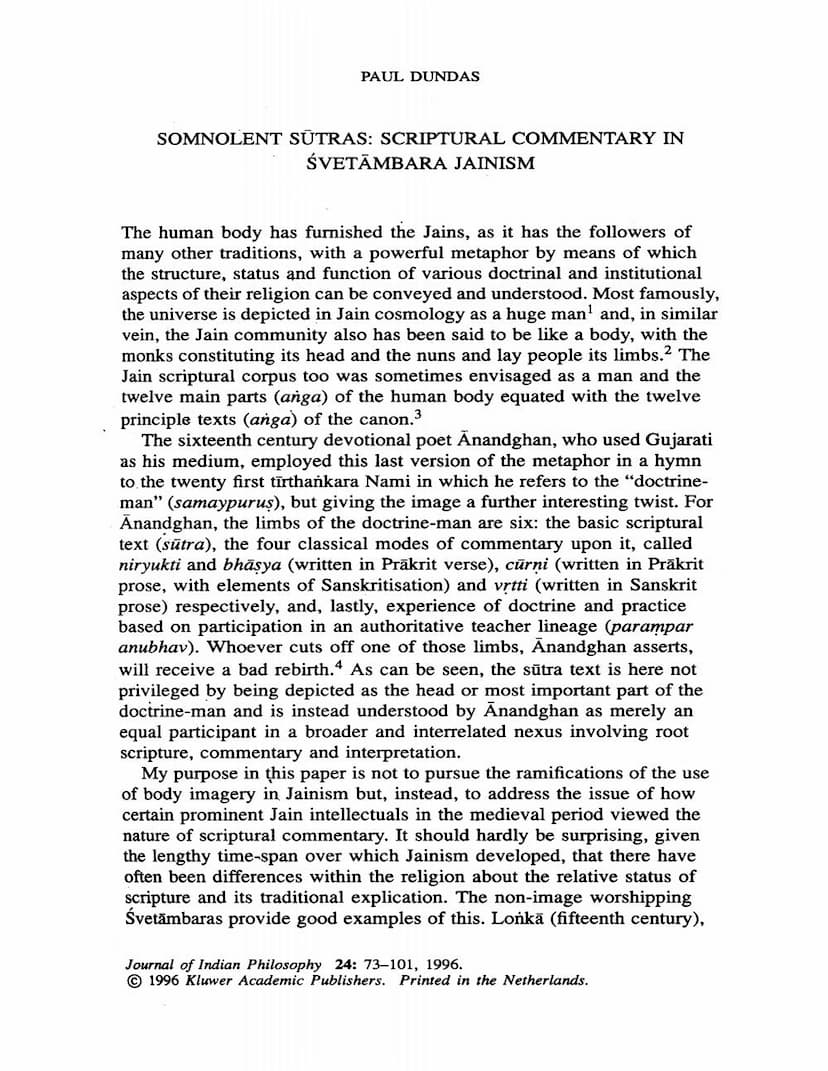
Here's a comprehensive summary of the provided text from Paul Dundas's "Somnolent Sūtras: Scriptural Commentary in Śvetāmbara Jainism":
The article explores the historical development and significance of scriptural commentary within Svetambara Jainism, focusing on how prominent medieval Jain intellectuals viewed the nature of this commentary. Dundas highlights a recurring theme: the idea that scripture without commentary is akin to a sleeping person, emphasizing the vital role of exegesis in bringing texts to life and making them understandable.
Key Themes and Arguments:
-
Body Imagery and Scriptural Structure: The text begins by noting the Jain use of the human body as a metaphor for various aspects of their religion. This extends to the scriptural corpus itself, which was sometimes envisioned as a "doctrineman," with its twelve parts equating to the twelve canoncial texts. A unique twist on this metaphor is presented by the sixteenth-century poet Anandghan, who viewed scripture (sūtra) as just one component (limb) among others like different forms of commentary (niryukti, bhāsya, cūrni, vrtti) and experiential understanding (paramparā anubhav). This suggests an equal, rather than hierarchical, relationship between root scripture and its explication.
-
Internal Debates on Commentary's Authority: Dundas points out that differences have existed within Jainism regarding the status of scripture versus its commentary. The aniconic Sthānakavāsī sect, originating from Lonkā in the fifteenth century, is presented as an example of those who seemingly rejected voluminous exegetical literature to preserve the purity of original teachings. Conversely, the Terapanthīs, another aniconic sect, exemplified by Jayācārya in the nineteenth century, actually incorporated portions of traditional Sanskrit commentary (vrtti) into their renderings of scriptures, effectively elevating commentary to a scriptural level.
-
The "Somnolent Sūtra" Analogy: The central thesis of the paper is rooted in an etymological "sleight of hand" that equates a sūtra without commentary to someone asleep. This idea is attributed to an earlier scholar and reiterated by the two main figures discussed: Abhayadeva Sūri and Dharmasāgara.
-
The Context of Indian Exegesis: Dundas situates Jain commentary within the broader context of South Asian scriptural traditions, referencing scholarly trends that increasingly recognize the centrality of commentary in shaping thought and religious traditions. He contrasts this with earlier Western scholarly tendencies to dismiss or overlook indigenous exegesis, or to focus solely on its fidelity to authorial intent.
-
Abhayadeva Sūri: The Great Exegete: Abhayadeva Sūri (eleventh century) is presented as Jainism's most significant scriptural exegete, particularly for his comprehensive Sanskrit commentaries (vrttis) on nine of the canonical anga texts. His hagiography highlights his crucial role in a period where existing commentaries had largely disappeared due to various societal disruptions. The narrative emphasizes the "uncultivated ground" that scripture became without its supporting exegesis. Abhayadeva's own remarks acknowledge the challenges of his task, including the lack of a proper teacher lineage and the corruption of manuscripts, but he was divinely inspired (by a goddess who consulted the tīrthankara Simandhara) to undertake this vital work. His commentaries were seen as keys to unlocking the inner meaning of the scriptures.
-
Dharmasāgara: The Polemicist and Advocate for Commentary: Dharmasāgara (sixteenth century) is introduced as a significant intellectual who further developed the "somnolent sūtra" idea, arguing for the equal status of scripture and commentary. He saw his role as defending Jain orthodoxy and confounding sectarians, particularly those who advocated a "sūtra-only" approach (pustaka-siddhānta). Dharmasāgara used bovine analogies to illustrate scripture's need for commentary to yield its meaning, comparing scripture without commentary to milking a cow without feeding it or trying to get milk from a dead cow. He also emphasized the importance of the niryukti commentaries, which he saw as crucial for understanding early heresies and solidifying Jain orthodoxy, particularly against the anti-iconic movement of Lonkā. For Dharmasāgara, commentary was not merely an explanation but an integral part of authoritative scripture (āgama), essential for correct Jain practice and lineage.
-
Commentary as Āgama: Both Abhayadeva and Dharmasāgara contributed to the shift in medieval Jainism where commentary began to be viewed not as a secondary element but as āgama (authoritative scripture) itself. This was partly due to the perceived necessity of commentary for understanding the scriptures and also because commentaries contained vital information and interpretations that amplified or clarified the root texts.
-
The Role of Teacher Succession (Adhikāra): Both scholars underscored the importance of qualified teacher-pupil succession (paramparā or adhikāra) for correct interpretation. Dharmasāgara, in particular, used this concept to discredit sectarian groups led by lay or unqualified monastic teachers, arguing that only those with proper ascetic initiation and training could truly access and transmit the meaning of the scriptures.
-
Modern Implications: The article concludes by reflecting on contemporary debates within Svetambara Jainism regarding the publication and interpretation of scriptures. It notes that even modern attempts to create critical editions of scriptures are often indebted to the interpretative frameworks established by medieval exegetes. The author suggests that understanding Jainism, or any religious tradition with sacred texts, requires recognizing the crucial role that adherents' exegetical activities play in shaping its present form.
In essence, Dundas's paper argues that scriptural commentary in Svetambara Jainism was not a peripheral activity but a dynamic and evolving field that was essential for the preservation, understanding, and transmission of Jain doctrine. Figures like Abhayadeva and Dharmasāgara were instrumental in elevating the status of commentary, ensuring that scripture remained a living force rather than a dormant text.