
Solution Of World Problems A Jaina Perspective
Added to library: September 2, 2025
Summary
Here's a comprehensive summary of the Jain text "Solution of World Problems: A Jaina Perspective" by Sagarmal Jain, based on the provided document:
The text argues that humanity's problems stem from human actions and that solutions lie within a Jain perspective, emphasizing core principles like non-attachment, non-violence, and non-absolutism.
The summary breaks down the solutions to various global issues:
1. Problem of Mental Tension and its Solution:
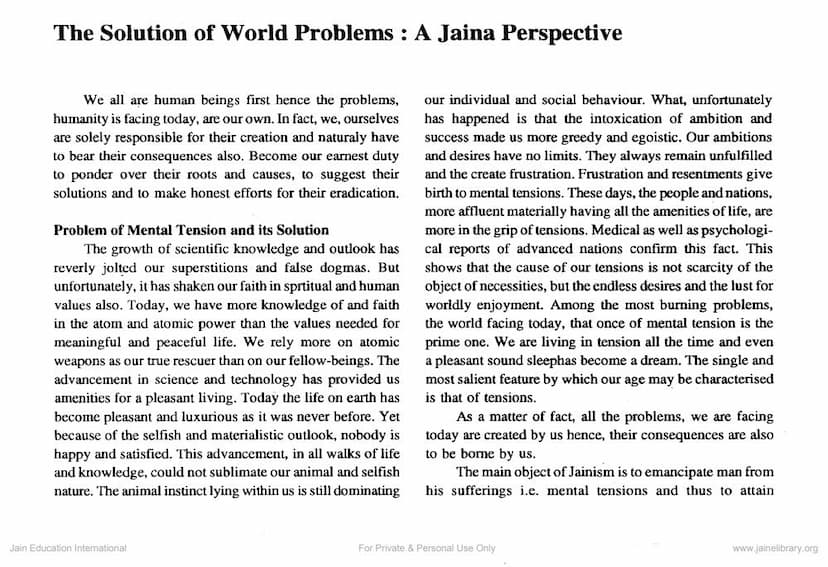
- Cause: Despite scientific advancements, humanity has lost faith in spiritual and human values, leading to a materialistic and selfish outlook. Unlimited desires and ambition create frustration and mental tension, not scarcity.
- Jain Solution: The core Jain solution is detachment (non-attachment) from worldly objects. Attachment is identified as the root of all physical and mental suffering. Lord Mahavira taught that eliminating delusion, desire, greed, and finally attachment leads to the cessation of misery and attainment of equanimity (tranquility).
2. Problem of Survival of Human Race and Disarmament:
- Cause: The advancement in war technology, particularly nuclear weapons, poses an existential threat. The loss of faith and rise of doubt lead to insecurity and an arms race.
- Jain Solution: The emphasis is on developing mutual faith and trust to eliminate fear and insecurity. The virtue of fearlessness is paramount, meaning not to fear others and not to cause fear to others. Lord Mahavira's proclamation that "nothing is superior to disarmament or non-violence" (asastra) is highlighted. Selfish and aggressive outlooks are the root of war; firm faith in mutual credibility and non-violence can end the arms race.
3. Problem of War and Violence:
- Cause: Discontentment, the will for power and possession, and attachment are the underlying causes of violence. Economic inequalities, insecurities, and frustrations also contribute.
- Jain Solution: Jainism strongly condemns war and violence. The primary fight should be against one's own passions. While perfect non-violence is an ideal for spiritually liberated beings, worldly individuals are advised to minimize violence. In defensive or just wars, Jainas advocate for fighting without weapons and with referees, citing the example of Bharat and Bahubali. The concept of non-violent resistance, as demonstrated by Gandhi, is also acknowledged, though its effectiveness is seen as dependent on the opponent's receptiveness to human values. Jainism permits defensive violence for householders to protect rights but never justifies violence as a virtue.
4. Problem of Disintegration of Human Society:
- Cause: Artificial divisions created by caste, creed, color, and nationality lead to hatred, hostility, and conflict, undermining the natural unity of the human race. Claims of superiority based on these divisions exacerbate class conflicts.
- Jain Solution: Jainism, from its inception, promotes the oneness of the human race. Lord Mahavira declared that all humans are equal in potentiality, and superiority is determined by self-purification and good conduct, not by class. Jainism advocates for mutual faith and cooperation, emphasizing that cooperation, not conflict, is the law of living. Unity is understood as an "organic whole" where diversity thrives for a common goal (human welfare), embodying "unity in diversity." Each race, religion, and culture has the right to exist, but also a duty to work for the welfare of humanity and be willing to sacrifice individual interests.
5. Problem of Economic Inequality and Consumer Culture:
- Cause: The will for possession, hoarding, and lust for worldly enjoyment fuels economic inequality and a materialistic consumer culture. This creates a divide between the "Haves" and "Have-nots," fostering jealousy and hatred.
- Jain Solution: Wealth is considered a means, not an end. Jainism advocates for self-imposed limitations on possessions and consumption. Vows like aprigraha (non-possession) for ascetics and limited possession for laity are prescribed. The vow of charity (Atithi samvibhanga) is crucial, where wealth is used for the welfare of humanity and the needy. Householders are encouraged to limit possessions and consumption, using surplus for the service of mankind. This adherence to vows can restore peace, harmony, and eradicate economic inequality.
6. Problem of Conflicts in Ideologies and Faiths:
- Cause: Dogmatic and one-sided approaches to reality lead to conflicts when different ideologies clash.
- Jain Solution: The theory of Anekāntavāda (non-absolutism or many-sidedness) is presented as the solution. It states that reality is complex and can be viewed from multiple perspectives, each offering a partial but true picture. Anekāntavāda encourages regard for others' ideologies and faiths, fostering open-mindedness and intellectual/social tolerance. It forbids dogmatism and promotes accepting what is rational and logical, regardless of its origin. Examples from Jain scholars like Haribhadra and Hemacandra are cited to illustrate the spirit of religious tolerance within Jainism.
7. Problem of the Preservation of Ecological Equilibrium:
- Cause: The text acknowledges that while not as prominent in the past, ecological imbalance and pollution are now critical issues for human survival.
- Jain Solution: Jainism's principle of non-violence (Ahimsa) is extended to all living beings, including earth, water, air, fire, and vegetation. Polluting, disturbing, hurting, or destroying these elements is considered violence. Jainism emphasizes seeking forgiveness for any harm caused to these elements. Restrictions on the use of water, air, and vegetables, prohibitions against hunting and meat-eating, and the prohibition of industries that cause pollution (termed maharambha or greatest sin) are highlighted. The use of pesticides is also discouraged as it harms insects and pollutes the environment. Jainas are conscious of air pollution, with monks often wearing cloth over their mouths. This deep respect for all life forms forms the basis of their approach to ecological preservation.
In conclusion, the text posits that Jainism offers a holistic framework for addressing the world's most pressing problems by advocating for inner transformation through non-attachment, non-violence, and a multifaceted understanding of reality, leading to personal peace and global harmony.