
Snatra Panch Kalyanak Puja Meaning
Added to library: September 2, 2025
Summary
Here's a comprehensive summary of the provided Jain text, "Snatra Panch Kalyanak Puja Meaning" by Dhirajlal D Mehta, focusing on the explanation of the Snatra Puja and the Panch Kalyanakas of Lord Parshvanatha:
The text explains the significance of the Snatra Puja and details the five auspicious events (Panch Kalyanakas) in the life of a Tirthankara (spiritual conqueror), using Lord Parshvanatha as a prime example.
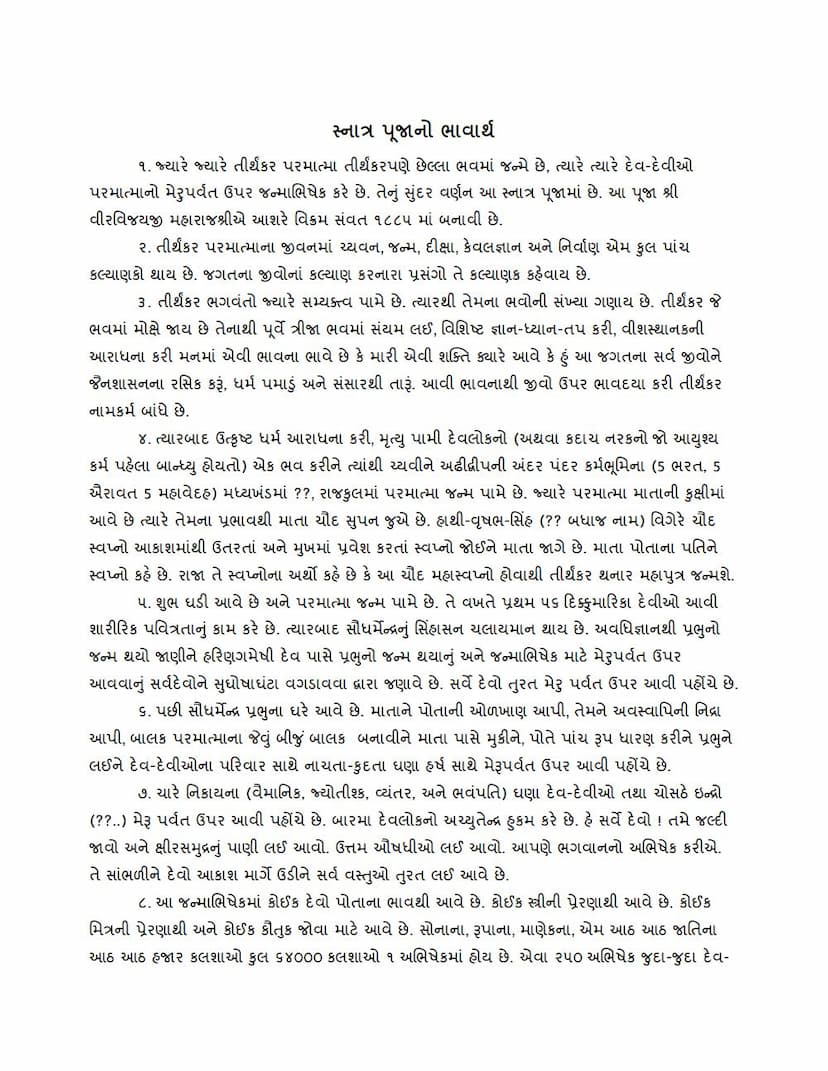
Understanding the Snatra Puja (Page 1):
- Purpose: The Snatra Puja describes the celestial ceremony performed by gods and goddesses when a Tirthankara is born in their last human life. This ceremony involves an anointment (abhisheka) on Mount Meru.
- Origin: The text states that this specific Snatra Puja was composed by Shri Veeravijayji Maharajashri around Vikram Samvat 1885.
- The Five Kalyanakas: The core of a Tirthankara's life are the five Kalyanakas – events that bring welfare to all living beings:
- Chyavan: The descent of the soul from a celestial realm to the womb.
- Janma: The birth of the Tirthankara.
- Diksha: The renunciation of worldly life for spiritual pursuit.
- Kevalgyan: The attainment of omniscient knowledge.
- Nirvana: Liberation from the cycle of birth and death.
- Bonding Tirthankara Name Karma: A soul earns the Tirthankara name karma in their third-to-last life before becoming a Tirthankara. This is achieved through rigorous spiritual practices, including the Veethsthanak penance, and developing a profound compassion and desire to guide all beings towards Jainism and liberation.
- Rebirth and Conception: After fulfilling their celestial life and completing their spiritual preparation, the soul descends to a human birth in a royal family within the middle continent of the Adhidveepa.
- The Fourteen Dreams: Upon conception, the mother experiences fourteen divine dreams, such as seeing an elephant, a bull, and a lion descending from the sky and entering her mouth. These dreams are interpreted by the king as foretelling the birth of an extraordinary son who will become a Tirthankara.
- The Birth Ceremony (Janmabhisheka):
- Upon the Tirthankara's birth, 56 Dikumarika goddesses first perform purification rites.
- Indra, the chief of the Sowdharma heaven, feels his throne shake, signifying the birth.
- Knowing the divine birth through his clairvoyance, Indra sends a divine messenger to invite all gods to Mount Meru for the anointment.
- Indra himself visits the mother, places a divine replica of the infant with her, and then, taking the actual infant Tirthankara with his divine entourage, proceeds to Mount Meru.
- Gods from all four categories of celestial beings (Vaimanika, Jyotishka, Vyantara, and Bhuvanapati) gather at Mount Meru.
- The gods are instructed to fetch water from the ocean of milk and gather precious herbs for the anointment.
- This anointment is a grand spectacle involving a vast number of golden, silver, and jewel-encrusted pots (64,000 pots of eight different types), with 250 such anointments performed by various gods and goddesses, totaling 16,000,000 pots of water.
- After the anointment, the Tirthankara is returned home, and the gods perform celebrations and rituals.
- The gods depart with the fervent wish that the Tirthankara grows up quickly, takes renunciation, and that they too can soon celebrate the Diksha and Kevalgyan Kalyanakas.
The Panch Kalyanakas of Lord Parshvanatha (Pages 1-3):
The text then elaborates on the five Kalyanakas specifically for Lord Parshvanatha:
- Chyavan: The soul of Lord Parshvanatha, after practicing the Veethsthanak penance in his third-to-last life and bonding the Tirthankara name karma, ascended to the tenth heaven. After living for twenty Sagaropama years there, he descended to the womb of Queen Vama, wife of King Ashvasena of Varanasi. This descent occurred on the 4th day of the bright half of Chaitra (or Phalguna in Gujarati).
- Janma: Upon conception, Queen Vama had the fourteen auspicious dreams. On the 10th day of the dark half of Posh (or Magshar in Gujarati), under an auspicious star, Lord Parshvanatha was born. Immediately after birth, 56 Dikumarika goddesses performed purification. Subsequently, Indra, along with celestial beings, arrived, took the infant to Mount Meru, and performed the grand Janmabhisheka with divine guests.
- Diksha:
- During his birth, all beings, even those in the seven hells, experienced happiness.
- Lord Parshvanatha was nourished by nectar and grew up. He had the emblem of a snake and was seven hands tall.
- In his youth, he married Princess Prabhavati.
- While with his queen, he witnessed people going to see a great ascetic named Kamatha. Curious, he went to observe.
- Kamatha was performing severe penance by five fires. Lord Parshvanatha, with his clairvoyance, saw a snake being burned alive in the fire. He confronted Kamatha, pointing out the futility of his penance and the lack of compassion. When Kamatha dismissed his understanding, Lord Parshvanatha revealed the suffering snake, spoke the Navkar mantra to it, and the snake, upon dying, was reborn as the divine serpent king Dharanendra. Kamatha, shamed and angered, died and was reborn as the god Meghamali.
- Later, seeing a painting of Nemi and Rajul in the forest, Lord Parshvanatha felt a sense of renunciation and decided to take up asceticism. The Lokantik gods descended to encourage him.
- At the age of thirty, Lord Parshvanatha began his Varshidan (charitable giving) and then embarked on his renunciation. He was carried in a palanquin, accompanied by a grand procession of gods, kings, and people. He reached the Ashrama-pada garden, where he performed Panchamusti Lochan (plucking out five handfuls of hair) and took his vows of asceticism.
- Kevalgyan:
- Lord Parshvanatha first broke his fast at the house of Dhan Sarthavaha.
- Later, in the Kadambari forest, a wild elephant worshipped him, leading to the establishment of the holy place Kalikund.
- Dharanendra and Padmavati arrived and established the city of Ahichhatra.
- Kamatha, reborn as Meghamali, recognized Lord Parshvanatha and caused hardships (upsarga) for him, including a torrential downpour that rose to his nostrils. Dharanendra protected him, and Meghamali fled.
- Exactly 84 days after his initiation, Lord Parshvanatha arrived at a garden in Varanasi and attained Kevalgyan on the 4th day of the bright half of Chaitra (or Phalguna in Gujarati).
- Upon hearing the news, King Ashvasena, Queen Vama, and his daughter-in-law Prabhavati came to listen to his teachings and took initiation from him.
- Nirvana: Lord Parshvanatha, who had a lifespan of 100 years, finally ascended Mount Shikharji and attained Nirvana on the 8th day of the bright half of Shravana.
In essence, the text provides a devotional explanation of the Snatra Puja, highlighting the divine birth ceremony of a Tirthankara, and then traces the life of Lord Parshvanatha through his five glorious Kalyanakas, emphasizing his compassion, spiritual prowess, and eventual liberation.