
Significance Of Regulation Of Temperature In Mammals
Added to library: September 2, 2025
Summary
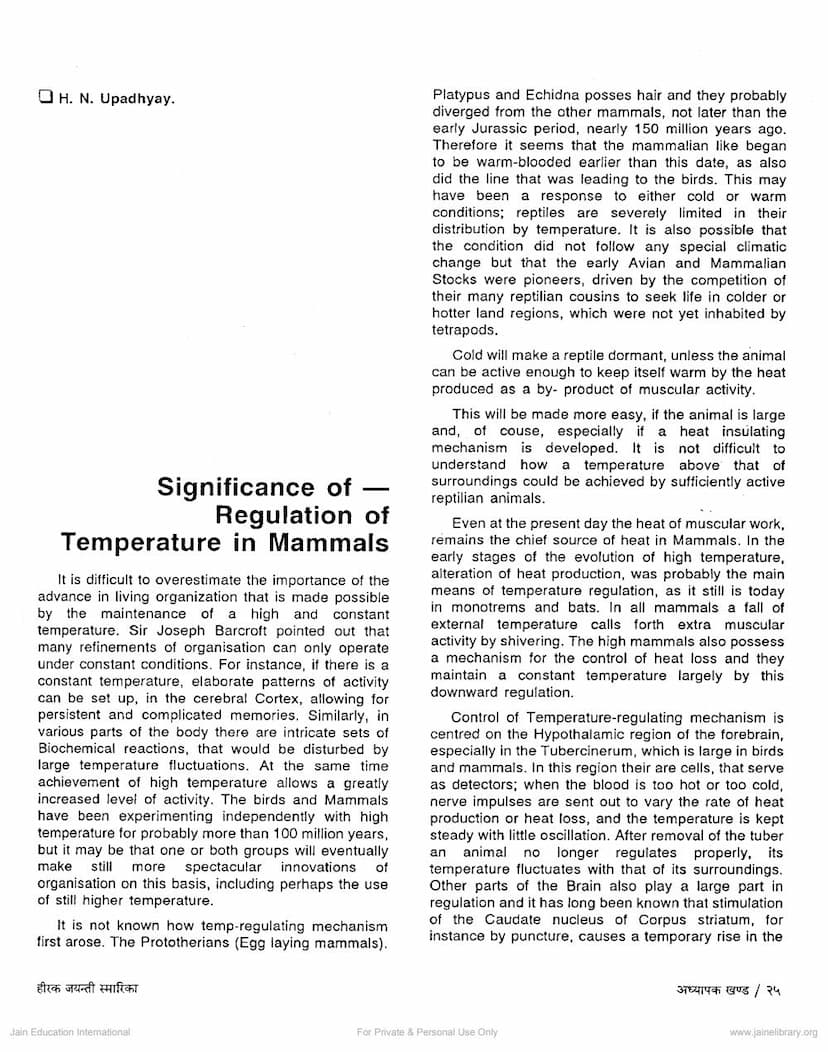
Here's a comprehensive summary of the provided Jain text, "Significance of Regulation of Temperature in Mammals" by H. N. Upadhyay:
The text explores the evolutionary significance of thermoregulation, the ability to maintain a stable internal body temperature, in mammals. It posits that the development of warm-bloodedness likely occurred before the Early Jurassic period, around 150 million years ago, evidenced by the presence of hair in early mammals like the platypus and echidna. This adaptation was probably a response to challenging climatic conditions, allowing mammals to inhabit regions too extreme for reptiles.
The core of mammalian temperature regulation relies on two primary mechanisms: increasing heat production and reducing heat loss.
Heat Production:
- Muscular Activity: Even today, muscular work is the primary source of heat in mammals. Early thermoregulation likely focused on increasing metabolic heat production through activity.
- Shivering: In response to cold, mammals exhibit shivering, which is involuntary muscle activity that generates heat.
- Metabolic Processes: Heat is also generated by other organs like the liver. Hormones, particularly from the thyroid gland, play a crucial role in regulating basal metabolism and thus heat production. Other endocrine glands are also implicated.
Heat Loss and Conservation:
- Hair: Hair acts as an insulator by trapping a layer of air, reducing heat exchange with the environment. This insulation is enhanced by the arrangement and texture of hair, forming a "pelt." Seasonal changes in coat thickness further aid in temperature regulation.
- Fat Layers (Blubber): In aquatic mammals like whales and walruses, a thick layer of fat (blubber) serves as insulation, replacing hair. Humans primarily conserve heat through subcutaneous fat layers.
- Body Size: Very large mammals like elephants have a small surface area relative to their heat-producing volume, necessitating less heat conservation and resulting in reduced hair.
Control Mechanisms:
- Hypothalamus: The brain's hypothalamic region, specifically the tuber cinereum, is the central control center for thermoregulation. Specialized cells within this region detect blood temperature and send nerve impulses to adjust heat production or loss. Damage to this area disrupts temperature regulation.
- Nervous System: The sympathetic nervous system controls sweat gland activity, while blood flow to the skin is regulated through a network of capillaries and arteriovenous anastomoses, influencing heat loss via convection and radiation.
- Panting and Evaporation: Mammals with fewer sweat glands, like dogs, resort to panting to lose heat through evaporation from the respiratory tract.
- Surface Area Modification: Some animals, like the African elephant, can increase their surface area for heat dissipation by raising and flapping their large ears. This adaptation is also seen in hares with longer ears in warmer regions.
Significance of Constant Temperature:
The text emphasizes the profound importance of maintaining a high and constant body temperature. This stability allows for:
- Refined Organization: Complex biological processes and elaborate behavioral patterns, particularly in the cerebral cortex for memory and learning, can only operate effectively under stable thermal conditions.
- Efficient Biochemical Reactions: Intricate biochemical pathways are sensitive to temperature fluctuations and function optimally at a consistent temperature.
- Increased Activity Levels: High body temperature enables a greatly enhanced level of physiological activity, contributing to the evolutionary success of mammals and birds.
In conclusion, the text highlights thermoregulation as a pivotal evolutionary advancement that granted mammals greater environmental adaptability, metabolic efficiency, and behavioral complexity, paving the way for their diversification and dominance.