
Siddha Pujan
Added to library: September 2, 2025
Summary
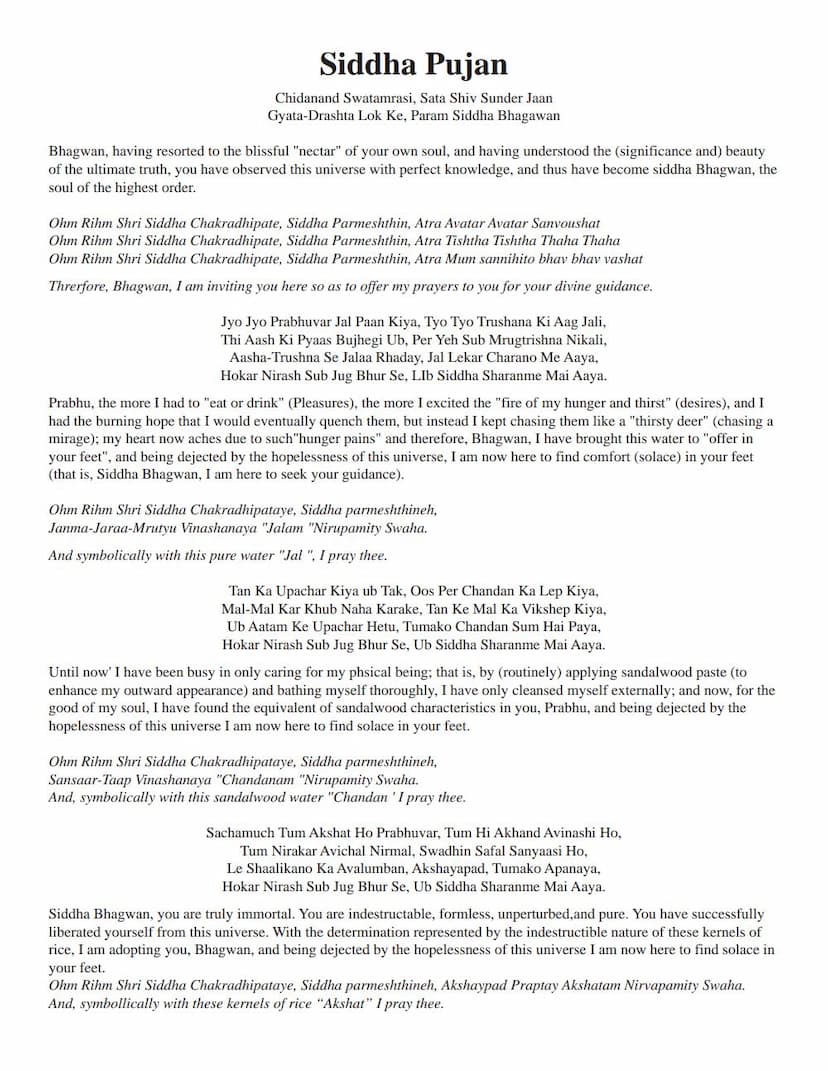
This Jain text, "Siddha Pujan," is a devotional hymn or prayer offered to the Siddha Bhagwan, who are liberated souls in Jainism. The text is structured as a series of invocations and reflections, expressing the devotee's journey from worldly suffering and delusion to seeking solace and guidance from the Siddhas.
Here's a comprehensive summary of its content:
Core Theme: The central theme is the devotee's realization of the futility of worldly pursuits and the desire to emulate the Siddhas, who have achieved ultimate liberation, perfect knowledge, and eternal bliss. The devotee seeks the Siddhas' guidance to transcend their own suffering and attain a similar state of spiritual purity.
Structure of the Prayer: The prayer is presented in a traditional devotional format, offering symbolic representations of various items used in worship to the Siddhas. Each offering is accompanied by a verse explaining its significance in the context of the devotee's spiritual aspirations.
Key Concepts and Symbolism:
-
The Siddha Bhagwan:
- Described as having "resorted to the blissful 'nectar' of your own soul," understood the "ultimate truth," and observed the universe with "perfect knowledge."
- They are the "soul of the highest order," "immortal," "indestructible," "formless," "unperturbed," "pure," and "liberated from this universe."
- They have "conquered the 'desires,' the foremost enemy of the world."
- They are the source of "ever-lasting blissfulness" and have achieved "moksha" (liberation).
- They are the "embodiment of knowledge," "true consciousness," and an "indestructible source of blissfulness."
- They are not described as giving material boons but rather the opportunity for devotees to "be like you."
-
The Devotee's State:
- The devotee expresses a deep sense of disillusionment with the "hopelessness of this universe."
- They have been chasing worldly "pleasures" and "desires" like a "thirsty deer," finding only temporary satisfaction and increasing their suffering ("hunger and thirst").
- They acknowledge past focus on "physical being" and external appearances, realizing the need for "care of my soul."
- They have mistaken worldly pleasures for true happiness and have been misled by the "glitter of external light" and "karmic matter."
- They confess to have not truly recognized the correct spiritual path, prioritizing the "body as supreme" over the "soul."
- Their "charitable deeds have been tainted by pride" and their worship has been for "rewards in return."
- They understand that "all passions lead to misery."
- They realize that "comfort is to be found within our own 'self.'"
-
Symbolic Offerings and Their Meanings:
- Jal (Water): Represents the quenching of the worldly "hunger and thirst" (desires) that the devotee has realized is ultimately a mirage. They offer this to the Siddha, seeking relief.
- Chandan (Sandalwood): Symbolizes the cleansing and purity of the soul, which the devotee finds in the Siddhas, in contrast to their previous focus on mere "outward appearance."
- Akshat (Kernels of Rice): Represents the "indestructible nature" of the Siddhas and signifies the devotee's adoption of their determination to achieve liberation.
- Pushpam (Flowers): Symbolizes the victory over "desires" (Kama), the enemy of the world. The devotee offers these to signify their commitment to renouncing desires.
- Naivedam (Food): Represents the devotee's realization that true sustenance and bliss do not come from physical food but from the spiritual essence of the Siddhas, who are "indestructible and blissful even without food."
- Deepam (Lamp/Light): Symbolizes the devotee's understanding that true knowledge and illumination come from within the soul, not from external senses or objects.
- Dhupam (Incense): Represents the burning away of "karmic matter" and impurities, signifying the devotee's resolve to purify their soul.
- Phalam (Fruit): Represents the renunciation of the "fruits" of good karma and worldly pleasures, which the devotee now understands do not bring true happiness.
- Arghyam (Mixture): A grand offering symbolizing the complete renunciation of all worldly attachments and the entire pursuit of sensory pleasures, from "water to fruit," in favor of seeking the Siddhas' guidance.
- Jaymala (Garland of Victory): A litany praising the Siddhas and invoking their message for the illumination of the world, leading to the quenching of everyone's thirst.
- Mahaargha: A final, significant offering signifying the devotee's wish to seek "myself" and remain steadfast in their natural self, free from impurities.
The Devotee's Plea and Resolution: The recurring phrase, "Hokar Nirash Sub Jug Bhur Se, Ub Siddha Sharanme Mai Aaya" (Being dejected by the hopelessness of this universe, I am now here to find solace in your feet), emphasizes the devotee's profound despair with the material world and their unwavering commitment to seeking refuge and guidance from the Siddhas. The prayer culminates in a strong resolution to understand the true nature of the self and to follow the path of the Siddhas towards liberation.
In essence, "Siddha Pujan" is a powerful expression of spiritual yearning, a confession of past ignorance, and a fervent plea for divine guidance from the Siddha Bhagwan to achieve ultimate spiritual freedom.