
Self And Meditation In Indian Buddhism
Added to library: September 2, 2025
Summary
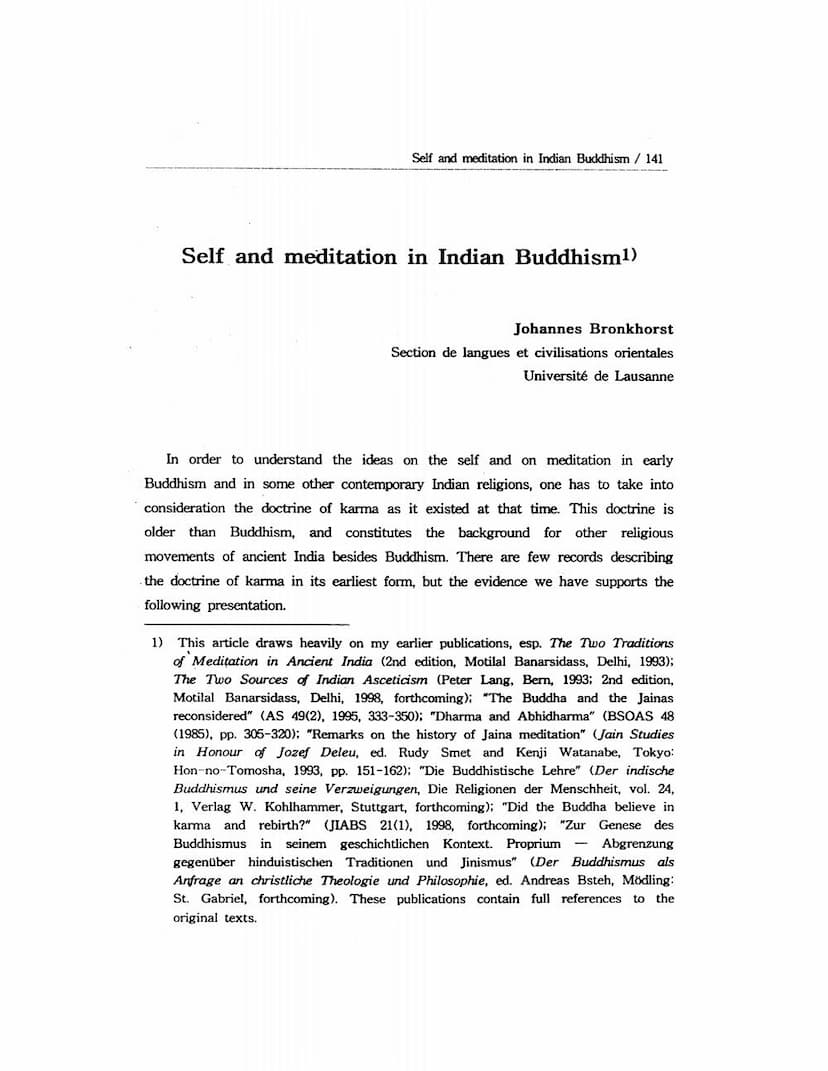
Here's a comprehensive summary of Johannes Bronkhorst's "Self and Meditation in Indian Buddhism," based on the provided text:
The article explores the concepts of "self" and "meditation" in early Buddhism and other contemporary Indian religions, emphasizing the foundational role of the doctrine of karma.
The Doctrine of Karma and its Solutions:
- Karma's Core: Deeds (actions) are the primary cause of rebirth and determine the quality of future lives (good deeds, good rebirth; bad deeds, bad rebirth).
- The Goal: The highest aspiration in these traditions was not a good rebirth, but the cessation of all rebirth.
- Two Dominant Solutions:
- Inaction/Immobilization: If deeds cause rebirth, then abstaining from all activity would prevent it. This led to ascetic practices focused on complete bodily and mental stillness until death. Liberation was achieved by exhausting past karma and then hastening death through fasting and breath cessation. This approach is most clearly represented in early Jainism and also found in early Hindu texts.
- Insight into the True Self: This solution questioned what constitutes a "person" and proposed that the true self is distinct from all that acts (body, mind, etc.). The true self is inherently immobile and actionless. Realizing this meant distancing oneself from one's actions, understanding that "no deeds whatsoever belong to the person." This insight liberates the individual, allowing liberation to be attained during life. This idea is prevalent in classical Hinduism, appearing in the Upanishads and forming the basis of Brahmanical philosophical schools.
The Buddha's Distinctive Approach:
- Rejection of the Traditional Karma Doctrine: The Buddha did not accept the doctrine of karma as presented by other traditions. For him, it wasn't deeds themselves that determined fate, but what was behind deeds.
- Thirst/Desire as the Root Problem: Early Buddhist texts identify "thirst" or "desire" (trṣṇa) as the fundamental issue, not mere actions. Deeds were identified with intention (cetana). A deed done with strong desire but not carried out still left karmic traces, while a deed done without intention (e.g., by mistake) did not.
- Consequences for Solutions: This psychological focus meant the two traditional solutions were unacceptable to the Buddha:
- Immobilization: Would be ineffective without the removal of desire.
- Insight into the Self: Knowledge of the self played no role in his path to liberation.
- Psychological Transformation: The Buddha's solution had to be psychological. He taught meditation with the aim of bringing about a radical change in the practitioner's psychological makeup, which could be achieved during life.
Self and Meditation in Early Buddhism:
- Rejection of Self-Knowledge: The Buddha rejected the idea that knowledge of the "self" was essential for liberation. His path was different, and meditation was crucial, but not as a means to understand a static self.
- Meditation's Role: Meditation was a method for achieving the necessary psychological changes. The Buddha did not aim for the immobilization of the mind, unlike other traditions.
- The "Self" Debate: The Buddha's stance on the existence of a self is debated among scholars. However, it's certain that he didn't preach knowledge of the self as an essential part of the liberation path. His method was psychological.
- Jaina Meditation vs. Buddhist Meditation: The term dhyana (often translated as meditation) in early Jainism refers to mental immobilization, part of the overall immobilization of body and mind. This differs significantly from the Buddhist use of the term.
Later Developments and Influence of Non-Buddhist Ideas:
- Confusion and Misunderstanding: The Buddha's psychological understanding of karma caused confusion among some followers, who reverted to the older view that deeds themselves led to rebirth and were attracted to the two traditional solutions.
- Incorporation of Non-Buddhist Practices:
- Knowledge of Non-Self as Liberating Insight: Early Buddhist texts, like the famous "Sermon at the Deer Park," present the idea of identifying with "non-self" (anātman) as a liberating insight, a modification of the non-Buddhist concept of knowledge of the true, inactive self. This knowledge, rather than self-knowledge, was seen as the key to detachment and liberation.
- Tathāgatagarbha Doctrine: The Mahayana Buddhist concept of tathāgatagarbha (Buddha-nature) bears striking similarities to the non-Buddhist concept of an eternal, non-active self, leading to debate even within Buddhism about their distinction.
- Pudgala: The notion of pudgala (person/self) accepted by the Pudgalavadins is distinct from the "inactive self" previously discussed. The pudgala was not considered inactive, and knowledge of it was not a precondition for liberation.
- Physical Practices: Some Buddhist texts ridicule the suppression of senses, yet other texts attribute such practices (like not noticing a thunderstorm) to the Buddha, reflecting an admiration for non-Buddhist ascetic feats.
- Jaina Practices Ascribed to the Buddha: Buddhist texts criticize Jainas for practices like "annihilation of former actions by asceticism" and "non-performing of new actions," but some texts attribute these very practices to the Buddha himself, indicating their adoption by some Buddhists.
- Suppression of Mental Activity: Practices like restraining, coercing, and tormenting the mind, initially associated with the Buddha's futile attempts to reach liberation in the Jaina manner, became characteristic of some forms of Buddhist meditation, particularly the "Formless States" (arūpya) and the "Cessation of Ideations and Feelings" (samjñāvedayitanirodha). These were not part of the Buddha's original teaching according to later Abhidharma evidence.
Conclusion:
The development of Buddhism in India was not merely a preservation of the Buddha's teachings. Elements not taught or even explicitly rejected by him found their way into Buddhist practices and theories. This included a resurgence of the idea of an inactive self (first through "non-self," then tathāgatagarbha) and the adoption of meditation practices aimed at mental immobilization, rather than the Buddha's original emphasis on psychological transformation through meditation. Understanding Buddhism historically requires acknowledging these influences and developments.