
Sectional Studies In Jainology II
Added to library: September 2, 2025
Summary
Here's a comprehensive summary of Klaus Bruhn's "Sectional Studies in Jainology II," based on the provided text:
Core Concept: Sectional Studies Methodology
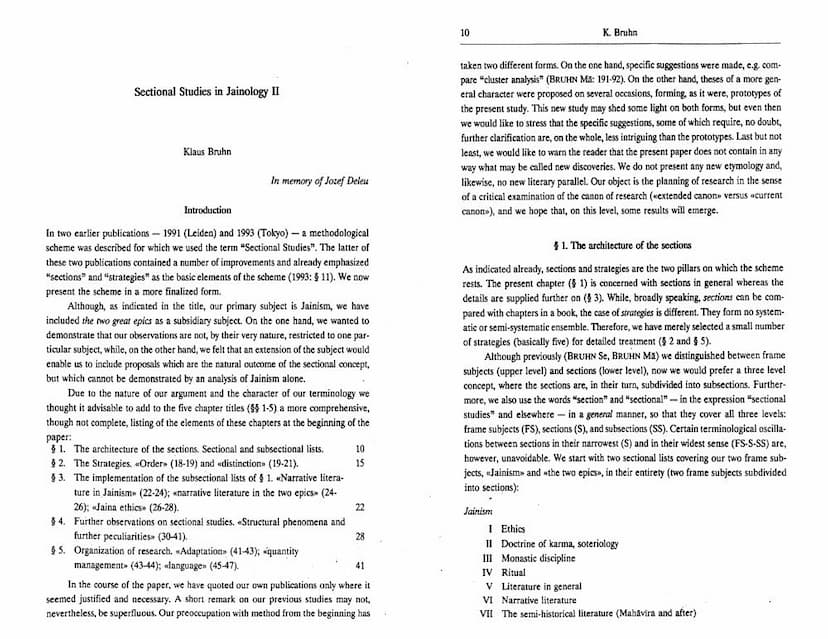
Klaus Bruhn introduces and refines a methodological approach called "Sectional Studies." This system aims to provide a structured and comprehensive framework for academic research, particularly in Jainology and related fields like the two great Indian epics. The methodology is built upon two fundamental pillars: sections and strategies.
1. Sections:
- Hierarchical Structure: Bruhn proposes a three-level concept for organizing research subjects:
- Frame Subjects (FS): Broad, overarching categories (e.g., "Jainism," "The two epics"). These are considered "microcosms" or worlds in themselves, possessing a distinct character (Eigencharakter).
- Sections (S): Subdivisions within Frame Subjects.
- Subsections (SS): Further subdivisions within Sections, considered the most specialized and effective units for research.
- Purpose of Sections: Sections (and subsections) serve to define and organize research material. They demand completeness in terms of both "material" research (textual analysis) and "formal" (methodological) research.
- Completeness and Openness: While aiming for completeness within defined areas, the lists of sections and subsections are acknowledged as inherently incomplete and open to revision and continuous remodelling by different scholars.
- Eigencharakter (Distinctive Character): Frame Subjects are emphasized for their unique, content-oriented character, similar to individual cultural styles or coherent conceptual systems. This distinctiveness is crucial for understanding a subject in its entirety.
- Examples of Sectional Lists:
- Jainism: Ethics, Doctrine of karma, Monastic discipline, Ritual, Literature (general and narrative), Semi-historical literature, History of the church, Natural philosophy, Cosmography, Gods and goddesses, Dialectic techniques, Religious instruction.
- The Two Epics: Literature (general and narrative), Mythology, Philosophy, Dharma, Culture and society, Cosmography.
- Overlap: Bruhn acknowledges that an increase in sections and subsections can lead to unavoidable overlapping, but views this as a necessary price for the intrinsic advantages of the scheme.
2. Strategies:
- Purpose of Strategies: Strategies are the operational tools that guide the research process and give substance to the defined sections. They are not a systematic ensemble but are selected for detailed treatment.
- Core Idea: The overarching goal is to create an "extended canon" that supplements and builds upon the existing "current canon" without replacing it. This involves importing and adapting methods from other fields.
- Key Strategies Discussed:
- Order: Involves classification and establishing a systematic arrangement of facts. This can include chronological subdivisions (e.g., in dogmatics) or typologies of styles.
- Distinction: Essential for separating different elements within a larger whole, making them clearer as distinct subjects. This can be dichotomous (e.g., verse vs. prose, canonical vs. post-canonical) or involve more complex categorizations.
- Adaptation: The process of updating a discipline by incorporating well-established methods and tools from related fields to fill research deficits. This also extends to "institutionalization" of research (journals, symposia, bibliographies).
- Quantity Management: Dealing with large bodies of literature, particularly exegetical or pseudo-exegetical works in Jainism. This involves developing models, technical analyses, and systematic cataloging.
- Language: Refers to the specific form of information and communication in research, including the treatment of unsolved problems, the presentation of well-known but complex facts, and the development of an appropriate "idiom" to spotlight research issues. It also encompasses the language of translations and the critical examination of opposing research trends.
- Methodological Principle ("A minore ad maius"): Bruhn advocates for the principle of moving from the smaller to the larger (e.g., from a single verse to a cluster of works or a literary genre) to achieve better integration and a more complete understanding of a topic.
3. Structural Phenomena and Further Peculiarities (SP):
- Definition: This is a broad category encompassing various aspects of Jain (and Indian) thought and literature that don't fit neatly into traditional disciplinary boundaries. It includes formal characteristics, methodological approaches, and recurring patterns.
- Key SP Examples:
- Parallel Versions: The study of multiple versions of the same story, requiring careful comparison and segmentation.
- Conflicting Accounts: Analyzing inconsistencies within texts.
- Motifs: Identifying and categorizing recurring narrative elements.
- Normalization: The adaptation of external materials (e.g., Brahmanical themes) to align with Jaina ideology.
- Sthāna Pattern: A form of tabulation or classification, evident in biographies of Jinas and the doctrine of karma.
- Subdivision: Formal and informal methods of dividing texts.
- Synonymy and Ambivalence: The complex relationships between terms and the extension and reinterpretation of their meanings.
- Pseudo-explanations: Terms "explained" through ad hoc mobilization of quasi-related terms.
- Importance of SP: Bruhn argues for the systematic study of SP, particularly in Jainology, due to its prevalence. He notes that the formal nature of SP can deter research, but emphasizes that understanding these phenomena is crucial for a comprehensive grasp of the subject.
4. Organization of Research:
- This chapter focuses on practical aspects of conducting research, reinforcing the strategies.
- Adaptation: Emphasizes updating disciplines by integrating external knowledge and developing institutional structures for research.
- Quantity Management: Highlights the need for systematic cataloging, analysis of large texts, and specialized bibliographies to manage vast amounts of material, especially in Jain exegetical literature.
- Language: Discusses the development of clear and effective "languages" for research, including how to present unsolved problems, explain complex ideas, and navigate differing scholarly perspectives. This also includes attention to the language of translations and the critical analysis of research currents.
Overall Goal:
Bruhn's "Sectional Studies" methodology aims to provide a robust and adaptable framework for academic inquiry. It encourages a systematic, comprehensive, and interdisciplinary approach to studying complex subjects like Jainism. By meticulously dividing subjects into manageable "sections" and employing specific "strategies," researchers can achieve a deeper understanding, avoid intellectual fragmentation, and ensure that no aspect of a subject is overlooked. The work emphasizes critical examination of research canons and the development of new methodological tools rather than the discovery of entirely new factual data.