
Saurseni And Other Prakrits In The Bhagavati Aradhana
Added to library: September 2, 2025
Summary
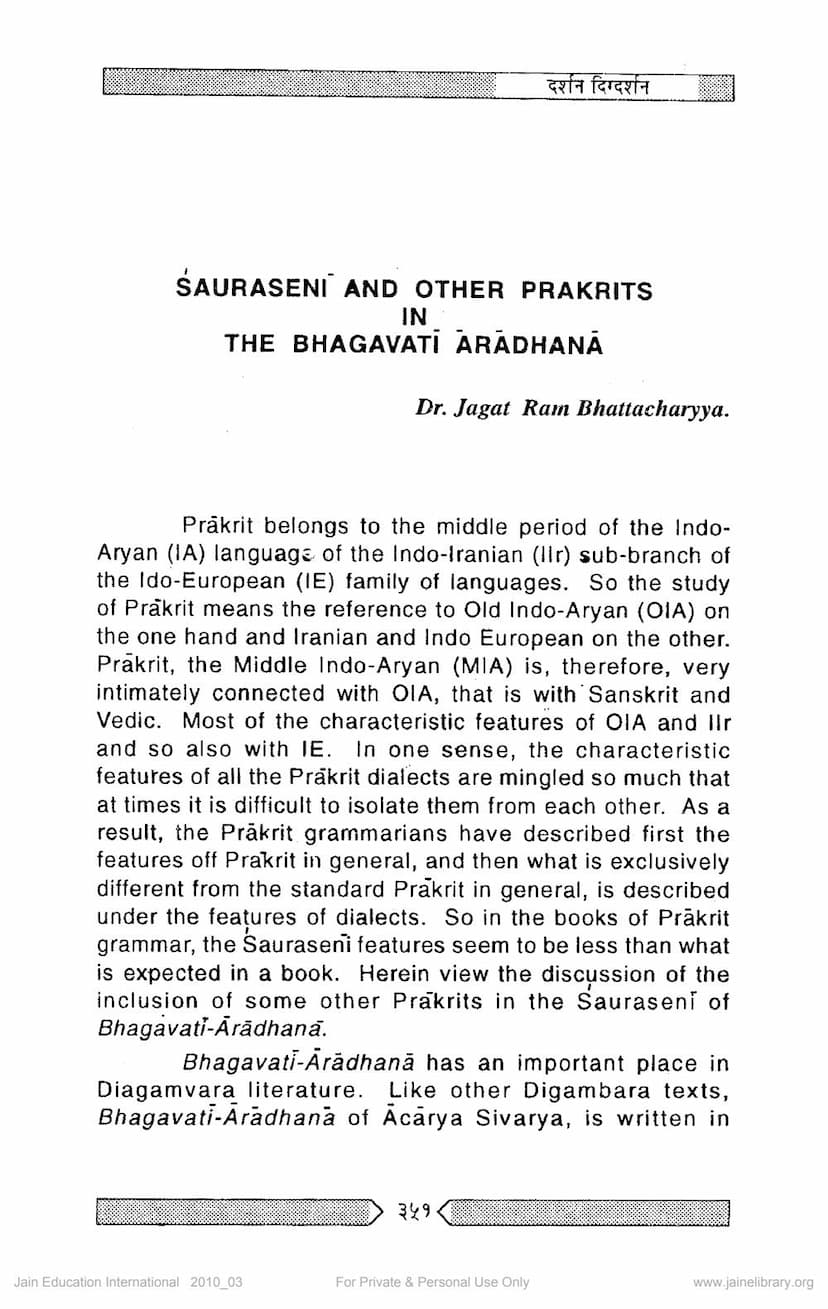
Here's a comprehensive summary of the provided text, "Sauraseni and other Prakrits in the Bhagavati Aradhana" by Jagat Ram Bhattacharya:
This paper by Jagat Ram Bhattacharya examines the linguistic landscape of the Bhagavati Aradhana, a significant Digambara Jain text attributed to Acarya Sivarya. The central argument is that while the Bhagavati Aradhana is primarily written in Sauraseni Prakrit, it exhibits a notable admixture of other Prakrit dialects, indicating an influence from them.
Key Points and Observations:
-
Prakrit as a Linguistic Context: The paper begins by establishing Prakrit's place within the Middle Indo-Aryan (MIA) period, highlighting its close relationship with Old Indo-Aryan (Sanskrit and Vedic) and, by extension, Indo-Iranian and Indo-European languages. It notes the often mingled characteristics of Prakrit dialects, making their isolation difficult, which leads grammarians to first describe general Prakrit features and then dialect-specific ones.
-
Elision of Intervocalic Consonants (k, g, c, j, t, d, etc.):
- This is a common feature in Prakrit in general (Maharashtri Prakrit included), as codified by grammarians like Hemacandra, Vararuci, and others.
- Sauraseni, according to grammarians, typically preserves intervocalic 't' by changing it to 'd', rather than eliding it, signaling its closer connection to Sanskrit and its antiquity.
- However, the Bhagavati Aradhana shows a blend: instances where 't' becomes 'd' (Sauraseni characteristic) and instances where it is elided (Maharashtri characteristic).
- The paper also notes the presence of 'y-śruti' (insertion of 'y') in words like "bhaniya," which Hemacandra attributes exclusively to Arsa or Ardhamagadhi (Amg), suggesting Amg influence in this Sauraseni text.
- Instances where 'd' should be preserved in Sauraseni are also found to be elided in the Bhagavati Aradhana, further demonstrating the presence of Maharashtri features.
-
Treatment of 'k' becoming 'g':
- While the elision of intervocalic 'k' is common, its transformation into 'g' is not a standard Sauraseni feature according to grammarians.
- Hemacandra mentions this change ('k' to 'g') as frequent in Ardhamagadhi.
- The Bhagavati Aradhana does present examples of 'k' becoming 'g' (e.g., "jugāni" from "yukabhih"), which the author suggests might be remnants of Ardhamagadhi.
-
Treatment of Sanskrit 'th':
- Sauraseni grammarians stipulate that intervocalic 'th' becomes 'dh' (e.g., Hemacandra's "tho dhah").
- The Bhagavati Aradhana shows irregularities. While some words follow the Sauraseni rule (e.g., 'vasati' becoming 'vasadhisu'), others, like the indeclinables "yathā" and "tathā" (which should be "jahā" and "tahā" in Sauraseni), are treated according to Maharashtri norms, retaining the 'th' sound (e.g., "jana," "taha").
- The paper also discusses the treatment of intervocalic 'dh', noting that while grammarians don't explicitly state its elision in Sauraseni, the Bhagavati Aradhana shows instances influenced by Maharashtri where 'dh' is elided or modified.
-
Treatment of the word 'Ātmā':
- Sanskrit "Ātmā" has various Prakrit forms, including "appā" and "attā" in Maharashtri, with "attā" being considered the ideal Sauraseni form.
- The Bhagavati Aradhana shows diverse forms of "Ātmā," including "appā," "ādā," and "attasuddhim," suggesting a mixed linguistic usage. The presence of "appā" is noted as regular in Ardhamagadhi, further indicating its influence.
-
Influence of Magadhi in Sauraseni:
- The paper highlights distinct Magadhi features like 'r' becoming 'l', 'ś'/'ṣ' becoming 's'', and the 'e'-ending in the nominative singular of masculine a-stems.
- The Bhagavati Aradhana contains "Magadhi words" such as "cattālam," "lukkho," and "kalunam," demonstrating the penetration of Magadhi vocabulary.
- It also notes the presence of 'e'-ending words in the nominative singular, a Magadhi trait.
-
Treatment of the root 'bhu':
- Prakrit grammarians prescribe forms like "ho," "huva," and "hava" for the root "bhu."
- While Hemacandra considers these optional in Sauraseni, he states 'bh' is regular. Other grammarians agree.
- The Bhagavati Aradhana exhibits sporadic use of these forms, but also instances influenced by Maharashtri ("hoi," "havai," "hodi"). The imperative "hojja" and optative forms derived from Sanskrit "bhavet" are also noted.
-
Gerundial Forms:
- The application of gerunds in the Bhagavati Aradhana doesn't strictly adhere to Sauraseni rules. Examples like "kāuna" (from "kṛtvā") and "ṇāuṇa" (from "jñātvā") are common in Maharashtri.
- Sauraseni typically uses "-iya" and "-duna" for "kṛtvā." The text shows instances of both Sauraseni ("laddhuṇa") and Maharashtri ("una") forms.
- Peculiar forms like "soccā" and "bhoccā," which are regular in Amg, also appear, further supporting the paper's thesis of mixed Prakrit usage.
Conclusion:
The paper concludes that the Vijayodayā commentary of Aparajita Suri is a key factor in the Sauraseni characteristics of the Bhagavati Aradhana. It reiterates the inherent close linguistic relationship between Sauraseni and Sanskrit, as both originated in the Midland. However, it strongly emphasizes that the Bhagavati Aradhana has indeed borrowed words and linguistic features from other Prakrit dialects, particularly Maharashtri and Ardhamagadhi, making its linguistic profile a blend of Sauraseni with influences from other Prakrits.