
Satkaryavada And Asatkaryavada
Added to library: September 2, 2025
Summary
Here's a comprehensive summary of Johannes Bronkhorst's text "Satkāryavāda and Asatkāryavāda," focusing on the Jain context and the philosophical debate it engages with:
Core Problem: The Correspondence Principle and Origination
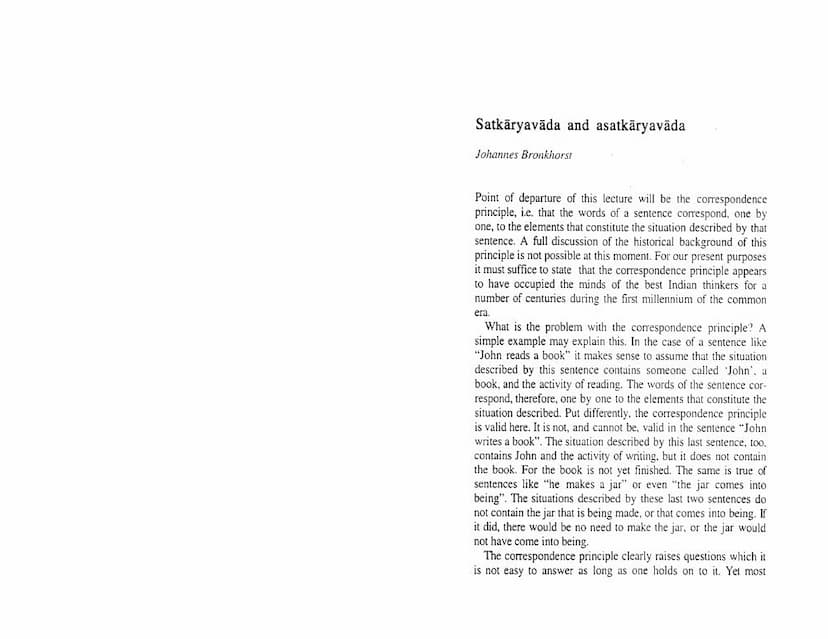
The lecture begins by introducing the correspondence principle, which states that words in a sentence directly correspond to elements in the situation being described. This principle, which occupied Indian thinkers for centuries, faces a significant challenge when describing the origination of things.
For example, in "John reads a book," John, the book, and the act of reading all exist. However, in "John writes a book" or "a jar comes into being," the book or the jar doesn't fully exist yet. If they did, there would be no need to write or make them. This creates a problem for the correspondence principle: what do the words "book" or "jar" refer to in these sentences if the object is not yet fully present?
Early Solutions to the Origination Problem
Faced with this dilemma, many thinkers sought solutions to explain how things come into being while adhering to the correspondence principle:
- Rejection of Origination: Some, like the Buddhist philosopher Nagarjuna and later the Vedantist Gaudapada, concluded that nothing truly comes into being. This position is known as ajativada (non-origination).
- Universal or Pre-existence in Causes: Most thinkers, however, still affirmed the possibility of origination. They proposed that the word "jar" could refer to something that does exist before the jar is made. Two main approaches emerged:
- Universals: The word "jar" refers to the universal "jar-ness," which is eternal and already present.
- Satkāryavāda ("the position according to which the effect exists in its causes"): This view, which gained significant appeal, posits that the effect (e.g., the jar) already exists in a latent form within its causes (e.g., the clay, the potter's skill) before it fully comes into being.
Asatkāryavāda and the Vaiśeṣika Response
In contrast to Satkāryavāda, some philosophers, notably the Vaiśeṣika school, adopted asatkāryavāda ("the position according to which the effect does not exist in its causes"). Bronkhorst explores how Vaiśeṣika grappled with the correspondence principle under this framework.
Since Vaiśeṣika denies the pre-existence of the effect in its causes, it couldn't rely on that solution. Instead, it initially proposed that words like "jar" might refer to the universal "jar-ness" or to other existing elements.
However, Bronkhorst highlights a more nuanced Vaiśeṣika position, particularly as described in later texts and commentaries:
- Secondary Thought and "Existence": The Vaiśeṣikas, according to their opponents like Mallavādin, explained the origination of things through a "secondary thought" (gaunya kalpanaya). When a jar comes into being, it is then connected with the universal "existence" (sattā). The word "jar" refers to the substance that, upon this connection, is considered "existing."
- The Meaning of "Asat" (Non-existent): The term asatkāryavāda itself was reinterpreted by Vaiśeṣika. They argued that "asat" (non-existent) doesn't mean a complete absence of identity, like a "hare's horn." Instead, it means "that which does not have connection with existence (sattā) as yet." Things possess an "essence" (astitva, svabhāva) that allows them to come into being, even before they are connected to the universal "existence."
- Analogy with Other Categories: Vaiśeṣikas themselves acknowledged that their own categories like universals (sāmānya), particulars (viśeṣa), and inherence (samavāya) exist without being directly connected to "existence." This led to comparisons with the Sāṁkhya system (which is Satkāryavāda), suggesting that Vaiśeṣikas, in their attempt to solve the origination problem, came close to the Sāṁkhya position.
- Intermediate Time: The concept of "intermediate time" emerged, defined as the period from when causes begin to act until the effect is produced. This suggests that the "half-existence" or potential of the effect is not beginningless but starts when the causal factors are engaged.
The Role of Language and the Vaiśeṣika Corpus
Bronkhorst also delves into the Vaiśeṣika understanding of language and its corpus:
- Language as a Key to Reality: Vaiśeṣikas believed that the Sanskrit language provided access to reality. They argued that names were given by seers who perceived everything directly. This led to a strong emphasis on the parallelism between words and things, where linguistic expressions were seen as justified by ontological situations, and vice versa. The core Vaiśeṣika categories (substance, quality, movement) also correspond to the main word types (nouns, adjectives, verbs).
- The Vaiśeṣika Textual Tradition: The lecture discusses the evolution of Vaiśeṣika texts. The Padārthadharmasangraha of Prasastapāda (c. 6th century CE) is presented as the oldest clearly understandable text. However, the Vaiśeṣika Sūtra is considered the oldest and earliest text, though its current versions are later revisions. A significant period separates the original Sūtra from the Padārthadharmasangraha, during which many developments occurred, including an increase in the number of enumerated qualities and the eventual inclusion of a creator god. The text Kaṭandī, a commentary on the Vaiśeṣika Sūtra by Rāvana, is identified as a crucial, authoritative text that influenced later schools and likely contained early discussions on origination.
Shifting Philosophical Landscapes and Textual Survival
Bronkhorst concludes by suggesting that changes in philosophical positions influenced the transmission of texts:
- Decline of the Older Vaiśeṣika Solution: As later Vaiśeṣikas adopted the solution of words referring to universals to explain origination, the earlier, more complex distinctions regarding "existence" became superfluous and were forgotten. The vagueness of the earlier position also contributed to its decline.
- Loss of Texts: The shift away from the Kaṭandī and Prasastapāda's commentary (which addressed the origination problem directly) might have led to their decreased transmission, while the Padārthadharmasangraha, which omitted this discussion, continued to be widely circulated. This illustrates how evolving philosophical viewpoints can impact the survival of textual traditions.
In essence, Bronkhorst's lecture traces the philosophical debate surrounding the origination of things, highlighting how the Vaiśeṣika school, through its asatkāryavāda and its unique understanding of language and existence, developed complex arguments to reconcile these concepts with the correspondence principle, ultimately undergoing significant evolution and textual shifts over time.