
Sanskrit Text Of Saddantavadana
Added to library: September 2, 2025
Summary
Here's a comprehensive summary of the provided Sanskrit text of the Ṣaḍdantāvadāna, based on the information presented in the document by J. W. De Jong:
Title: The Sanskrit Text of the Ṣaḍdantāvadāna
Author: J. W. De Jong
Publisher: J. W. De Jong
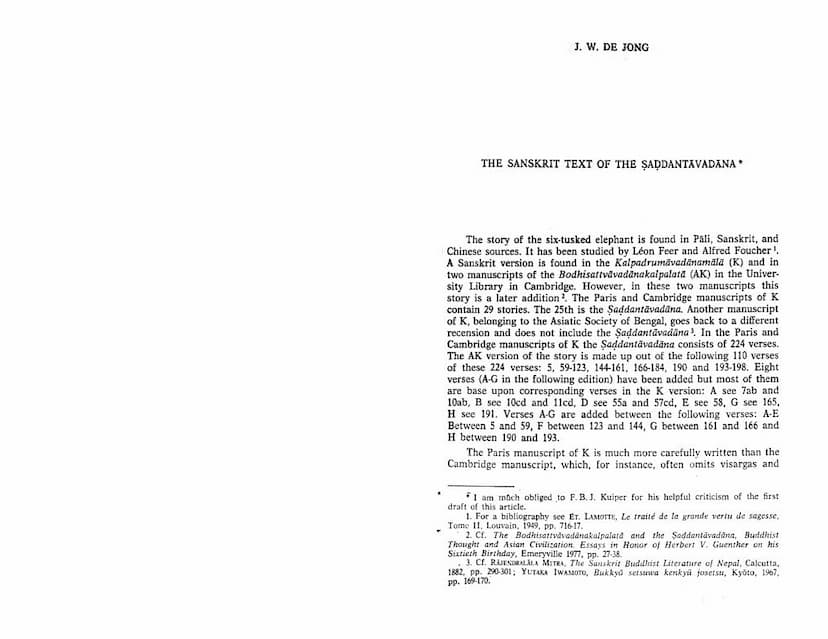
Source Material: The story of the six-tusked elephant (Ṣaḍdantāvadāna) is a well-known narrative found in Pali, Sanskrit, and Chinese traditions. This particular Sanskrit version is primarily based on the Kalpadrumāvadānamālā (K), specifically manuscript versions found in Cambridge and Paris. The Bodhisattvävadänakalpalată (AK) also contains a version of the story, which appears to be derived from a slightly different recension of the K text and incorporates some unique verses. De Jong meticulously notes the correspondences and additions between the K and AK versions.
Textual Issues and Apparatus: The article is a critical edition of the Sanskrit text. De Jong acknowledges that several verses present problems concerning their textual integrity, meaning, or meter. He lists these problematic verses in the introduction and indicates that the numbers of verses found in the AK version are printed in italics in his edition. The critical apparatus, noted at the end of the document, meticulously records variations in readings from different manuscripts (primarily K's Paris and Cambridge manuscripts, and AK's Cambridge manuscripts). De Jong points out that the Paris manuscript of K is generally more carefully written than the Cambridge manuscript.
Narrative Summary (as presented in the excerpt):
The excerpt focuses on the events leading up to and including the main narrative of the elephant. It begins with a conversation between King Aśoka and Upagupta, a spiritual teacher. King Aśoka requests another inspiring story.
-
Devadatta's Incitement: The story then shifts to Devadatta, described as a wicked and envious individual. Devadatta, disguised as a monk, visits the monastery and addresses a group of ascetics (Kṣapaṇakas). He attempts to sow discord by suggesting that the Buddha (referred to as "Śramaṇa," "Buddha," "Jineśvara," etc.) is a rival who will convert them and absorb their followers. He warns them that resisting the Buddha will lead to hell.
-
The Ascetics' Reaction: The ascetics react differently. Some virtuous ones are eager to hear the Buddha's teachings. Others are hesitant or doubtful. However, a more malicious group, driven by jealousy and arrogance, plots against the Buddha.
-
The Plan to Discredit the Buddha: One clever ascetic devises a plan to tarnish the Buddha's reputation. He instructs a beautiful woman to feign pregnancy and then falsely claim the Buddha is the father. This is intended to disgrace him.
-
The Woman's Accusation: The woman, under the influence of this plot, approaches the Buddha while he is teaching. She feigns embarrassment and makes accusatory statements, implying the Buddha has wronged her and is the father of her supposed pregnancy. Her actions are described vividly, highlighting her deceptive performance.
-
The Buddha's Response and the Woman's Demise: The Buddha recognizes the deceitful nature of the woman. He does not outwardly react with anger but reflects on the karmic consequences of her actions. Suddenly, the woman, unable to bear the weight of her deception and the consequences of her misdeeds (symbolized by the wooden vessel being broken by Indra's attack), bursts into flames and falls into a hellish abyss.
-
The Buddha's Explanation of Karma: The Buddha then explains that this incident is a result of past karma. He elaborates on the nature of karma, the persistence of desires and aversions from past lives, and how actions, even in different forms, can lead to suffering across lifetimes. He emphasizes the difficulty of escaping the cycle of suffering and the importance of right conduct.
-
Introduction of the Saddantāvadāna: The narrative then introduces the main protagonist, the six-tusked elephant (Ṣaḍdanta), described as dwelling near the Himalayas. His two devoted female companions, Subhadrā and Bhadrā, are mentioned.
-
Bhadrā's Jealousy and Past Karma: The story details an incident where Bhadrā becomes jealous of Subhadrā's favor with the elephant. This jealousy stems from a past-life connection. Driven by envy, Bhadrā performs severe austerities in a hermitage, vowing to be reborn as the destroyer of the elephant's tusks in a future life, thus seeking revenge and regaining her perceived lost status.
-
Rebirth and the Elephant's Tusks: Bhadrā is reborn as Bhadrā, the beloved wife of King Brahmadata. King Brahmadata has a dream where he sees the six-tusked elephant and desires his tusks to be made into a throne. He consults his minister, who advises against harming the powerful elephant.
-
The Elephant's Sacrifice: Despite the warnings, the king insists. Bhadrā, remembering her past vow, reiterates her desire for the tusks. The king then enlists a hunter. The hunter, under instruction, fatally wounds the elephant. The elephant, remembering his past life as a Bodhisattva and his commitment to generosity, willingly allows his tusks to be broken off by the hunter.
-
Consequences and Teachings: After the tusks are presented, the hunter's hands wither and fall off as a consequence of his cruel act. The elephant, having fulfilled his vow, then passes away. The narrative concludes with the Buddha reiterating the importance of truth, detachment, virtue, and the difficulty of obtaining a human birth, which offers the opportunity for spiritual progress. He emphasizes the benefits of good deeds and the consequences of evil.
Overall Significance: The Ṣaḍdantāvadāna, as presented in this edition, is a complex narrative that intertwines the stories of past lives, karma, jealousy, and the principles of Buddhist ethics. It highlights the virtues of compassion, generosity, and the long-term consequences of actions. The text serves as a moral lesson, encouraging virtuous conduct and detachment from worldly desires to achieve enlightenment. De Jong's scholarly work provides a critical foundation for understanding this important Buddhist avadāna.