
Sanskrit Pranabhrt Or What Supports What
Added to library: September 2, 2025
Loading image...
Summary
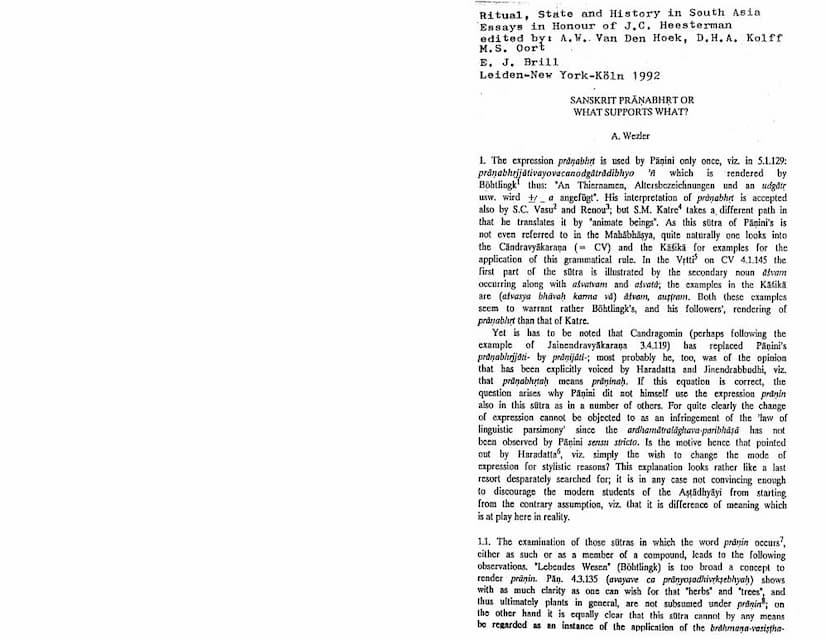
Here's a comprehensive summary of A. Wezler's article "Sanskrit Prāṇabhṛt Or What Supports What?", based on the provided text:
This article by A. Wezler delves into the meaning and usage of the Sanskrit term "prāṇabhṛt" within various stages of Sanskrit literature, primarily focusing on its grammatical context as defined by Pāṇini and its later interpretations in Vedic and classical texts.
1. Pāṇini and Grammatical Context:
- Pāṇini's Usage: Wezler begins by noting that Pāṇini uses "prāṇabhṛt" only once in his Aṣṭādhyāyī (5.1.129). The grammatical rule describes the addition of a suffix to terms related to animal names, age designations, and certain ritualistic terms.
- Scholarly Interpretations: He reviews different interpretations of "prāṇabhṛt" by scholars like Böhtlingk (who translates it as "animal-names"), S.C. Vasu, Renou (also leaning towards animal names), and S.M. Katre ("animate beings").
- Candragomin's Deviation: Candragomin, in his grammar, replaced Pāṇini's "prāṇabhṛj" with "prāṇij" and, along with commentators like Haradatta and Jinendrabuddhi, equated "prāṇabhṛt" with "prāṇin" (living being).
- The "Prāṇin" vs. "Prāṇabhṛt" Distinction: Wezler questions why Pāṇini, if he intended "living being," didn't use the more common term "prāṇin." He argues that the difference in expression likely signifies a difference in meaning.
- Analyzing "Prāṇin": Examination of sutras where "prāṇin" is used reveals that it doesn't encompass plants or herbs (Panini 4.3.135). However, it clearly includes human beings, as seen in compounds like "panipadam" and "śirogrivam." The examples associated with "aprāṇin" (non-living beings) in the Aṣṭādhyāyī and Kāśikā (e.g., "brāhmaṇakṣatriyau," "aṅga viśāla") also suggest "prāṇin" refers to "breathing living beings," from humans down to fish, but likely excluding plants and less recognizable lower animals.
2. Exploring "Prāṇabhṛt" Meaning in Vedic Texts:
- Dictionary Definitions: Wezler highlights the Larger Petrograd Dictionary's interpretation of "prāṇabhṛt" with multiple meanings: "life-sustaining," "carrying life within oneself" (living being, human), and relating to specific altar bricks. He expresses doubt about the "carrying life within oneself" meaning, as direct evidence in the form of "prāṇaṁ bharate" is scarce.
- Ritual Bricks (Prāṇabhṛt): A significant portion of the article focuses on the use of "prāṇabhṛt" to denote bricks used in constructing altars in Vedic rituals.
- TS 3.3.2.1: Gods are called "prāṇabhṛtaḥ" because they "support breath." The text implies they support human breath, suggesting a wish for continued life.
- AV(P) 4.12.3(ab): Bricks are identified with "anna" (food), and the act of laying them down is associated with "supporting breath."
- AV(P) 16.71.8(cd): "Odana" (cooked rice) is described as "prāṇabhṛt," meaning "breath-supporting." This suggests the term can refer to items that indirectly or directly sustain life.
- VādhS 3.53.1: Soma is addressed as "prāṇabhṛt," again indicating a life-sustaining role.
- SB 8.1.3.1: The passage distinguishes "prāṇāḥ" (breaths) as "prāṇāḥ" and "aṅgāni prāṇabhṛt" (limbs as prāṇabhṛt), stating that limbs support the breaths. It also equates "anna" (food) with "prāṇabhṛt" because food supports "prāṇāḥ." The text further clarifies that "prāṇabhṛt" refers to things that "support life" (prāṇaṁ bibharti).
- Association with Food and Cattle: Several Vedic passages connect "prāṇabhṛt" with food and, more significantly, with cattle.
- TS 5.7.10.2 & SB 8.3.3.4: Bricks are identified with "paśūrpśāṇi" (heads of domestic animals), and domestic animals are identified with "annam" (food). This creates a link: altar bricks -> animal heads -> food -> sustaining breath.
- TS 5.2.10.3: "Prāṇabhṛt" bricks are associated with placing "prāṇān" (breaths) into seed, leading to animals being born with speech, breath, sight, and hearing. This passage strongly links "prāṇabhṛt" to the origin of animal faculties.
- MS 3.2.8: This passage explicitly connects "prāṇabhṛt" with cattle, stating that "in the assembled cattle, breaths, speech, sight, and hearing are placed."
- Conclusion on Vedic Usage: Wezler concludes that in Vedic texts, particularly concerning ritual bricks, "prāṇabhṛt" consistently refers to something that supports or sustains "prāṇa" (breath/life force) for another entity or being. The term is understood as an "arthavṛtti" (meaningful designation).
3. Semantic Development and Classical Sanskrit:
- "Animal" to "Living Being": Wezler proposes that the meaning of "prāṇabhṛt" evolved from its original sense ("supporting breath") to encompass "certain animals" due to their importance in supporting human life (e.g., providing food, being used for sacrifice or labor). This led to a broader meaning of "animals in general" and eventually "living beings."
- AiA 2.3.1 & 2.3.2: These passages clearly distinguish between "osadhivanaspatayaḥ" (plants and trees) as food and "prāṇabhṛtaḥ" as feeders, stating that animals eat plants. This strongly supports "prāṇabhṛt" meaning "animal" and contrasting it with the plant kingdom. It also discusses the graded clarity of the "self" in plants, animals, and humans, with "prāṇabhṛt" referring to animals.
- JB 3.87: Here, "prāṇabhṛt" is used to refer to animals, specifically mentioning a lion.
- JB 3.359: The phrase "yad kiñca prāṇabhṛt śarīram" is found, likely meaning "whatever body is a living being."
- Raghuvamsa 2.42: In this passage, a lion addresses King Dilipa, and the king seems to include himself and the lion within the category of "prāṇabhṛt," indicating a meaning of "living being." This suggests an extension of meaning to include humans.
- "Living Being" in Classical Sanskrit: The article confirms that "prāṇabhṛt" did indeed acquire the meaning of "living being" in classical Sanskrit, and this is reflected in Middle Indo-Aryan languages like Pali.
- Philosophical Reinterpretation: In philosophical texts like the Brahmastras (1.3.4), "prāṇabhṛt" is used to denote the "individual soul" or "self." Wezler argues this is a philosophical reinterpretation possible because the original meaning of "supporting life" was clear.
4. Addressing Potential Misinterpretations and Concluding Remarks:
- Böhtlingk and Roth's Error: Wezler identifies the central error of Böhtlingk and Roth as assuming "prāṇabhṛt" inherently means "carrying breath within oneself," leading them to equate it with "living being" or "human" too readily. He argues that while "prāṇabhṛt" animals do breathe, this doesn't mean the term's primary meaning is "possessing breath internally."
- Anthropocentrism: The article emphasizes that the use of "prāṇabhṛt" to describe animals, especially domestic ones, highlights a naive anthropocentrism in Vedic India, where these animals were valued primarily for their service to humans.
- Distinction from "Paśu": Wezler considers Pāṇini's use of "grāmyapaśu" (domestic animal) in contrast to "paśu" (animal, domestic or wild). He suggests that if Pāṇini carefully distinguishes meanings, "prāṇabhṛt" likely refers specifically to "domestic animals" due to their critical role in supporting human life.
- Pāṇini's Precision: The author believes Pāṇini's use of "prāṇabhṛt" in 5.1.129 to denote only certain animals (like the horse and camel) reflects a precise semantic distinction, rather than a general term for all domestic animals.
- Summary of Findings: In conclusion, Wezler asserts that Vedic "prāṇabhṛt" (beyond its ritualistic brick meaning) most likely denotes certain animals valued for supporting human life. This meaning gradually broadened to "animals in general" and then "living beings," including humans, in classical Sanskrit. The original etymology of "supporting breath" remained understandable, allowing for reinterpretation and wordplay. The article highlights the cultural and economic importance of livestock in Vedic India and the underlying anthropocentric worldview.