
Sanskrit Fragments Of Jnendrabuddhis Visalamalavati
Added to library: September 2, 2025
Summary
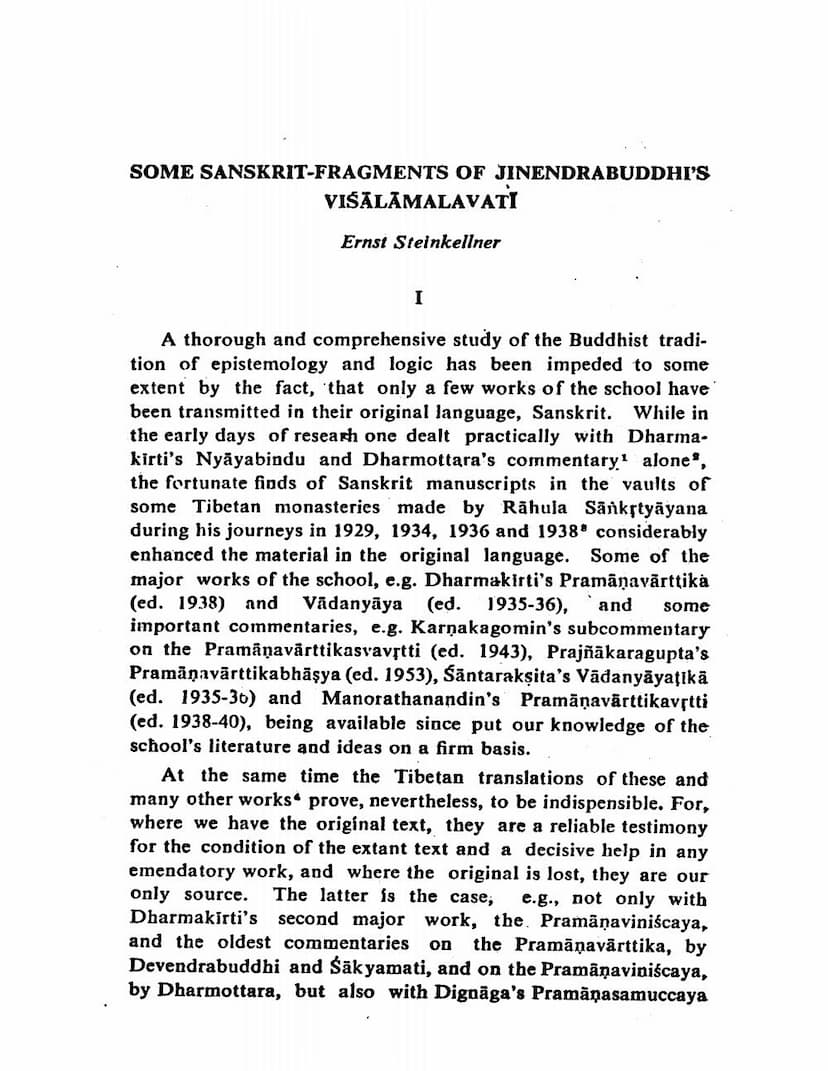
Here's a comprehensive summary of the provided text, "Some Sanskrit Fragments of Jinendrabuddhi's Viśālāmalavatī" by Ernst Steinkellner, focusing on its core arguments and findings:
Overall Goal:
The paper aims to highlight the significance of Sanskrit fragments for understanding Buddhist epistemology and logic, particularly for texts that are only preserved in Tibetan translations. It emphasizes that these fragments, when found and analyzed, are invaluable for corroborating, correcting, and enriching our understanding of the original Sanskrit works, offering a level of accuracy and nuance that Tibetan translations, while generally excellent, sometimes lack.
The Problem and the Solution:
- The Problem: Much of the early Buddhist tradition of epistemology and logic (like Dharmakirti's works) was initially only known through Tibetan translations. While Tibetan translations are generally accurate, they can sometimes simplify or lose the conceptual subtleties of the original Sanskrit, leading to ambiguity or a less vivid understanding of the original thought. Furthermore, some key foundational texts, like Dignāga's Pramāṇasamuccaya and its only known commentary, Jinendrabuddhi's Viśālāmalavatī, are entirely lost in Sanskrit, existing only in Tibetan.
- The Solution: The discovery of Sanskrit manuscripts in Tibetan monasteries has provided a crucial resource. These fragments, found scattered within other Buddhist, Nyāya, and Vaiśesika works, and especially within Jain epistemological texts, act as a vital link to the lost Sanskrit originals. They serve to:
- Confirm/Refute Tibetan Translations: They can verify the quality and reliability of the existing Tibetan translations.
- Improve Translations: They offer a direct comparison to refine and correct the Tibetan versions.
- Restore Original Meaning: Crucially, they provide the "dignity of original phrases and statements," which are unsurpassed in their precision and nuance compared to the sometimes simplified Tibetan renderings.
- Partial Reconstruction: Even fragmentary recovery of lost texts is highly valuable for understanding the development of Buddhist thought, as quotations indicate the significance of the author's contribution to specific issues.
- Distinction from "Re-translations": The author strongly cautions against "re-translations" into Sanskrit, which are often presented as reconstructions. He argues that these are essentially modern translations from Tibetan and lack the critical certainty of original fragments. Authentic reconstruction, on the other hand, is possible only when supported by extant Sanskrit fragments and commentaries that can be cross-referenced with Tibetan translations.
The Specific Case Study: Jinendrabuddhi's Viśālāmalavatī
- The Text: The paper presents a collection of Sanskrit fragments from Jinendrabuddhi's Viśālāmalavatī, the sole surviving commentary on Dignāga's foundational work, the Pramāṇasamuccaya and its Vṛtti.
- Source of Fragments: These fragments are identified from Appendix I (pp. 515-531) of Rahulaji's edition of Manorathanandin's Pramāṇavārttikavṛttitika. This appendix contains various textual pieces with a commentarial character. The copyist, Vibhūticandra, also added his own notes and comments.
- Content of the Fragments: The fragments presented primarily deal with:
- The Sequence of Chapters in the Pramāṇavārttika and the beginning of the "pramāṇa-chapter."
- Commentary on Dignāga's Mangala Verse: A significant portion of the fragments are devoted to Jinendrabuddhi's commentary on the important opening mangala (auspicious) verse of Dignāga's Pramāṇasamuccaya. This verse is key to understanding the spiritual and cultural significance of Buddhist epistemology and logic.
- Linguistic and Grammatical Discussions: Several fragments engage in detailed discussions about grammatical points, such as the use of the accusative and dative cases in relation to verbs like praṇamya (having saluted) and śeṣā. These discussions often involve referencing other important grammatical works like the Mahābhāṣya.
- Explanation of Terms: The fragments also explain key Buddhist terms such as śāstra (teacher/instruction) and sugata (well-gone, thus a Buddha).
- Methodology: The author meticulously presents the fragments, providing cross-references to their source in the PVV and the likely corresponding sections in the Viśālāmalavatī (PST). Where the Sanskrit fragments are incomplete, he supplements them with English translations of the Tibetan version. Parentheses and notes are used to clarify additions, omissions, and potential corruptions.
- Significance of the Findings: The recovered Sanskrit fragments from Jinendrabuddhi's commentary are presented as a small but potent example of the "surprising possibilities" in gathering these textual remains. They offer direct insights into how Jinendrabuddhi interpreted Dignāga's seminal verse, contributing significantly to our understanding of the philosophical and religious context of this tradition.
In essence, Steinkellner's paper argues for the critical importance of recovering and analyzing Sanskrit fragments for Buddhist studies, using the Viśālāmalavatī fragments as a concrete demonstration of their power to illuminate lost texts and refine our understanding of ancient Indian thought.